
Pupuk Indonesia Expands, ID Food Stripped Down
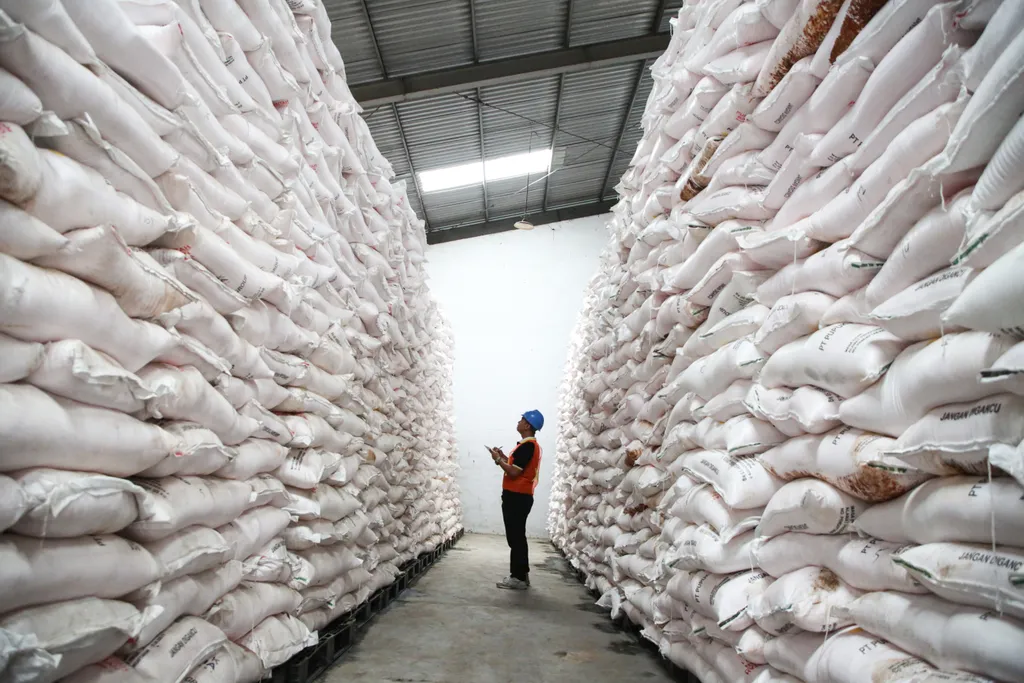
Several state-owned enterprises are undergoing transformation under the oversight of the State-Owned Enterprises Regulatory Agency (BP BUMN) and the Nusantara Future Investment Management Agency (Danantara).
PT Pupuk Indonesia (Persero) and ID Food, the holding company for state-owned food enterprises, are also targets. However, they face different fates. Pupuk Indonesia is encouraged to expand, while ID Food is being stripped down.
Pupuk Indonesia, whose main business line is fertiliser and which is pioneering an ash soda business, has been asked to build two methanol plants. Methanol is an alcohol that serves as a reactant converting crude palm oil (CPO) into fatty acid methyl ester (FAME) biodiesel for diesel blending.
President Director of PT Pupuk Indonesia, Rahmad Pribadi, said on Tuesday (7 April 2026) that the government has assigned the company to build two methanol plants to support the mandatory B50 programme (50 per cent blending of CPO-based biodiesel with 50 per cent diesel).
Danantara has approved the proposal for the construction plan of the two methanol plants. The plants will be built in Lhokseumawe, Aceh, and Bontang, East Kalimantan, with each having a methanol production capacity of 1 million tonnes.
“The locations are already set. The feasibility studies are complete. The memorandum of understanding for gas supply has been signed with Mubadala Energy, while progress is ongoing with PT Pupuk Kalimantan Timur,” he stated during a hearing with Commission IV of the House of Representatives (DPR) in Senayan, Jakarta.
According to Rahmad, the methanol requirement for the mandatory B40 in 2025 is around 1.8 million tonnes. With domestic methanol production capacity at only 400,000 tonnes, Indonesia still needs to import about 1.4 million tonnes of methanol.
The implementation of mandatory B50 will significantly increase domestic methanol needs to around 2.9 million tonnes. “Without an increase in domestic methanol production capacity, methanol imports will rise from 1.4 million tonnes to 2.5 million tonnes,” he said.
In addition to the ethanol plants, Rahmad continued, Pupuk Indonesia is also revitalising seven fertiliser plants. One plant has been inaugurated, three are entering the construction process, and the other three are in preparation for construction.
The revitalisation of these fertiliser plants is linked to the issuance of Presidential Regulation (Perpres) No. 113 of 2025, which amends Perpres No. 6/2025 on the Governance of Subsidised Fertilisers. The new regulation promotes transparency and savings in the national fertiliser industry.
On 18 February 2026, Senior Vice President of Sales Strategy and Customer Service at Pupuk Indonesia, Asep Saepul Muslim, stated that the new regulation enables savings for the company. The saved funds will be allocated to revitalise plants and keep fertiliser prices affordable.
Through the new regulation, the mechanism for claiming subsidised fertiliser, previously based on production costs, is now market-price based. Additionally, payments for procuring subsidised fertiliser raw materials are realised by the government at the beginning or before the production and distribution of subsidised fertilisers.
“With this change, Pupuk Indonesia no longer has to bear the burden of interest on working capital financing,” Asep said during a webinar titled “Dissecting Perpres No. 113 of 2025 on the Governance of Subsidised Fertilisers” organised by Sinar Tani.
ID Food faces a different fate. Several of the state-owned food cluster’s main business lines are being stripped away. Some shares are being released to PT Sinergi Gula Nusantara (SGN) or Sugar Co and PT Perkebunan Nusantara (PTPN). Others are even being absorbed by Danantara.
Since its launch on 12 January 2022, ID Food has become the parent of five companies and 11 subsidiaries. The five companies are PT Perusahaan Perdagangan Indonesia, PT Sang Hyang Seri, PT Perikanan Indonesia, PT Berdikari, and PT Garam.
The subsidiaries consist of PT Pabrik Gula (PG) Rajawali I, PT PG Rajawali II, PT PG Candi Baru, PT Perkebunan Mitra Ogan, PT Laras Astra Kartika (Laskar), PT Mitra Kerinci, PT Rajawali Nusindo, PT GIEB Indonesia, BGR Logistik Indonesia, PT Mitra Rajawali Banjaran, PT Rajawali Citramass, and PT Rajawali Tanjungsari Engineering.
In ID Food’s presentation material, it is stated that PG Rajawali I, PG Rajawali II, and PG Candi Baru will be managed by SGN. ID Food’s plantation companies, namely Mitra Kerinci and Laskar, will also come under PTPN.
Additionally, PT Garam, PT Berdikari, PT Perikanan Indonesia, and PT Sang Hyang Seri will be managed by Danantara. The transfer of these subsidiaries uses a share divestment mechanism with an exclusive management rights scheme to ID Food as the offtaker or buyer of the products produced by these companies.
This is done as part of ID Food’s transformation into a trading and distribution company for various foods. Thus, ID Food’s upstream food production role is being shed. It is also stated that this transformation is carried out in accordance with Danantara’s directives in portfolio arrangement and refocusing BUMN businesses.
This aligns with Danantara’s strategy for clustering BUMN portfolios.
Finance and Strategy Director of ID Food, Susana Indah Kris Indriati, explained that the divestment process for the three sugar mills has entered the final stage. ID Food hopes a final agreement can be reached in April 2026.
Additionally, two other subsidiaries, Mitra Kerinci and Laskar, will also be managed by PTPN. All plantations of these two companies will also be transferred to PTPN.
“This is in line with Danantara’s strategy for clustering BUMN portfolios,” Indah said during a hearing with Commission VI of the Indonesian House of Representatives (DPR RI) held hybrid in Senayan, Jakarta, on Monday (30 March 2026).
She added that several subsidiaries that own