
Public Stigma Against Criminal Offenders Drives New Criminal Procedure Code
Jakarta (ANTARA) - Deputy Minister of Law Prof. Edward Omar Sharif Hiariej stated that societal stigmatisation of criminal offenders is a key driver for the government to enact a new Criminal Code (KUHP) and Criminal Procedure Code (KUHAP).
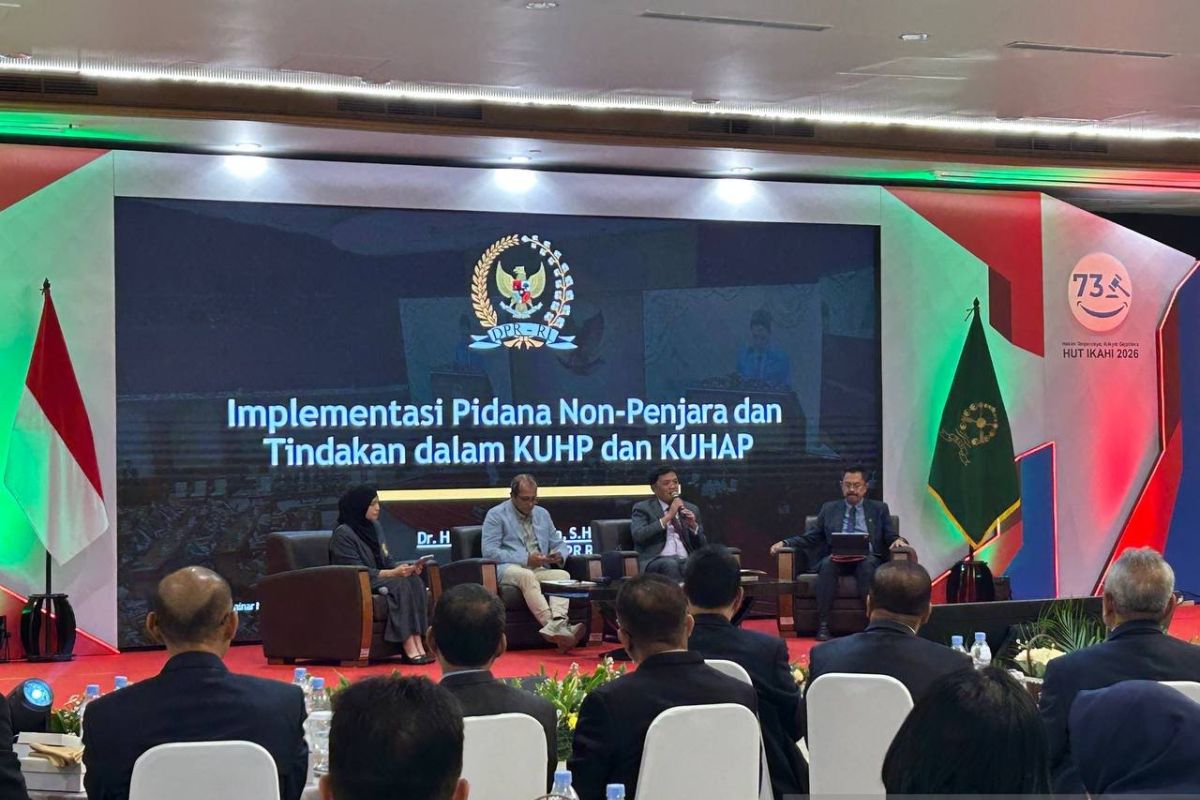
“The core reason we prioritise non-custodial measures and actions is to prevent stigmatisation of criminal offenders,” said Prof. Eddy at the national seminar themed “Sentencing in the 2023 KUHP and 2025 KUHAP: Implementation of Non-Custodial Penalties and Actions in Indonesia’s Criminal Justice System”, held at the Supreme Court Building in Jakarta on Tuesday.
He explained that the 2023 KUHP, reinforced by the 2025 KUHAP, introduces a new paradigm in criminal law, shifting from an imprisonment-oriented approach to a more humane sentencing framework.
He noted that offenders often cycle in and out of prison partly due to societal stigma.
It is commonplace for someone who has served a criminal sentence to become the subject of gossip upon returning to society.
According to him, what causes offenders to repeat their crimes is the community’s participation in stigmatising them as irredeemable.
“This is why it forms the mindset in developing the national KUHP, including provisions on imprisonment penalties. Even if imprisonment is imposed, it should not be for short durations,” he said.
Prof. Eddy also emphasised that the new orientation of national criminal law focuses on social reintegration.
“This is indeed a universal paradigm that no longer prioritises prison. Therefore, if we examine the academic paper for the national KUHP, one of its visions is social reintegration,” he stated.
He provided an example, such as a Muara Enim District Court judge on 9 January 2026 who applied the judicial forgiveness concept as regulated in Article 246 of the new KUHAP.
“So, there is a paradigm shift in our KUHP, and I am confident everyone understands it,” said Eddy.