
Psychiatrist Offers Tips for Maintaining Mental Health During Ramadan
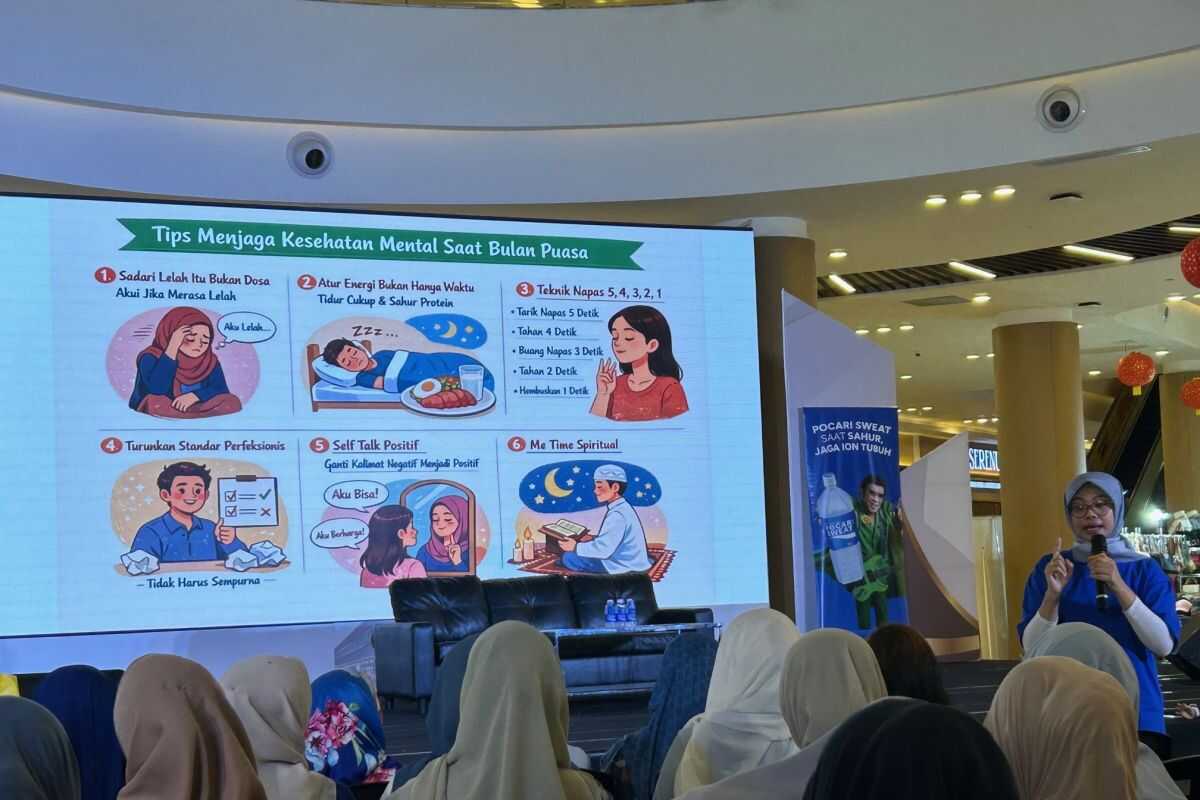
Batam (ANTARA) — Psychiatrist Revit Jayanti has shared tips for maintaining mental health during the month of Ramadan, to enable the faithful to observe the fast calmly without emotional disturbances that could harm themselves or others.
According to her, the blessings contained within Ramadan inherently bring tranquillity to those who observe it. Experiencing emotions is perfectly normal, but if left uncontrolled they can harm oneself and others, making it necessary to address them.
“The first tip is to recognise that fatigue is not a sin. Acknowledge it if you feel tired,” said Revit in Batam, Riau Islands, on Tuesday.
Revit explained that at the beginning of Ramadan, every individual inevitably feels fatigued due to the body’s adjustment from eating three meals a day to eating once.
From a neurological perspective, she said, the body undergoes changes during fasting — blood sugar levels drop after not eating for several hours, resulting in fatigue and heightened emotional sensitivity.
Additionally, cortisol (the stress hormone) levels may increase initially due to changes in sleep and eating patterns.
Furthermore, the process of autophagy (cellular cleansing) takes place. Fasting aids the cleansing of cells, including brain cells, supporting the protection and repair of nerve cells and potentially increasing Brain-Derived Neurotrophic Factor (BDNF), which plays a role in cognitive function and emotional regulation.
“When emotions arise, they must be validated — why did you become emotional? Identify the emotion,” said Revit.
Many individuals do not recognise their emotions, which is influenced by parenting patterns from childhood. When a child cries and is told to be quiet, the child fails to understand their emotions — why they are crying and what caused it.
Therefore, when validating emotions, she continued, one can confide in a trusted friend. However, it is rare to find a friend who can be trusted completely. For this reason, it is better to validate emotions with oneself or engage in self-talk.
The second tip, she said, is to manage energy by regulating sleep and eating patterns. “What needs to be managed is not just time, but also energy — by maintaining proper eating and sleeping patterns,” said Revit.
The third tip involves breathing techniques, such as inhaling for a count of four, holding the breath for four counts, and exhaling for four counts. Alternatively, a 4-7-8 counting pattern can be used.
Another way to maintain mental health, she said, is to lower perfectionist standards, as one’s environment does not demand them.
“For example, working hours have ended, but because you want the work finished by tomorrow to be perceived as the best, this standard needs to be lowered. It is better to go home, rest, and worship. Similarly, if you want to prepare breakfast for your children and end up preparing it until midnight, when it could be done the following morning,” she said.
The next approach, said Revit, is positive self-talk, which can be practised through journalling and replacing negative statements with positive ones.
“Talk to yourself, forgive others and forgive yourself. Before sleeping, apologise to yourself — for being a perfectionist when your environment does not demand it. Every night, practise affirmation and apologise to yourself,” she said.
The final tip is spiritual ‘me time’, which can include reciting the Quran, performing tarawih prayers, and participating in tadarus (communal Quran recitation).