
PSR Seen as Key to Boosting National Palm Oil Productivity
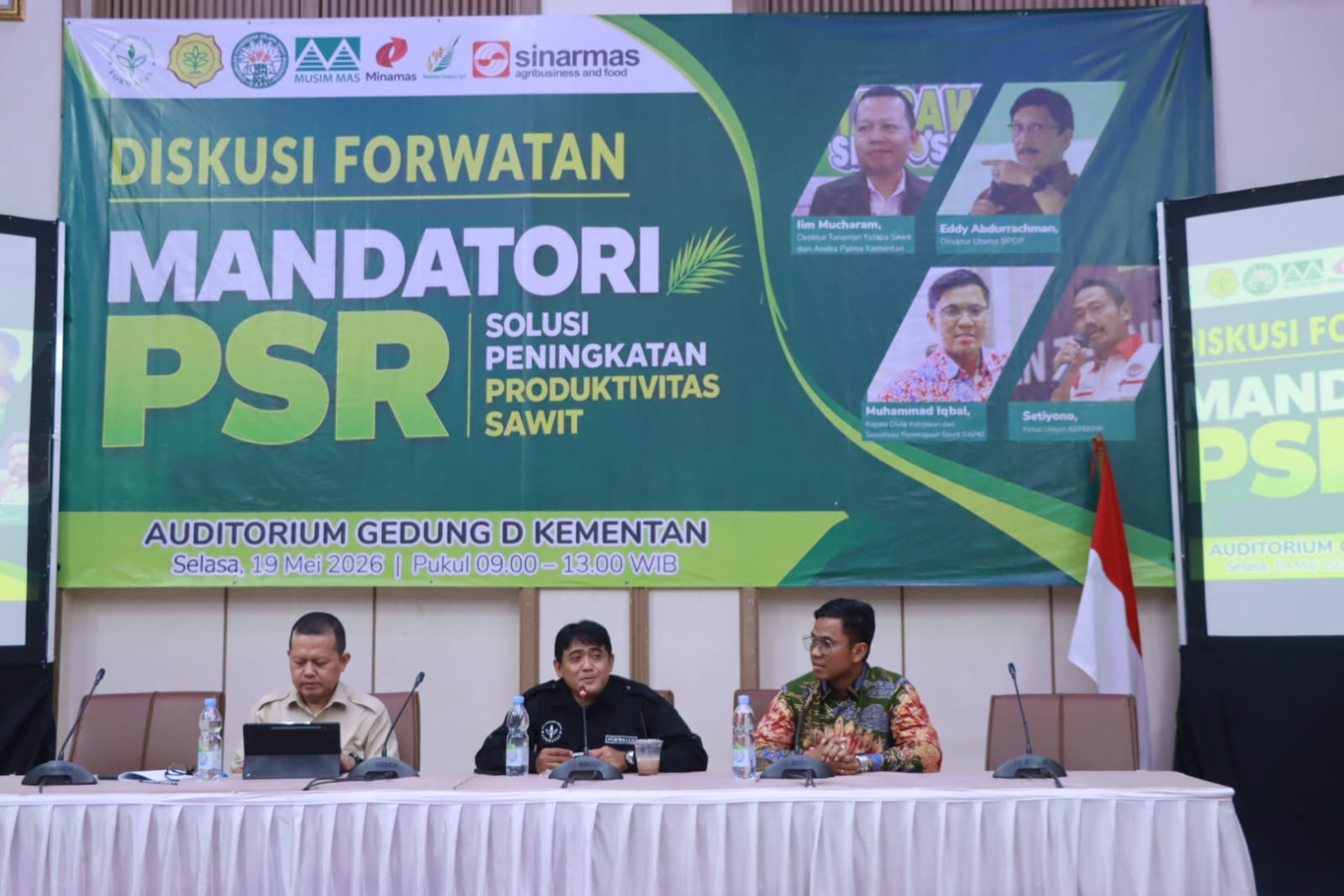
The People’s Palm Rejuvenation Programme (PSR) is seen as a key strategy to boost the productivity of national palm oil plantations in the face of land constraints and global pressure to curb expansion of the palm oil industry. However, the acceleration of the programme continues to encounter several classic problems, ranging from land legality and overlapping conservation zones to weak partnerships with farmers.
Director of Palm Plantations and Miscellaneous Oils at the Ministry of Agriculture, Iim Mucharam, said that increasing productivity is a more realistic option than opening new land.
“Expanding is no longer feasible because land is limited and there is international pressure and global issues. That is why PSR is the key,” he said in a written statement received on Wednesday (20/5).
Government data show that the national palm oil plantation area in 2025 reached 16.8 million hectares. About 51% of this is controlled by private companies, while 41% are smallholder plots. The large share of smallholders is seen as holding significant potential to raise national production.
“Imagine 41% of 16 million hectares—that is a huge potential,” he said.
Nevertheless, the realisation of the PSR programme is judged to be far from optimal. The government records total PSR technical recommendations amounting to 423,305 hectares, but the realisation of pruning and chipping has reached only 316,359 hectares, while planting has been realised on 295,691 hectares.
To accelerate the programme, the government continues to boost financing support through the Estate Fund Management Agency (BPDP). Aid previously of Rp25 million per hectare from 2017–2019 rose to Rp30 million per hectare from 2020–August 2024 and increased to Rp60 million per hectare since September 2024.
However, from the outset, Iim stressed that PSR was designed as a voluntary programme, thus it cannot be fully applied mandatorily.
“Fully mandating it right away is not possible due to regulatory and other issues,” he said.
He acknowledged various on-the-ground obstacles, particularly related to land legality and overlapping forest areas.
“Many farmers do not actually want rejuvenation because they fear losing income during the replanting period. On the other hand, land legality is not clean and clear,” he said.
Meanwhile, the Head of Policy and Socialisation Division for Palm Rejuvenation at the Indonesian Palm Oil Association GAPKI, Muhammad Iqbal, assessed that the Core-Plantation Private Estate (PIR) pattern previously implemented proved effective in building synergy between companies and farmers.
He said access to PSR funding remains hampered by several administrative and technical requirements that are quite complex.
“To access PSR funds it is very difficult. For example, coordinates must be exact, aerial photos are needed, while access in some areas is difficult and costly,” he said.
Chairman of the Asosiasi Petani Kelapa Sawit Perusahaan Inti Rakyat (Aspekpir) Indonesia, Setiyono, said farmers essentially support accelerating PSR, including if it is later implemented mandatorily, as long as there is clear mapping and strengthening of farmer institutions.
“Aspekpir supports mandatori PSR, but there must be mapping and strengthening of farmer institutions first. Don’t let farmers be left behind when facing legal problems,” he said.
He views regulatory reform as a key factor to ensure the palm oil rejuvenation programme for smallholders can run more effectively and not add to farmers’ burdens. (E-4)
GAPKI, RPN and Socfin Indonesia released palm oil genetic resources from Tanzania to create superior varieties that are climate-change adaptable.
BPDP and GPPI push for accelerated ISPO certification for palm farmers through funding support and institutional strengthening to enhance global competitiveness.
Since its establishment, Gapki has served as a unifying body for the palm oil industry, as well as a strategic partner for the government to spur national economic growth.
PT Astra Agro Lestari Tbk reported positive performance in Q1 2026 with notable profit growth, driven by operational efficiency and cost control.
By managing more than 40 percent of the national palm oil plantation area, farmers are no longer merely producers of raw materials. They must be encouraged to move up the value chain.