
Provisions on Incitement and False News in Criminal Code Challenged at Constitutional Court, Deemed Capable of Silencing Criticism
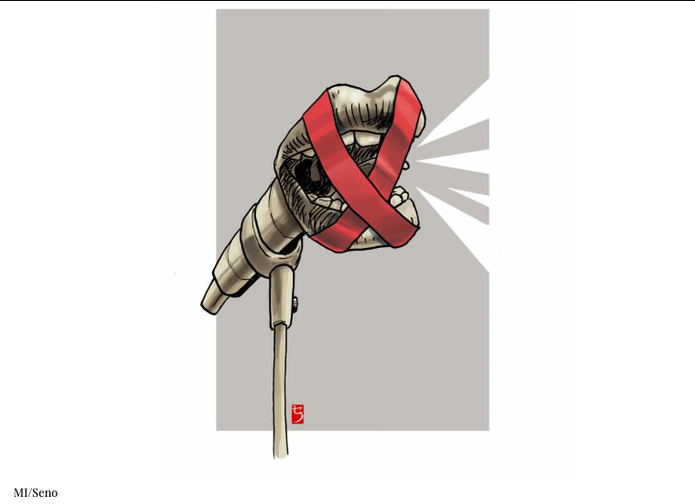
Several articles in Law Number 1 of 2023 on the Criminal Code (KUHP) that regulate incitement and the dissemination of false news have been challenged at the Constitutional Court (MK). The petition was filed by Delpedro Marhaen Rismansyah and Muzaffar Salim under case number 93/PUU-XXIV/2026. The petitioners argue that the provisions are unclear and could ensnare members of the public who express criticism or information in the public sphere. The petitioners are challenging Articles 246, 263 paragraphs (1) and (2), and 264 of the KUHP, which address incitement and the spread of false news that could potentially incite unrest. The petitioners’ legal representative, M. Fauzan Alaydrus, explained that they have refined the petition by clarifying the basis for the review and the arguments presented. “Previously, there were seven arguments; we have specified them into five and contextualised them with the cases experienced by Petitioner I and Petitioner II,” Fauzan stated during the hearing on Wednesday (2/4). Fauzan highlighted one problematic article, namely Article 263 paragraph (1) of the KUHP. According to him, the article does not provide a clear explanation of what constitutes “false news.” “The absence of a clear and measurable definition of the term ‘false’ creates legal uncertainty because it opens up very broad and subjective interpretive space for law enforcement officials,” he said. He added that in criminal law, a provision must be formulated clearly to avoid multiple interpretations. “A norm must fulfil the principle of lex certa, namely formulated clearly, firmly, and without multiple interpretations so that the public knows exactly what actions are prohibited,” he explained. In a previous hearing, Fauzan also emphasised that these articles could harm the constitutional rights of the petitioners, who work in advocacy and human rights. “The existence of the challenged articles could potentially criminalise the Petitioners, whose work focuses on advancing human rights, political education, and advocacy,” he said. The petitioners believe these articles could be used to target critical parties. They cited the case of alleged dissemination of false news regarding data on around 400 demonstrators arrested during an action in August 2025. According to them, the information was the result of data collection for legal advocacy purposes but was instead questioned criminally. In addition, the petitioners highlighted several ambiguous phrases in the articles that could lead to multiple interpretations, such as “reasonably suspected,” “may cause unrest,” “uncertain news,” and “exaggeration.” Furthermore, Article 246 of the KUHP on incitement is also seen as lacking firm boundaries. “As a result, calls or invitations in the public sphere in a democratic context could potentially be interpreted as criminal acts,” Fauzan said. The petitioners argue that the lack of clarity in the formulation of these articles could violate the principle of legal certainty guaranteed by the constitution, while also hindering freedom of expression and the right to express opinions.