
Proof Indonesia is the 'King'! Formula Change, Global Nickel Prices Soar Immediately
The government has officially implemented a new formula for the Mineral Reference Price (HPM) for nickel ore starting yesterday, 15 April 2026. This policy is outlined in Ministerial Decree No. 144.K/MB.01/MEM.B/2026, which revises Ministerial Decree No. 266 of 2025.
The policy was immediately responded to by the global nickel market, causing prices to rise. According to Trading Economics, on trading 15 April 2026, nickel stood at US$18,323.88 per tonne, up 0.63% from the previous day. Over the past month, prices have surged 4.8%, while annually they have soared 17.5%.
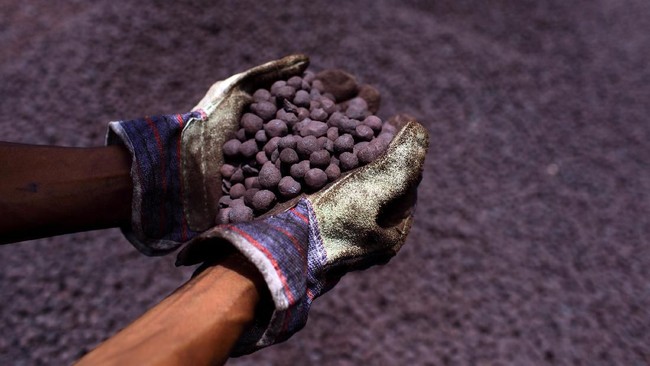
This increase comes as the market reads one important message: Indonesia is tightening governance of nickel raw materials. The government has revised the Mineral Reference Price (HPM) formula for nickel ore. In the new scheme, the valuation components now include other elements such as iron, cobalt, and chromium. The correction factor for determining the minimum price has also been raised.
Director General of Minerals and Coal (Dirjen Minerba) at the Ministry of Energy and Mineral Resources, Tri Winarno, explained that the price formula adjustment is intended to correct the domestic nickel ore prices, which have been deemed too low compared to international market prices.
The formula change aims to increase state revenues from the royalty sector. He believes that with the new, more accurate calculation, the contribution from the nickel mining sector to state income will rise.
“Yes, there will be some additions (to state revenue),” he said when met at the DPR RI Building in Jakarta, quoted Thursday (16/4/2026).
Tri revealed the reason for the price formula correction due to a significant price gap between domestically produced nickel ore and export prices in competitor countries like the Philippines and New Caledonia. His side found that nickel prices in Indonesia have not captured the premium value that should be included in the HPM calculation.
“Indeed, the ore prices here were too low previously. You can check with the association too that there was a premium before. Well, that premium wasn’t captured in the HPM price at that time. Then we made the correction. That’s roughly the point,” Tri explained.
The new formula adjustment includes the application of a correction factor and the valuation of other minerals contained in nickel ore. Besides nickel, elements such as iron (ferro), cobalt, and chromium are now considered in the price formula.
“Just the correction factor and valuing ferro, ferro is iron, cobalt and chromium,” he added.
The government hopes this new regulation will be more adaptive to market dynamics. ESDM is committed to continuously updating rules to respond to commodity price changes so as to remain beneficial for the state and industry players.
“Hopefully it’s good, something like that. I don’t have price targets or anything, but the point is we keep updating for any changes that occur and hopefully we’re adaptive to changes,” he emphasised.
Meanwhile, Secretary General of the Indonesian Nickel Mining Association (APNI), Meidy Katrin Lengkey, stated that the impact of the policy was immediately felt in the global market. Nickel prices on the London Metal Exchange (LME) surged within hours after the new HPM was released.
“Nikel prices on the LME exchange rose a few hours after the new HPM release, from 17,090 to 17,680. For miners, this strengthens the price floor. But for smelters, especially HPAL, this adds pressure on production costs,” Meidy said in a written statement on Wednesday (15/4/2026).
She assessed that the surge occurred amid ongoing short-term oversupply pressures in the global nickel market, particularly in the Chinese market. Prices in the upstream sector such as nickel ore, Nickel Pig Iron (NPI), and nickel sulphate remain under pressure, while demand, especially from the battery sector, has not fully recovered.
Nevertheless, the HPM reform is seen as a strong signal that Indonesia is beginning to play a more active role in regulating global supply and price balance.
“This becomes a signal that Indonesia is no longer just following the market, but starting to actively regulate supply and pricing balance,” she said.