
Private Investment in Cattle Rises, but Land Constraints Slow Indonesia's Supply Push
Private Investment in Cattle Rises, but Land Constraints Slow Indonesia’s Supply Push
Jakarta. Private sector investment in Indonesia’s cattle industry has begun to scale up, but progress remains below expectations as land constraints and structural gaps continue to hinder efforts to cut the country’s heavy reliance on imported beef and milk.
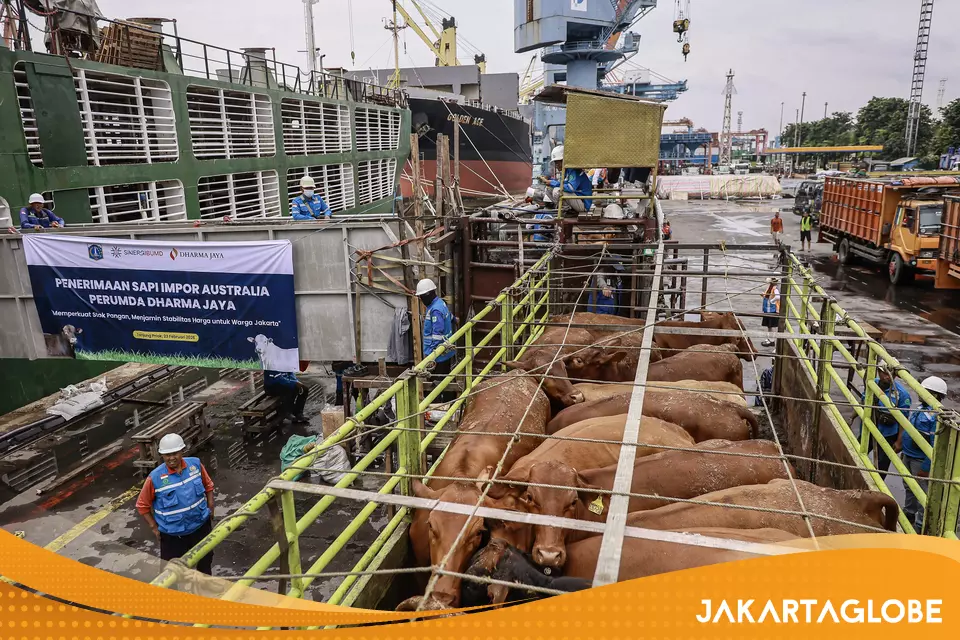
A total of 136 private investors had committed Rp 3.29 trillion ($194.54 million) as of Dec. 31, 2025, bringing in 32,108 dairy and beef cattle to expand domestic production, according to data from the Agriculture Ministry’s Directorate General of Livestock and Animal Health.
The realized figures, however, fall short of the government’s 2025 targets, which aimed for the importation of 48,754 dairy cattle and 52,594 beef cattle by a larger pool of investors.
Of the realized imports, 12,052 were dairy cattle contributed by 62 investors, while 20,056 were beef cattle from 74 investors.
Indonesia continues to face a significant supply gap. Domestic beef and buffalo meat production reached 0.43 million tons in 2025, leaving a deficit of 0.39 million tons, or 48% of national demand. Meanwhile, fresh milk production stood at just 0.82 million tons, far below the shortfall of 3.9 million tons, equivalent to an 82% deficit.
The government has increasingly leaned on private investment to address these gaps, particularly as fiscal space remains limited.
“Due to limited government budget, we are currently encouraging investors to develop dairy and beef cattle in Indonesia,” said Hary Suhada, Director of Breeding and Livestock Production at the ministry.
Despite identifying around 1.7 million hectares of potential land for livestock investment, execution has been slower than expected, largely because much of the land is not yet ready for use.
“The main challenge is land availability, especially land that is clear and clean. We have identified around 1.7 million hectares of potential land, but investors have not been able to fully enter because the land is not suitable,” Hary said.
“As a result, we can only utilize land that is already clear and clean, which is why realized imports reached only 12,052 dairy cattle and 20,056 beef cattle,” he added.
To address these constraints, the government is preparing a presidential instruction under the Program for the Acceleration of National Milk and Beef Production (P2SDN).
Looking ahead, the government has set an ambitious investment target of Rp 228.66 trillion for 2025–2029, covering nearly 1 million dairy cattle and over 577,000 beef cattle under a mix of independent and partnership schemes.
Beyond increasing herd size, policymakers and researchers are also emphasizing productivity gains through genetic improvement.
“Breeding and genetic improvement programs are key strategies to sustainably enhance dairy cattle production performance,” said Santoso, Head of the Livestock Research Center at the National Research and Innovation Agency (BRIN).
He added that approaches such as progeny testing, evaluating the genetic quality of breeding stock, could accelerate long-term gains if supported by strong data systems and consistent implementation.
“Ultimately, this will contribute to higher national milk production, a stronger dairy industry, and improved livestock welfare,” Santoso said.
However, he stressed that success will depend on close coordination between researchers, policymakers, industry players, and farmers.
Tags: Keywords: