
Primary School Teacher Accidentally Discovers a Multi-Billion Rupiah Treasure in the Schoolyard
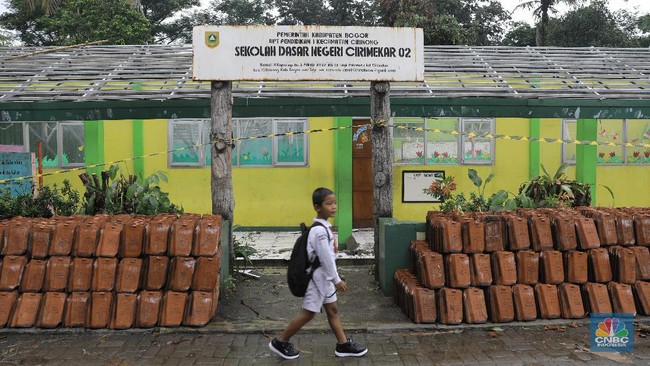
Jakarta, CNBC Indonesia - The saying “rain brings blessings” came true for Nuryasin, a primary school teacher and head of SDN Pejagan IV in Madura. In the middle of a downpour, he discovered a valuable treasure. The incident began when Nuryasin saw the school’s field muddy after rain, worried that the clean floor would become dirty as pupils passed by. He took the initiative to resolve the issue. Nuryasin then picked up a spade and began digging the soil to cover the wet areas with dry earth.
“I was digging the ground in the yard to fill in the other puddles left by the rain,” Nuryasin said.
The digging progressed very smoothly. Nuryasin managed to cover one damp spot after another. Only a few spots remained.
As he planned to dig the dry soil deeper by around 25-30 cm, Nuryasin suddenly startled. He was astonished to see ancient pottery in the excavation hole.
The pottery was removed and, unexpectedly, contained a treasure. Namely ancient coins from the VOC era.
“The money found bears the VOC inscription and the symbol of the Kingdom of the Netherlands, dating to between 1746 and 1760, with a diameter of 2.1 cm. Then, a second type with a diameter of 2.9 cm which on its obverse bore ‘Indiae Batav’ 1819-1828,” wrote reporter Suara Karya (1 February 1991).
News of Nuryasin finding a treasure immediately made waves in Indonesia. The relevant authorities rushed to the site.
In short, the find was confirmed as a historic artefact consisting of silver coins dating from the VOC and Dutch colonial rule. In total, they weighed 13 kg, equivalent to billions of rupiah.
After the discovery, many people thought Nuryasin would become a billionaire. Because he had found a historic treasure of high value. However, Nuryasin refused to monetise the archaeological find, even though many urged him to sell all the artefacts instead of handing them to the government.
“But I cannot do that. The proceeds from the find will be donated to a museum, in accordance with the guidance of the Depdikbud,” said Nuryasin.
In the end, Nuryasin did not become a billionaire. Yet his name is recorded in history as the discoverer of a historic treasure.
Ultimately, the treasure found on the school field shed new light on how people traded in the VOC era hundreds of years ago.
Trading with Gold-Silver Coins
For background, even in the Hindu-Buddhist period, communities already used money in transactions, not barter.
Erwin Kusuma in Money of Indonesia: History and Developments (2021) notes that ancient Java commonly used coins of gold in large-scale trade, such as land transactions, not in markets.
Then when the VOC arrived, coin-based transactions continued. However, the VOC standardised currency.
The Museum of Bank Indonesia notes that the trading company sought to replace all foreign currencies circulating in the Nusantara. Hence, the VOC circulated a wide variety of currencies for trade.
There were rijksdaalder, ducat, stuiver, gulden, and doit. All were flat round coins made of gold, silver, copper, and nickel. Of all the coins, the doit probably left the strongest impression in the Indonesian consciousness.
Because the name of the doit during the VOC era gradually became the generic term for money among Indonesians, i.e. ‘duit’. The coin’s presence became more widespread after the VOC produced it domestically.
From here, the whole population used these coins to transact. But the VOC era ended when the trading company collapsed in 1799.
Subsequently, new currency circulated popularised by the Dutch East Indies government. Meanwhile, the VOC-era currency then remained only in history.
Some of it remains buried treasure of historical and high value. This is what Nuryasin found 33 years ago.
(fsd/fsd)