
Pressure mounts on Indonesia to review, exit Board of Peace amid US-Israel conflict with Iran
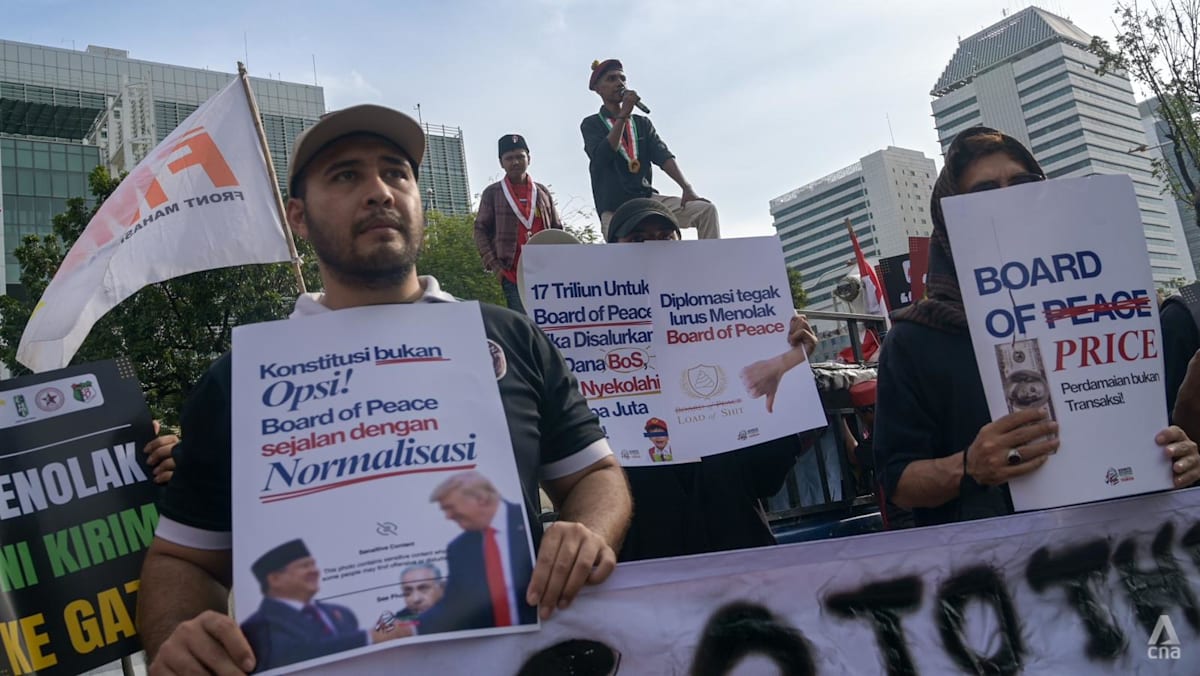
analysis Asia
Pressure mounts on Indonesia to review, exit Board of Peace amid US-Israel conflict with Iran
Calls for Indonesia to leave the Board of Peace tasked to oversee Gaza reconstruction efforts are being made by the country’s religious groups, academics and former diplomats.
JAKARTA: Religious bodies, academics and civil society groups in Indonesia are urging the government to review - or even revoke - its membership to United States President Donald Trump’s Board of Peace (BoP) for Gaza reconstruction efforts, amid the US-Israeli war on Iran.
The Indonesian Ulema Council (MUI) is among those who made demands early on for Indonesia to leave the group amid the conflict.
“The MUI urges the Indonesian government to revoke its membership from the BoP, as it is deemed ineffective in achieving true independence in Palestine,” it said on Sunday (Mar 1) in a press statement.
Citing the US-Israel strikes that began on Feb 28, MUI said Indonesia, the world’s largest Muslim-majority country, should not be linked to the US through its membership of the BoP, which it became a founding member of on Jan 22 in Davos.
The council also questioned whether the US established the BoP to create peace in Gaza.
“America, which is playing a central role in managing the Palestinian conflict through the BoP, faces a big question: Is this strategy truly aimed at achieving real peace or is it actually strengthening the unequal security architecture and burying Palestinian independence?,” the press statement added.
Indonesia is a supporter of the Palestinian cause and has long pushed for a two-state solution. It has no diplomatic ties with Israel.
Dozens of public figures and civil society groups have also urged Jakarta to reconsider its position, arguing that continued participation risks undermining Indonesia’s long-standing independent foreign policy, known as the free and active policy.
There are also parties which said that Indonesia should postpone sending troops to Gaza amid the war in Iran, which has retaliated by hitting US bases across the Gulf.
However, some analysts CNA spoke to warned of consequences should Indonesia withdraw from the BoP.
“Indonesia must deal with the US which may not be pleased with the decision,” said Dinna Prapto Raharja, executive director of the think tank Synergy Policies.
Indonesia is not just a member of the board. At the first BoP meeting on Feb 19 in Washington, it was announced that the archipelago would assume a deputy commander role in the International Stabilization Force (ISF) after accepting an offer from the US for the position.
President Prabowo Subianto, who was in Washington for the meeting, said that he would deploy 8,000 military personnel to Gaza as part of the ISF within two months.
For now, talks on BoP are on hold as “all attention has shifted to the Iran situation”, said Minister of Foreign Affairs Sugiono, who goes by one name.
“We will also consult with our friends and colleagues in the Gulf because they are also under attack,” Sugiono told reporters on Tuesday without giving details.
He was speaking to the media right after a meeting held by Prabowo with former presidents, former and current vice-presidents, current and former ministers, as well as political party leaders to discuss various national and global issues.
IS THE BOARD OF PEACE MISSION GENUINE?
The MUI, academics and civil society CNA spoke to questioned whether the US-led Board of Peace would genuinely advance Palestinian independence.
Lawmaker Dave Laksono, a member of the parliament’s commission on defence, foreign policy, communication and intelligence, told CNA that although Prabowo had said that 8,000 troops would be deployed to Gaza, it has yet to be determined exactly when.
“The lack of an official schedule reflects a cautious approach. The safety of military personnel, the credibility of the mission, and public support are key considerations before any concrete steps are taken,” he said.
“The ministry of defence has emphasised that the plan remains within the constitutional framework, but implementation will depend on the president’s directives and operational readiness on the ground.”
CNA has reached out to the ministry of defence and ministry of foreign affairs for comment.
In its press statement on Mar 1, MUI said it believed that there is a strategic motive behind the attack “suspected to be a systematic attempt to weaken Iran’s strategic position in the region, while simultaneously limiting Iran’s support for the struggle for Palestinian independence”.
The Retired Indonesian National Armed Forces Soldiers Forum (FPP-TNI) has also called for Indonesia to leave the board, and on Prabowo to withdraw the plan to deploy 8,000 Indonesian troops to the Palestinian enclave.
It said on Tuesday that the BoP has the potential to violate the constitution, the state defence principles and the principles of an independent and active foreign policy.
Retired General Fachrul Razi, quoted by local media platform Tempo, explained that Indonesia’s involvement in international peacekeeping forces can only be carried out under a UN mandate and not any other organisation.
“Especially with the Board of Peace that is headed by an American general. This truly offends the feelings of our Palestinian friends,” he said, after a forum meeting on Feb 26.
Meanwhile, on Mar 1, 65 public figures, including academics and environmentalists, as well as 79 civil society groups, including Human Rights Working Group and Indonesia Corruption Watch, issued a statement urging the government and the parliament to evaluate Indonesia’s agreement in the BoP charter.
“The BOP established in Davos is not the BoP mandated by UNSC Resolution 2803,” the statement said.
They were referring to the United Nations (UN) Security Council Resolution 2803, which was passed on 17 Nov 2025 to give effect to the Gaza peace plan agreed by Israel and Hamas in October 2025.
The resolution was welcomed by Indonesia and the Palestinian Auth