
Press Council Urges Removal of Harmful Clauses to Press in Indonesia-US Trade Agreement
Indonesia’s Press Council has urged the Indonesian Government to revoke clauses in the reciprocal trade agreement with the United States because they contravene domestic regulations and threaten to further destabilise the media industry.
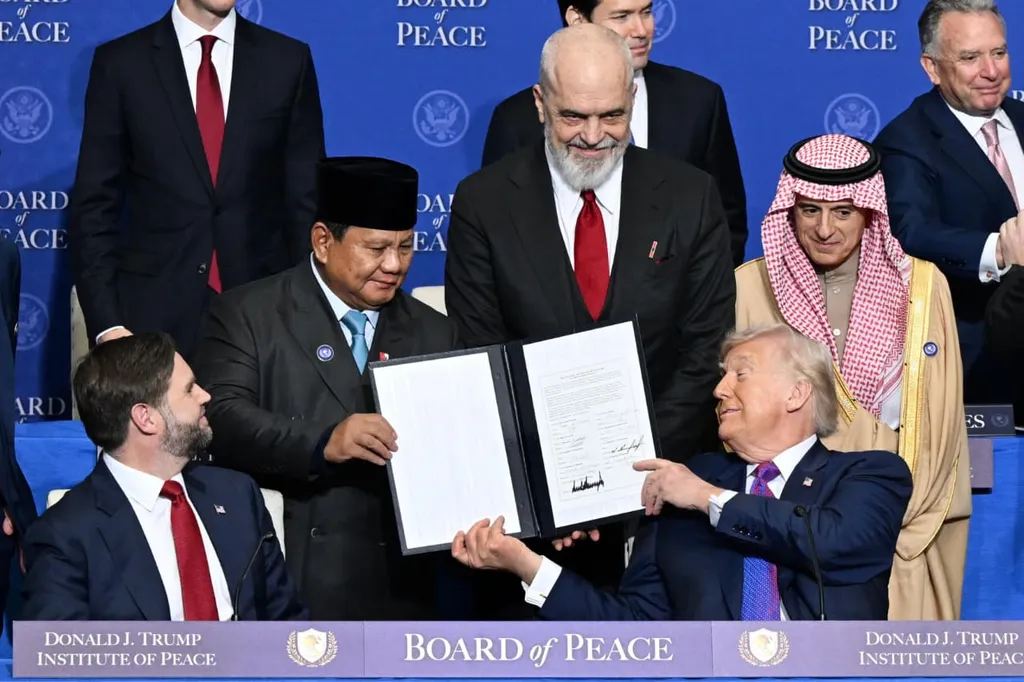
Press Council Chairman Komaruddin Hidayat stated that the agreement signed by Indonesian President Prabowo Subianto and US President Donald Trump on 19 February 2026 is inconsistent with Law No. 40 of 1999 concerning the Press and Law No. 32 of 2002 on Broadcasting.
“The agreement addresses many aspects, ranging from trade tariffs to regulating digital platform and media relationships. At least two articles directly impact Indonesian press operations,” Komaruddin said in a press statement in Jakarta on Wednesday, 11 March 2026.
First, there is a clause concerning foreign shareholding of up to 100 per cent in the publishing sector. Article 2.28 of the agreement essentially requires Indonesia to permit unrestricted foreign investment for US investors across several sectors, including publishing.
Komaruddin argued that this provision would open foreign capital in the media sector to 100 per cent ownership, specifically for US investors. This contradicts the Broadcasting Law, which caps foreign capital in broadcasting institutions at a maximum of 20 per cent.
“The Press Law also permits foreign capital in media through capital markets, but ownership cannot be majority-held. This clause must be revoked,” he stated.
The Press Council also urged the government to revoke Article 3.3 of the agreement, which essentially asks Indonesia to refrain from obligating US digital service platforms to support domestic news organisations through paid licensing, user data sharing, and profit-sharing arrangements.
This article conflicts with Presidential Regulation No. 32 of 2024 on the Responsibility of Digital Platform Companies to Support Quality Journalism, known as the Publisher Rights Regulation.
However, this regulation represents the fruits of the media industry’s efforts to secure fair rights by obligating digital platforms to support quality journalism, including through partnerships with press companies.
The forms of cooperation permitted have been outlined in Article 7 of the regulation, including paid licensing, profit-sharing, and user news aggregation data sharing.
Komaruddin stressed that the state should be obligated to strengthen the press, for instance by establishing policies that enable the press to grow sustainably as a business to produce quality journalism and protect it from all forms of violence so it can fulfil its function in accordance with the Press Law.
The Indonesia-US trade agreement, however, works differently. Cooperation between digital platforms and mass media is now still possible, but it is of a business-to-business nature and is not imperative as stipulated in the regulation.
“The provisions in this bilateral agreement will render Presidential Regulation No. 32 of 2024 toothless or unable to function. The government should revoke this clause,” said Komaruddin.
When contacted separately, Suprapto Sastro Atmojo, Chairman of the Committee on the Responsibility of Digital Platform Companies to Support Quality Journalism, emphasised that the agreement could make US-origin digital platforms increasingly unaccountable to the Publisher Rights Regulation.
“Even with only the regulation’s requirements, they show limited compliance; with voluntary measures, this would be even worse,” said Suprapto.
Changes to digital platform companies’ obligations would threaten efforts to build sustainable press operations. Additionally, the public would suffer because they are at risk of not receiving quality journalism and information.
“This is not merely for the interests of the press sector, but for the broader public interest entitled to quality information,” Suprapto emphasised.
Earlier, Deputy Communications and Digital Minister Nezar Patria acknowledged that under the agreement, US-origin digital platforms are not obligated to support Indonesian press companies. However, he said this does not diminish government protection of the press industry.
He also claimed that the trade agreement does not nullify the publisher rights policy. Thus, this regulation retains its legal force as a national policy to ensure balanced relations between digital platforms and the press and maintain journalism sustainability.
“What might change is the technical implementation approach to align with the agreement,” he said.
According to Nezar, implementation of the Publisher Rights Regulation will continue to be strengthened through various governance instruments, including transparent negotiation guidelines and dispute resolution mechanisms between digital platforms and press companies.