
Press Council Submits Input Document to Government for Copyright Bill
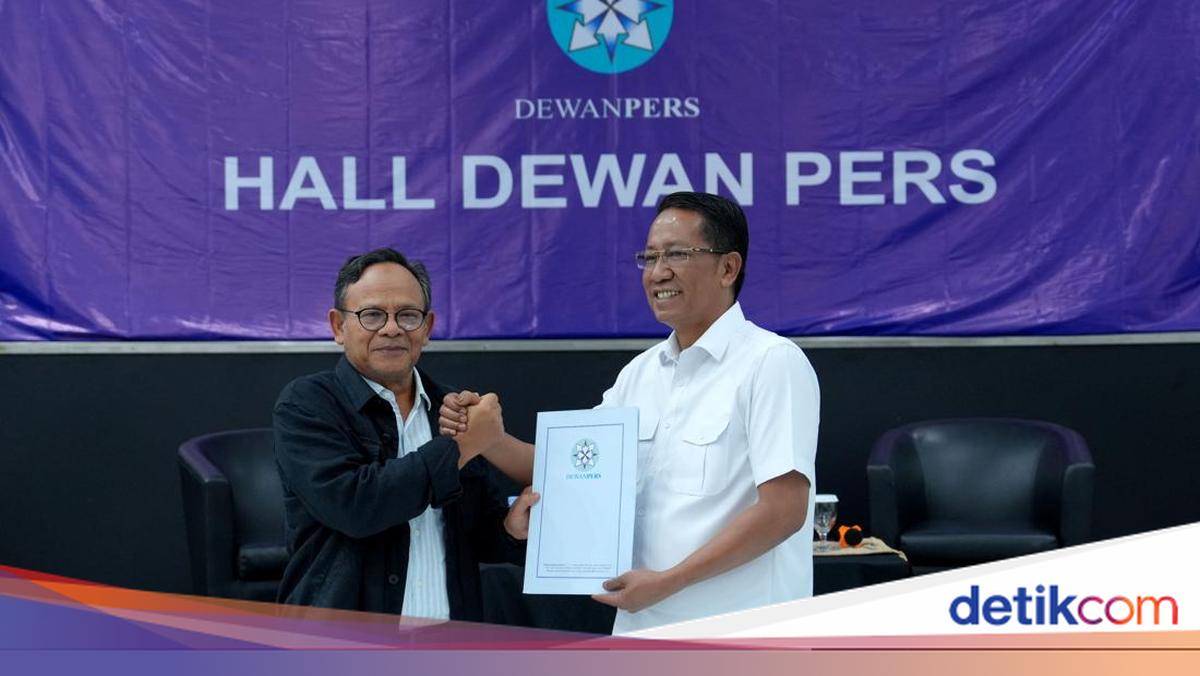
The Press Council has submitted a document related to the protection of journalistic works as important input for national intellectual property through the Copyright Bill to the government. The input document was handed over by Press Council Chairman Komaruddin Hidayat to Minister of Law Supratman Andi Agtas.
The submission of the input document took place at the Press Council Hall, Jakarta, on Thursday (23/4). Komaruddin stated that journalistic works possess significant intellectual, economic, and social value for the public and the national media ecosystem, thus needing to be affirmed as protected creations in the Copyright Bill regulations.
“The Press Council views that journalistic works must be affirmed as protected creations because they hold intellectual, economic, and social value for the public,” emphasised Komaruddin Hidayat, as seen on the official Press Council website on Friday (24/4/2026).
According to Komaruddin, the revision of the Copyright Law presents a crucial opportunity to bolster legal certainty for the press industry amid changes in the digital landscape and challenges posed by unauthorised content use.
“The amendment to the Copyright Law must serve as a momentum to strengthen legal protection for journalistic works as part of the nation’s intellectual property,” he said.
The Press Council also proposed the implementation of the fair use principle in a proportional manner, so that copyright protection remains aligned with public interests and access to information.
“The use of journalistic works must consider the purpose of use, the substance taken, and its impact on the market and value of the original work,” explained Komaruddin.
Meanwhile, Minister of Law Supratman Andi Agtas affirmed that journalistic works are not merely information products, but intellectual creations with economic value and a strategic role in upholding democracy.
“Journalistic works are not just information that is read once and then forgotten, but intellectual assets with economic value that the state must protect,” stated Supratman.
In this era of artificial intelligence (AI), the government is also focusing on the unauthorised use of journalistic data and content. Future regulations are expected to create a fair digital ecosystem between technological innovation and copyright protection.
“In the era of artificial intelligence, journalistic data must not be taken, trained, and commercialised without permission and without fair compensation to the rights holders,” emphasised the Minister of Law.
Both institutions agreed that protecting journalistic works will strengthen the sustainability of the press industry, maintain the quality of public information, and support healthy democracy.
“Protecting journalistic copyright means protecting democracy, protecting information quality, and protecting the nation’s future,” he added.
The Press Council emphasised several key points in its input for the Copyright Bill regarding the protection of journalistic works, as follows:
First, requesting the DPR to explicitly include “journalistic works” in the definition of protected creations in the law. This is intended to provide clear recognition of journalistic products as intellectual works.
Second, proposing the removal of several provisions deemed potentially to weaken copyright protection, particularly regarding the use of quotes and the taking of current news without clear limitations.
Third, adding provisions to clarify the status of journalists as creators in journalistic works, and strengthening recognition of journalistic outputs that include writing, audio, visuals, data, and graphics.
Fourth, proposing regulations on the duration of copyright for journalistic works, whether following the creator’s lifetime or based on the time of publication, to provide legal certainty.