
Presidential Palace Becomes Dream Space for Students
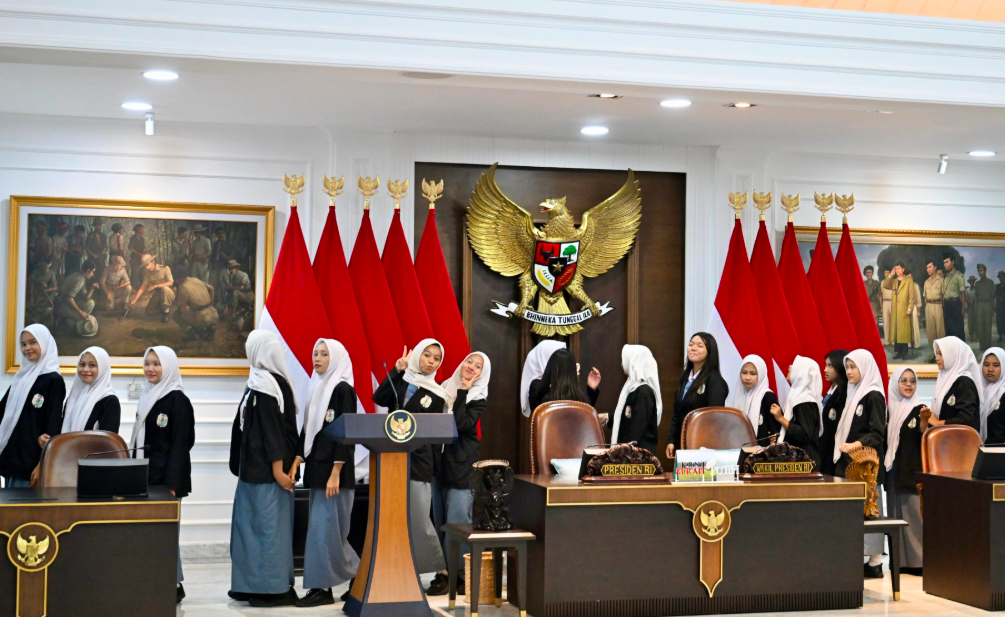
President Prabowo Subianto opened access to the Presidential Palace for students through the Presidential Palace for School Students programme on Tuesday (7/4). This policy is positioned as part of the government’s long-term investment in shaping the quality of human resources from an early stage.
Cabinet Secretary Teddy Indra Wijaya stated that the step complements various ongoing priority education programmes, from fulfilling nutrition to improving teacher welfare.
“One of the President’s biggest programmes is investing in building and shaping the young generation. There is nutritious meals, school renovations, toilets, we install digital learning TVs. Then there is people’s schools, integrated schools, Garuda schools, incentives and welfare for teachers and so on. Today we open the palace for school children for the nation’s successor generation,” he said.
Through the programme, students are not only invited to visit but also introduced directly to the state governance process. They tour strategic rooms and participate in discussions to understand how national decisions are made.
“We invite them to see the palace, we invite them to see the places where this nation’s big decisions have been made. For what? To give them the desire to aspire as high as possible for this nation,” he explained.
The government plans to expand the programme to all Presidential Palace complexes in various regions to reach more students, including those from outside Java Island.
“We have eight, later each palace we will also open for school children. For those outside Jakarta or also outside Java Island, they will be facilitated to come here,” Teddy clarified.
He added that no selection mechanism is applied to keep access open. “For the selection, there is none. So please register as I mentioned earlier, then it will be arranged by the organisers,” he said.
The opportunity was immediately welcomed enthusiastically by the students who had the chance to arrive early. For many pupils, the visit became their first experience seeing the Palace from the inside.
“I’m so happy, I can know what the inside of the Palace is like, and the functions of each room are so different, and I can learn more deeply about the environment here,” said Kayla Annisa Maulida, a student from SMKN 19 Jakarta.
Ine Ratriana Pertiwi had a similar experience and was impressed by the atmosphere and interactions in the Palace environment. “For me, the first visit here was really fun, satisfying, and the staff here are all cool, really kind. And here there is so much history of Indonesia from before independence until now,” she said.
The students also admitted to gaining new insights into history and state activities that they previously only knew from books or media. “There are lots of documentaries too. It’s really cool,” added Ine.
Meanwhile, Wahyu Khoirul Setiawan said the visit opened his understanding of the functions of the rooms in the Palace. “I feel very happy because it’s my first time at the Presidential Palace,” he said.
From an educational perspective, the visit is considered to provide an irreplaceable learning experience. Christine Rambing, a teacher from SMKN 19 Jakarta, assessed that the activity brings concrete understanding about bureaucracy and government.
“Our children get education related to bureaucracy in government, especially in the State Secretariat. Our friends, the teachers too, are very happy. Our children also feel very happy that we were given the first for this activity,” she said.
According to her, the activity, which was initially expected to be just a discussion, developed into a direct exploration experience. “We followed and beyond expectations, we were taken on a room tour to see the conditions of the State Palace environment that we had never entered before, finally we got inside too, room by room and we got education,” she said.
She assessed that this direct interaction makes students better understand how public policies are implemented, while also providing space for them to express aspirations.
Christine also revealed that the school’s participation did not happen by chance, but through active efforts to seek information and register. “It just so happens there is an activity from the programmes where staff come to the school. Well, we got information from there. Finally, we followed up whether every activity carried out by the Cabinet Secretariat can include us,” she explained.