
President Prabowo's Economic Speech and Indonesia's Labour Market Future
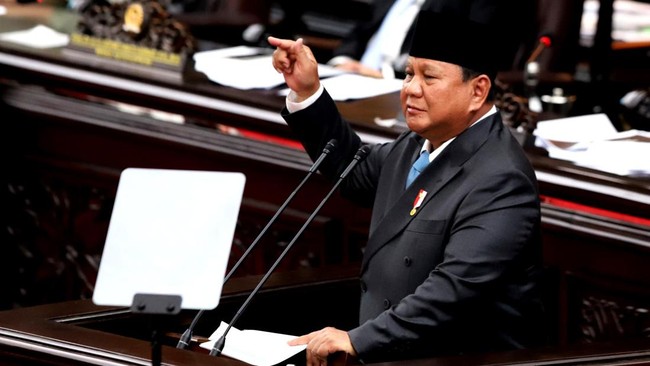
President Prabowo Subianto’s Economic Address in the Plenary Session of the House of Representatives on the Macro Economic Framework and the Main Principles of Fiscal Policy of the Draft State Budget for 2027, held on 20 May 2026, provides an important picture of the direction of Indonesia’s economic development.
One of the interesting parts of the speech is the inclusion of labour market indicators into the macro framework, particularly the target to reduce the open unemployment rate from around 4.44%-4.96% in 2026 to 4.30%-4.87% in 2027, and the target to raise the share of formal employment creation to 40.81 percent by 2027.
These targets show that the government not only seeks economic growth but also begins to place the creation of formal employment as a key metric of development success.
However, the targets are not light. BPS data show the open unemployment rate in February 2026 still at 4.68%, with 147.67 million people employed and an average worker wage of Rp3.29 million per month.
At the same time, informal workers still total 87.74 million or 59.42 percent of the employed population (BPS, 2026). In other words, although unemployment continues to decline, the structure of Indonesia’s labour market remains heavily dominated by informal employment.
Therefore, the main issue is not merely how to reduce unemployment, but how to ensure that the jobs created are formal, productive, protected, and decent.
In other words, success in 2027’s targets should be measured not only by how many people are employed, but also by the quality of the jobs they obtain.
The first prerequisite is industrialisation that truly creates broad employment. The President’s speech places downstreaming and industrialisation as the engine of economic transformation. In theory, this strategy can boost demand for manufacturing workers, technicians, operators of modern industry, engineers, and workers with digital skills.
However, in the last five years, Indonesia’s labour absorption structure has shown heavy dependence on sectors with relatively low productivity. In February 2026, the agriculture, forestry and fishery sector remained the largest absorber of labour, with 42.49 million people or 28.78 percent of the total employed population (BPS, 2026).
This condition shows that structural transformation of the labour market has not moved quickly enough. If industrialisation relies only on capital-intensive downstream sectors, such as smelters, mineral processing, or electric vehicle battery industries, its impact on labour absorption could be limited.
The risk is that industrialisation increases output and exports but does not sufficiently reduce unemployment or expand formal employment. Therefore, the downstream agenda needs to be complemented by the development of labour-intensive modern industries, agro-industry, food and beverage industries, mid-technology textiles, light electronics, and a domestic supply chain capable of absorbing more workers.
The second prerequisite is realistic and gradual formalisation of the labour market. The target to increase the share of formal employment creation to 40.81% by 2027 is quite ambitious compared with current conditions. In February 2025, informal workers accounted for around 59.40% of total workers, and in February 2026 remained at 59.42% (GoodStats Data, 2025).
In other words, over the past two years, the informal structure has not shown a meaningful decline. This indicates that formalisation cannot be achieved by growth alone. Many informal workers are in micro-enterprises, agriculture, small trading, personal services, informal transport, and platform work.
They do not automatically transition to formal workers simply because the economy grows. More targeted policies are needed: simplification of micro-enterprise legality, incentives for SMEs to employ workers formally, expansion of social insurance coverage, and productivity support for small businesses so that they can pay higher wages and provide better job protections.
The third prerequisite is reforming the skills of the workforce. Industrialisation and formal employment require workers with appropriate skills. However, in the last five years, Indonesia has still faced a mismatch between education, skills, and industrial demand.
Unemployment remains relatively high among those with intermediate education and youth. Data on unemployment by education level shows that the problem is not only about low education but also the mismatch between graduates and labour market needs.
Therefore, vocational education, on-the-job training, reskilling, and upskilling must be central to the strategy to achieve the 2027 target. Without this, Indonesia could face a paradox: industrial investment rises, yet local labour is not fully absorbed because it does not meet the required competencies.
In the short term, sector-priority, needs-based training should be expanded. In the medium term, vocational education curricula must be more closely aligned with industry, especially in the manufacturing, agro-industry, energy, logistics, digital, and modern services sectors.
The fourth prerequisite is improvements in job quality, not merely changes in formal status. This matters because formal jobs are not automatically decent if wages are low, working hours are unstable, social protection is weak, and productivity is low.
BPS recorded the average monthly wage for workers in February 2026 at Rp3.29 million, up from Rp3.09 million in February 2025. But this average conceals large variations.