
President Prabowo Requests Cabinet Ministers to Study Fuel Savings and Work-from-Home Policies
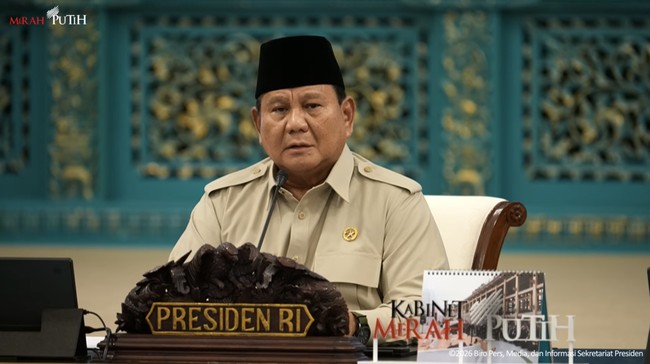
President Prabowo Subianto has instructed members of the Red-and-White Cabinet to examine policies relating to fuel consumption savings and work-from-home arrangements as a precautionary measure should conflicts in the Middle East continue to escalate.
This was announced by President Prabowo during a full Cabinet session at the State Palace on Friday, 13 March 2026.
During his remarks, President Prabowo stated that fuel prices could affect many areas, such as food supply, and that this issue must be resolved with accelerated and proactive steps, namely fuel conservation.
According to him, the government should not assume that developments abroad do not impact the nation’s conditions. The government must also anticipate ways to reduce fuel consumption.
“We face developments occurring globally in the European and Middle Eastern regions, and this of course has an impact on us as it will affect fuel prices. Fuel prices can also affect food prices. We are grateful that we have secured the fundamental food issue, but for the fuel matter, we actually already have plans that we will accelerate. However, we must certainly take proactive steps—that is, we must reduce fuel consumption. We cannot assume that we are safe regardless of what happens if we make no effort to reduce our fuel consumption. Many countries have already taken such steps,” Prabowo said during the full Cabinet session at the State Palace on Friday, 13 March 2026.
Prabowo noted that many countries have already implemented fuel conservation measures. He cited the policy applied by Pakistan as an example.
The General Chair of the Gerindra Party even presented slides showing the measures Pakistan has taken in response to global oil price volatility.
“This is merely for comparison, so they regard this as critical, hence the term ‘critical measures,’” Prabowo explained.
He explained that Pakistan implemented policies similar to those during the COVID-19 pandemic, where private and government offices applied work-from-home policies for 50 per cent of their employees. Additionally, working hours were reduced to just four days per week.
“They even reduced salaries for cabinet members and parliamentary members, and all these salary savings were collected to assist the most vulnerable and weakest groups,” Prabowo said.
Additionally, Pakistan also implemented policies to cut fuel availability or consumption for all ministries and required 60 per cent of government vehicles to remain unused daily.
“They then halted all air conditioning purchases, vehicle purchases, furniture purchases from all government institutions for an indefinite period,” he said.
These measures included reducing official visits and not using government budgets for celebrations, including implementing online learning across all higher education institutions.
However, according to Prabowo, these measures could be examined by his team for implementation domestically.
“I believe we must endeavour to reduce consumption. I am confident that in two to three years we will be very strong, but we must conserve. Thus, we hope that we will always ensure our deficit does not increase. In fact, my aspiration is that if possible, we have no deficit at all,” Prabowo said.
Fuel Conservation Policies of Various Asian Nations
It should be noted that several countries, particularly in the Asian region, have issued various policies to secure oil supplies mainly sourced from the Middle East and to mitigate risks should war in the Middle East persist. Below is a summary of policies from several Asian countries:
China
China, which possesses the world’s largest onshore oil reserves, has reportedly received millions of barrels of oil from Iran since the war began. These large reserves give the country a temporary buffer against global supply disruptions.
India
India has reportedly increased oil imports from Russia following temporary sanctions exemptions granted by the United States. However, reports also indicate that hot food and beverages have begun disappearing from various menus across different regions of India due to concerns about fuel shortages for cooking.
Japan
In Japan, the government is utilising large strategic reserves to address the crisis. The country has approximately 350 million barrels of oil reserves and has released approximately 80 million barrels, equivalent to 45 days of supply.
This move was part of the largest coordinated energy reserve release ever coordinated by the International Energy Agency.
However, the relatively stable conditions in some major Asian economies are not being experienced by many other countries in the region.
South Korea
President Lee Jae Myung stated that his country is heavily dependent on global trade and energy imports from the Middle East.
He announced the first domestic fuel price cap in nearly three decades to curb the impact of rising energy prices.
Thailand
In Thailand, the national fuel fund is spending tens of millions of dollars daily to keep fuel prices low through consumer subsidies.
Thai Commerce Minister Suphajee Suthumpun urged the public not to panic and stated that the government has prepared various scenarios “to address any potential impacts”.
The government has also encouraged civil servants to adopt remote work arrangements and postpone non-essential travel.
Bangladesh
The Bangladesh government has begun implementing fuel sales rationing to prevent panic buying. All universities have also been closed in an effort to preserve national energy supplies.
The military has been deployed to major oil depots, whilst police have been stationed at petrol stations.
Myanmar
The military government in Myanmar has imposed fuel rationing and banned certain activities.