
President Chooses to Visit the Mountain of Rubbish
Replicating a model does not mean copying its infrastructure, but rather understanding why Banyumas succeeded and then translating that logic into a different context.
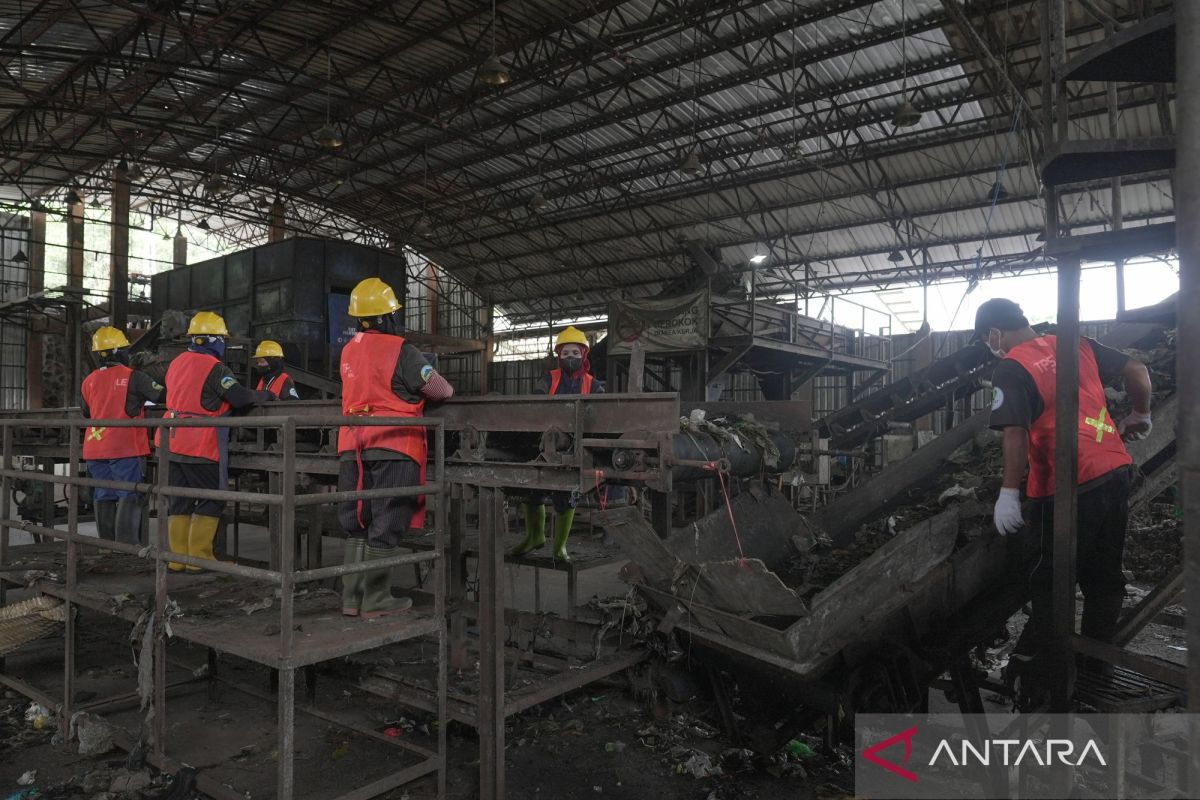
Jakarta (ANTARA) - The rubbish is transported on conveyor belts, ascending towards even larger machines. The large machine, spinning rapidly inside, separates the rubbish into two different streams: organic and plastic.
In another corner of the same facility, black soldier fly larvae break down leftover rice and vegetables into animal protein. In yet another area, the plastic sheets are shredded and melted into a sticky liquid, which is then moulded into hard roof tiles and paving blocks.
President Prabowo Subianto witnessed these processes at the Integrated Waste Processing Facility with Environmental and Educational Insight (TPST BLE) Wlahar Wetan, Banyumas Regency, on 28 April.
It felt odd when the head of state visited a place with towering hills of rubbish, after which his aides eventually provided masks for the President to wear.
“Rubbish, waste processing, is now a national priority. In two or three years, we must control the waste across all of Indonesia,” said Prabowo.
The President’s statement was firm on this continuously accumulating environmental issue. Prabowo emphasised that waste management has been set as one of the national priorities that must be handled in a structured manner, and the Banyumas model, which has successfully reduced waste by up to 80% before it reaches the final processing site, will be used as a blueprint for national implementation.
Indonesia produced 27.74 million tonnes of waste in 2024, equivalent to 76,000 tonnes per day. That is not just a large number. It is a mountain of rubbish that keeps growing every day, every year, and the statement that the current waste management system is no longer adequate.
The “collect-transport-dump” model, which has been the concept for waste management workers in almost all regions so far, has caused most Final Processing Sites (TPA) to bear a burden exceeding their capacity.
The national waste composition further complicates the problem. Data from the National Waste Management Information System (SIPSN) shows that the proportion of plastic waste has risen from 15.88% in 2019 to 19.65% in 2024.
Plastic is difficult to break down and is not absorbed by conventional recycling industries if its quality is low. And, in the worst-case scenario, it ends up in the sea.
Indonesia is still recorded as one of the largest contributors to marine plastic waste in the world. The government is responding to this situation with an ambitious target: to control the waste problem by 2029 with a zero waste concept.
The TPST BLE in Banyumas is not an ordinary place if it is visited by the President. This regency in Central Java provides an example of waste management carried out in an integrated manner from infrastructure, technology, community, and market, which can be integrated into one mutually supportive system.
The core of this model is the TPST operated in a decentralised manner at the sub-district and village level by Community Self-Help Groups (KSM). At TPST Kedungrandu, for example, this facility serves more than 3,100 customers with a processing capacity of 15 tonnes per day.
The key to its efficiency is the automatic waste sorting machine known as the “gibrik” machine, the machine described at the beginning. This is a local innovation that replaces manual sorting, separating organic and inorganic waste with high capacity in a more hygienic process.
Inorganic waste, especially low-value residual plastic like plastic bags and packaging wrappers that are not absorbed by conventional recycling, is directed to the Refuse Derived Fuel (RDF) pathway. This process includes sorting, shredding, and biological drying until the waste reaches a sufficient calorific value to be used as industrial fuel.
Waste processing products