
Premium Packaged Cooking Oil Prices Begin to Rise, Retail Boss Reveals This
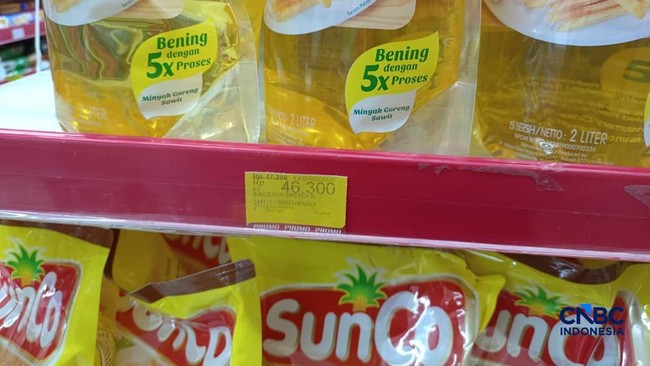
Prices of premium packaged cooking oil in modern retail outlets have been observed to rise in recent times. Based on monitoring at several minimarkets in the Setiabudi area, South Jakarta, the price of 2-litre cooking oil is now sold at a higher rate, while stocks of certain sizes, particularly 1 litre, are starting to become limited.
At Alfamart outlets, Sunco brand 2-litre cooking oil is priced at Rp46,300, while Tropical is sold for Rp45,400. At Indomaret, Sunco 2-litre reaches Rp47,000 and Bimoli Rp45,500. Meanwhile, 1-litre packaging is reported to be increasingly difficult to find at several outlets.
In response to the situation, Chairman of the Indonesian Retail Entrepreneurs Association (Aprindo) Solihin emphasised that modern retail basically only sells products and has no control over prices from the upstream side.
“Here’s how it is, let me explain first. Modern Retail, which is currently a member of Aprindo, only sells goods, it does not produce goods,” Solihin told CNBC Indonesia on Tuesday (21/4/2026).
He explained that the selling price in retail greatly depends on the price set by producers, distributors, or suppliers, then added with a standard margin that is relatively limited.
“So that means if the distributor or supplier gives us a price, we have an average standard margin, so it depends on the distributor or supplier, because we don’t produce. So if the distributor offers a certain amount, we have a standard margin of 5% or 10%, well, from the price we buy, we increase it by 10% to become the selling price,” he clarified.
According to him, the current rise in premium cooking oil prices indeed comes from the producer or distributor side, not from retail policy. Moreover, premium cooking oil is not included in the category regulated by the Highest Retail Price (HET).
“Coincidentally, premium oil is not regulated in the HET,” he said.
He emphasised that retail only follows the prices that have already been adjusted by suppliers.
“Yes, that’s right, and now several products have this condition, the prices have already been adjusted… adjusted, yes, we just accept what they offer, with the addition of the standard retail margin, like that. So that’s how our selling price becomes,” he continued.
Regarding the factors for the price increase from the upstream side, Solihin acknowledged the presence of cost pressures, including from raw materials for packaging such as plastic. “Yes, that’s right,” he said briefly.
On the other hand, he assured that retail does not have a strategy to hoard stock in large quantities to anticipate price increases. The available stock is generally only a short-term buffer.
“So Aprindo members do not have the idea to stock goods, the stock that exists now is more for things that are indeed buffer stock,” Solihin explained.
“Generally, buffer stock can be assumed, the assumption of buffer stock that retail has is between 14 days to a maximum of 28 days,” he continued.
He emphasised that retail cannot hold stock too long due to cash flow limitations. “We can’t (if held longer), because we have to pay for the goods after 14 days or 28 days, so we don’t want to risk our cash turnover. It would be problematic if we stock too much,” he stated.
Furthermore, Solihin also mentioned that retail does not have enough bargaining power to ask suppliers to raise prices gradually to maintain consumer purchasing power.
“Almost on average, in this context, we don’t have the strength for that. It’s always based on what is offered by the distributors or suppliers,” said Solihin.
Nevertheless, he acknowledged that suppliers generally still provide notice before price increases are implemented.
“And usually, if suppliers in certain conditions have to raise prices, they don’t do it suddenly, usually they inform that on such and such date there will be an increase,” he explained.
In the end, he emphasised that market mechanisms remain the determinant of whether products with the new price can be accepted by consumers or not.
“Yes, and then it will be reflected in the repeat order, whether with that price the product sells or not, it will be visible. It comes back to the consumers later, like that,” Solihin concluded.
Daily Movement of Premium Packaged Cooking Oil Prices
Based on data from the Market and Basic Needs Monitoring System (SP2KP) of the Ministry of Trade as of 21 April 2026, the national price of premium packaged palm cooking oil was recorded at Rp21,796 per litre. This price rose 0.19% compared to yesterday, 20 April 2026, which was at Rp21,755 per litre.
Meanwhile, compared to a week ago, or as of 17 April 2026, the premium packaged cooking oil price was at Rp21,712 per litre, or an increase of 0.39% from today’s price.
On a monthly basis, compared to 2 March 2026 (Rp21,094 per litre), the price has also increased by around 3.13%.
On a yearly basis (year-on-year), the price of premium packaged cooking oil has risen significantly. On 21 April 2025, the price was recorded at Rp20,875 per litre, 4.41% lower than the current position of Rp21,796 per litre.
This means that over the year, the price of premium packaged cooking oil reflects a continuing upward trend. This increase aligns with the trend in the field, where prices in modern retail have also undergone adjustment.