
Praising Bali, Environment Minister Hanif Orders Complete Halt to Open Dumping Landfills
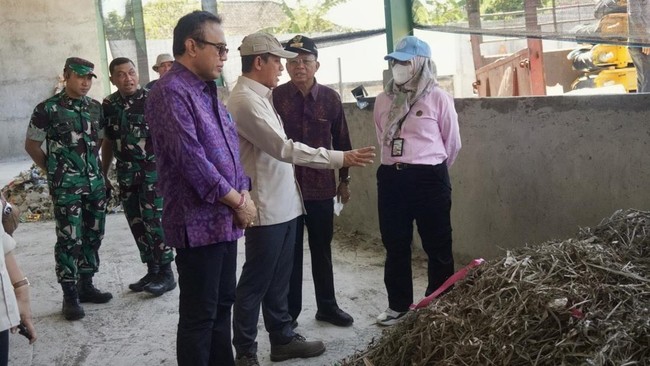
Jakarta, CNBC Indonesia - The Minister of Environment and Forestry/Head of the Environmental Control Agency (MenLH/Head of BPLH) Hanif Faisol Nurofiq has ordered all cities and regencies to halt the practice of TPA (Tempat Pemrosesan Akhir), which is the conventional waste management method where rubbish is piled or spread out and left exposed without soil cover, processing, or environmental safeguards.
This practice must cease completely by August 2026. Hanif stated that this policy stems from the RPJMN and refers to Presidential Regulation No. 12 of 2025, which targets a national waste processing rate of 63.49%.
“To that end, I urge all regional heads to take steps by strengthening waste management from upstream, namely sorting waste at the household level, waste processing based on waste-to-energy, and improving TPST and TPS3R facilities,” said Hanif, quoted from a post on his official Instagram account on Monday (20/4/2026).
According to the official website of the Ministry of Environment (KLH)/BPLH, by the end of 2025, around 30% of the total 485 TPAs have stopped open dumping practices. Thus, approximately 369 TPAs still need to transform immediately, including those in Bali Province.
It is mentioned that KLH/BPLH together with the Bali Provincial Government (Pemprov) are strengthening the commitment to end open dumping practices through the Declaration to Halt Open Dumping Landfills in Bali Province.
Furthermore, in a statement on the official KLH/BPLH website, Hanif explained that this step is part of transforming the waste management system from a collect-transport-dispose pattern to management based on reduction at source, sorting, and sustainable processing.
“The cessation of open dumping must go hand in hand with increased sorting at source. This target can only be achieved if open dumping practices are stopped and the community sorts waste. Waste can no longer be handled through the collect-transport-dispose pattern, but must be managed from the source,” he emphasised.
Hanif also highlighted the steps taken in Bali and praised the achievements there as a leap in changing community behaviour in a relatively short time.
“I see very rapid changes in Bali. More than 60 percent of the community has carried out waste sorting. This is a very good achievement that needs to be maintained through consistent rule enforcement,” said Hanif.
He added that the government is also continuing to encourage the strengthening of waste processing facility capacity, including TPST and TPS3R, as well as organising a region-based distribution system to improve waste quality as a prerequisite for developing waste-to-energy technology in the future.
“Law enforcement will be carried out strictly and evenly across all regions as part of national efforts to comprehensively address the waste problem, while building a responsible waste management culture in society,” said Hanif.