
Prabowo’s 6-Hour Roundtable Opens Rare Window Into Indonesia’s Policy Thinking
President publicly defends free meals, Board of Peace, and growth strategy in an unusually open discussion with critics
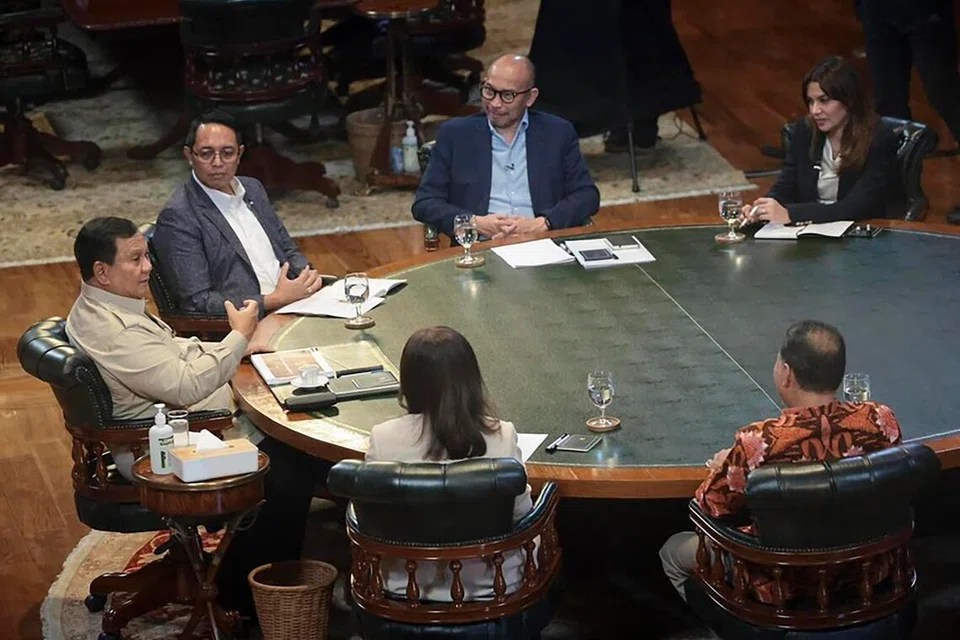
President Prabowo Subianto has taken an unusually direct approach to defending his administration’s policies, using a marathon roundtable with economists, journalists, and commentators to explain his views on free meals, Gaza, and Indonesia’s growth strategy. The discussion, which lasted more than six hours and was later released on YouTube, is being seen as one of the most open public-facing exchanges of his presidency so far.
A Rare and Unusually Open Presidential Forum
The roundtable brought together six invited guests, including economists, a political scientist, journalists, and a podcast host, and allowed them to question Prabowo directly on a wide range of issues. According to current reporting, the President opened the discussion with a blunt invitation: “Go ahead, ask me anything.” The session was held at his Hambalang residence on March 17 and later aired publicly on March 19 and 20.
That matters because analysts described the format as unprecedented for Prabowo’s administration. Rather than relying on one-way official messaging, the event gave the public a long and unusually candid look at how the President is trying to justify controversial or expensive policy choices.
Prabowo Strongly Defended the Free Meals Program
One of the most heavily scrutinized topics was the Free Nutritious Meals program, known as MBG, which has been budgeted at Rp335 trillion for 2026. Prabowo said he would defend the program “as much as I can,” arguing that it is necessary because he has personally seen the effects of child malnutrition and stunting in rural areas.
He also acknowledged operational flaws in the program, including poor-quality kitchens and food safety problems, but said the government had already shut down more than 1,000 substandard kitchens out of 25,000. That position is consistent with his broader stance this month that MBG remains a protected flagship policy even under fiscal and oil-price pressure.
He Framed Board of Peace Membership as Strategic, Not Symbolic
Prabowo also used the discussion to defend Indonesia’s participation in Donald Trump’s Board of Peace, saying Jakarta joined because being inside the initiative gives it influence over Gaza-related decisions. He said Indonesia retains the right to withdraw if the board fails to deliver benefits for Palestinians or for Indonesia.
He reiterated that Indonesia had committed peacekeeping personnel rather than a US$1 billion payment for permanent membership, a point he clarified separately in a presidential statement this week. His argument was that joining the BOP was a calculated move aligned with Indonesia’s support for a two-state solution and civilian protection in Gaza.
The 8% Growth Goal Was Challenged Directly
Economist Chatib Basri reportedly questioned whether Indonesia can realistically raise growth to 8 percent by 2029 from a trend rate closer to 5 percent. The criticism centered on Indonesia’s high incremental capital output ratio, meaning the economy requires unusually high investment to generate each unit of growth.
Prabowo responded by pointing to education and infrastructure spending, including the distribution of digital learning panels to hundreds of thousands of schools and large-scale school renovation plans. He also outlined plans to stimulate coastal economies, including the distribution of more fishing vessels starting in 2027. The exchange showed that the President is willing to publicly defend his growth model, but it also highlighted that expert skepticism remains strong.
Communication Style May Be Changing, but the Real Test Is Follow-Through
Some observers praised the discussion as a refreshing change in government communication, arguing that more open engagement can strengthen policy legitimacy during a period of global instability and domestic pressure. But others said the value of such forums depends on whether criticism actually affects policy decisions.
That is the real significance of the roundtable. For Indonesians, it may signal a more experimental communication style from Prabowo, one that allows public testing of major policies like MBG and BOP membership. For Singaporeans and regional observers, it offers a clearer look at how Indonesia’s leadership is thinking under pressure, especially on spending, foreign policy, and growth targets.
Prabowo’s six-hour roundtable was unusual not just because it was long, but because it exposed the internal logic of some of Indonesia’s most contested policies. He made clear that he sees the free meals program as politically and morally non-negotiable, and the Board of Peace as a strategic tool rather than a diplomatic liability. Whether the session marks a lasting shift toward more open policy engagement will depend on what happens after the cameras are off.
Sources: Straits Times (2026) , The Star (2026)
Keywords: Prabowo roundtable March 2026, Indonesia free meals defense, Board of Peace Indonesia, Prabowo Ask me anything, Indonesia 8 percent growth plan, Prabowo policy discussion