
Prabowo-Trump Trade Agreement Not Seen as Damaging to National Industry, Here's Why
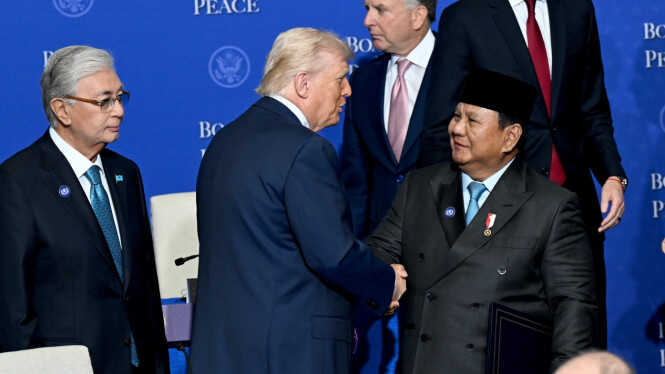
The trade agreement between Prabowo and Trump is not considered to be detrimental to the national industry, according to economist Salamuddin Daeng. He views the Agreement on Reciprocal Trade (ART) between Indonesia and the United States as a normal occurrence in the trade relations between the two countries. According to him, such trade agreements are not new.
“We have signed and ratified similar agreements regionally to liberalize the market broadly, comprehensively, and fundamentally in the regional area, such as the ASEAN Free Trade Agreement (AFTA), followed by the ASEAN China Free Trade Agreement (AC FTA),” said Salamuddin in a statement in Jakarta, Wednesday, February 25, 2026.
Salamuddin said that the ASEAN-China Free Trade Agreement (AC-FTA), signed in 2002 and implemented in 2010/2012, is actually a much broader agreement, including an agreement eliminating tariffs on more than 90% of trade between ASEAN and China.
In October 2025, this agreement was modified to include agreements covering the digital economy, green economy, and supply chain connectivity.
According to Salamuddin, the Prabowo-Trump agreement is simply a continuation of the GATT 1994 agreement as stated in the considerations of this agreement. Donald Trump wants to take the same opportunity as China and the European Union (EU) to enter large markets such as Indonesia.
In turn, Prabowo also wants to take the opportunity to enter the large American market with our national industrial products.
“In fact, Indonesia has long been involved in multilateral international trade agreements that are legally binding, such as the World Trade Organization (WTO),” said Salamuddin.
Salamuddin, who was formerly a researcher at the Institute Global Justice (IGJ), views the Prabowo-Trump agreement as a better agreement because it is done bilaterally. If it is a bilateral agreement (involving only two countries), it is possible to renegotiate it at any time if it turns out that the agreement is detrimental.
“This is different compared to regional agreements such as AFTA, AC-FTA, and multilateral agreements such as WTO, which are difficult to renegotiate because they are legally binding and involve many countries,” said Salamuddin.
Salamuddin explained that the Prabowo-Trump trade agreement is also better because it does not have a detrimental impact on national industrial products and MSMEs. If compared to the impact of the AFTA and AC-FTA agreements, which in several studies actually harmed national industries and MSMEs.