
Prabowo Refuses to Increase National Debt, 40% Ratio Won't Be Exceeded!
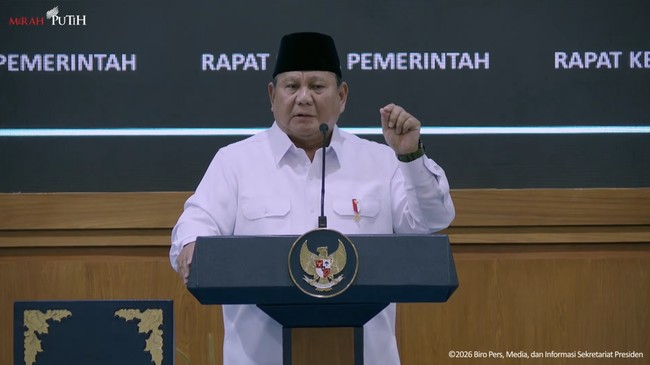
President Prabowo Subianto has assured that the government will not recklessly add new debt, even as the state’s spending needs grow larger. This is particularly in response to economic pressures caused by the war in the Middle East, which temporarily drove up global oil prices and increased the need for energy subsidies in the 2026 state budget. Coordinating Minister for the Economy Airlangga Hartarto stated that during yesterday’s government working meeting at the State Palace on Wednesday (8 April 2026), President Prabowo Subianto instructed his ministers to keep the debt-to-GDP ratio and the state budget deficit within the limits set by the State Finance Law. “The President is committed to maintaining the debt ratio at 40% level even though the law allows up to 60%, and similarly the budget deficit at 3%. This will be maintained until the end of the year,” Airlangga said at a press conference after the meeting, quoted on Thursday (9 April 2026). For information, the Ministry of Finance recorded total government debt at Rp9,637.9 trillion in 2025. This pushed the debt-to-GDP ratio to 40.46%. Deputy Chairman of the National Economic Council (DEN) Mari Elka Pangestu assessed that a debt ratio of 40.46% of GDP is actually relatively low compared to many other countries, especially advanced ones that are over 100%. What needs attention, according to Mari, is the debt service ratio (DSR). DSR is a financial ratio that measures the ability of individuals or businesses to pay debt instalments compared to total net monthly income. “We can’t assess debt management just from the debt-to-GDP ratio. We also have to look at the debt service ratio. So how much of our budget is absorbed for paying interest, for example, in revenue,” she explained when met after the launch of the official DEN website on Friday (13 February 2026). On this occasion, she reminded that debt should not be viewed negatively. She urged the public to see debt in terms of its use for economic development. “So don’t view debt as something negative. All countries borrow. The important thing is that the debt is used to generate growth so it can be repaid,” she said. Not only that, Mari emphasised the important next step is efforts to increase revenue, both through expanding the tax base or improving tax administration. This is crucial homework. “Important homework. Beyond that, of course, the expenditure side. We already discussed government spending that can be more efficient,” she explained.