
Prabowo on Indonesia's Political Stance in Middle East Conflict: Non-Aligned and Active
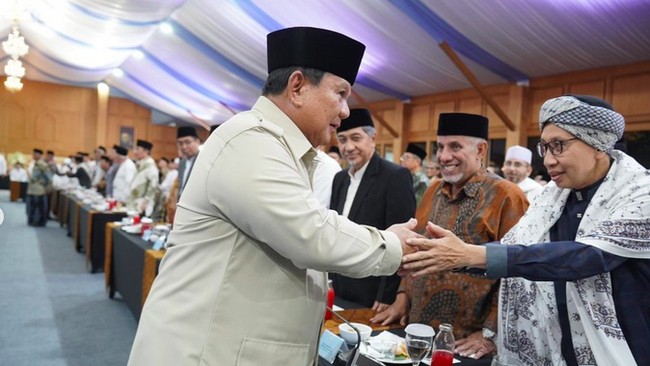
Jakarta — President Prabowo Subianto has addressed the increasingly volatile global geopolitical situation, particularly in the Middle East, whilst inaugurating 218 bridges across various regions in Indonesia on Monday, 9 March 2026.
In his remarks, Prabowo warned that the world faces profound uncertainty due to conflicts involving major powers. He assessed that wars occurring in various regions could impact many nations, including Indonesia.
“Wars are breaking out everywhere, in almost every region of the world, particularly in the Middle East,” Prabowo said.
He referenced major conflicts in Europe, such as the ongoing Russia-Ukraine war, and noted that tensions are escalating across nearly the entire Middle East region.
According to Prabowo, these developments will ultimately affect Indonesia, despite its geographical distance.
“Although we are geographically far away, the world has effectively become smaller. What happens in one region will influence another,” Prabowo stated.
Indonesia to Maintain Non-Aligned Stance
Amid these conflicts, Prabowo emphasised that Indonesia remains committed to maintaining a non-aligned, active foreign policy that does not favour any bloc of powers. This principle, he explained, enables Indonesia to preserve stability and coexist peacefully with diverse groups and nations.
“We maintain a non-partisan, active, non-bloc position. We respect all powers, we respect all nations,” he said.
Prabowo noted this stance is reflected in the national motto “Bhinneka Tunggal Ika” (Unity in Diversity), which Indonesia applies both domestically and internationally.
“Bhinneka Tunggal Ika applies domestically, but also internationally we respect all nations, all religions, all races, all ethnic groups. This is what allows Indonesia to currently enjoy peaceful conditions. We can coexist with hundreds of ethnic groups in harmony,” he said.
Tackling Corruption and State Revenue Loss
During the event, Prabowo also stated that the government will not hide behind regulations or existing systems. He affirmed the government’s determination to overcome all difficulties and will not ignore the impact of the Middle East conflict that must be confronted.
Prabowo noted that whilst Indonesia possesses considerable strength, it has governance shortcomings including corruption and abuse of authority.
He attributed state revenue leakage to collusion between officials and unscrupulous business owners.
“I must reiterate that we must combat corruption at every level. Corruption, abuse of authority, fraud, collusion with unscrupulous businessmen — these cause state revenue to leak away. This results in the loss of wealth that we could use to face any disaster,” Prabowo said.
Indonesia Optimistic About Managing Crisis
Prabowo stated that Indonesia must be prepared to withstand the economic shocks resulting from Middle East conflicts.
“Frankly, we must be ready to face difficulties,” Prabowo said.
However, he expressed pride in witnessing evidence of unity within the Indonesian National Armed Forces (TNI), which serves the people. This was demonstrated through the construction of 218 bridges completed in just 2.5 months with strong coordination.
Regarding resource capacity, Prabowo expressed confidence that Indonesia possesses considerable strength to manage the impact of conflicts. He has reviewed the latest data and the country’s resource potential.
The chairman of the Great Indonesia Movement Party highlighted the importance of food self-sufficiency, which has been pursued for several years. Currently, Indonesia has achieved rice self-sufficiency.
“In times of war everywhere, when fuel prices are soaring and could affect food prices, we are grateful that we are approaching complete food self-sufficiency. We have achieved rice self-sufficiency, where rice is our staple food,” he said.
Additionally, Indonesia is approaching self-sufficiency for protein needs, which strengthens the nation’s resilience during ongoing conflicts.
“Whatever happens, whilst many other nations will face difficulties, at minimum we are secure regarding food,” Prabowo said.
Regarding fuel shortages, efforts are also underway to achieve independence and reduce import reliance. These efforts involve downstream processing of agricultural products such as palm oil, cassava, corn, and sugarcane.
“Fellow citizens, we must work hard, we must be harmonious, we must unite to face this crisis,” he said.