
Prabowo Furious as Indonesia Trails Cambodia by a Wide Margin
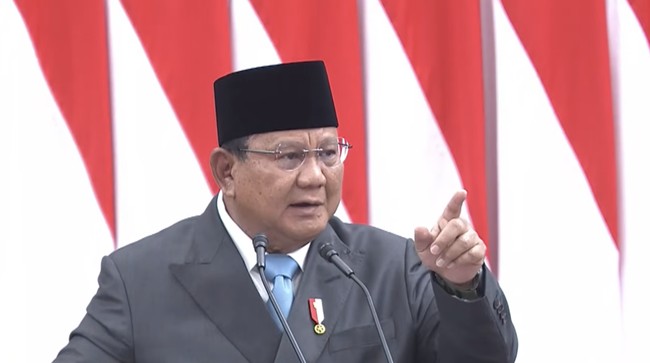
President Prabowo Subianto delivered a speech on the broad direction of Indonesia’s economic and fiscal policy at the 19th Plenary Meeting of the Indonesian House of Representatives on Wednesday, 20 May 2026. The speech was made as part of the introductory discussions for the 2027 RAPBN. Prabowo emphasised that the APBN is not merely a document of state finances, but a tool of struggle to protect the people, strengthen the national economy, and ensure that Indonesia’s wealth is truly enjoyed by its people.
Amid global geopolitical pressures, conflicts in several regions, and the risk of leakage of national wealth, the government stressed the need for stronger economic governance, particularly in the management of natural resources, exports, export earnings, food, energy, and industrialisation.
The government believes Indonesia possesses large wealth reserves, but the country’s ability to convert that wealth into fiscal revenue remains behind many other developing countries.
Prabowo began by outlining Indonesia’s export strengths. “Our market can be as large as Europe. And indeed our abundant natural resources. We have valuable communities. Our coal, our nickel, our copper, our palm oil, rare earths, and abundant marine wealth,”
He then detailed the foreign exchange earnings from Indonesia’s strategic commodities for 2025. According to Prabowo, foreign exchange earnings from palm oil exports reached US$23 billion, about Rp391 trillion. Coal exports yielded US$30 billion, about Rp510 trillion. Meanwhile, iron alloy exports reached US$16 billion, or about Rp272 trillion.
“These three strategic commodities generate foreign exchange worth more than US$65 billion equivalent to about Rp 1,100 trillion per year,” Prabowo said.
However, after outlining the scale of natural resource exports, Prabowo immediately highlighted a fundamental weakness for Indonesia: the country fails to collect revenue commensurate with the size of its economy.
“Today Indonesia, as a G20 member, has the lowest ratio of government expenditure to GDP among G20 countries. The same goes for our revenue-to-GDP ratio—it is the lowest among G20 nations,” he said.
The data in the speech come from IMF 2025. In that data, Indonesia’s government revenue-to-GDP ratio for 2024 was around 11%-12%.
That figure lags behind several other developing countries. Cambodia had already reached 15% of GDP. India is at the 20% level. The Philippines 21%. Mexico even 25% of GDP. Indonesia remains below Malaysia.
That gap has drawn attention because Indonesia has long been seen as a country with stable economic growth. Prabowo acknowledged that Indonesia’s economy has grown by around 5% per year over the last seven years. Cumulatively, that growth has reached about 35%.
“We should be 35% richer. But what has happened?” Prabowo said.
In his address, Prabowo repeatedly urged national elites to look at fiscal issues openly. He questioned why a country with vast commodity wealth remains behind in attracting government revenue.
“We must introspect, be honest with ourselves and our people, this may be painful for us. I felt, after receiving this data a few weeks after I became president, as if I were punched in the chest,” Prabowo said.
CNBC Indonesia Research