
Prabowo Explains BoP Diplomacy to Ulama
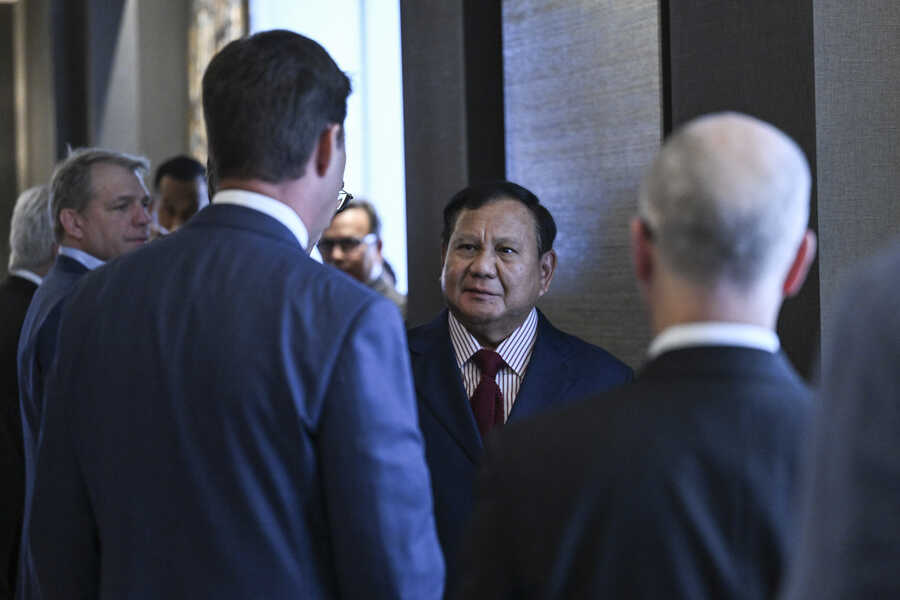
PRESIDENT Prabowo Subianto used a meeting with religious scholars and leaders of Islamic organisations to explain Indonesia’s diplomacy within the Board of Peace (BoP). The gathering at the Presidential Palace in Jakarta, on Thursday night (5 March), also served as a forum for discussion on global geopolitical dynamics, particularly the evolving conflicts in the Middle East.
Several figures attended the silaturahmi forum, including Muhammadiyah’s head of Economy, Business and Halal Industry Muhadjir Effendy, Minister of Agrarian Affairs and Spatial Planning Nusron Wahid, and Nahdlatul Ulama chairman Yahya Cholil Staquf.
Muhadjir explained that in the meeting, President Prabowo outlined the background to Indonesia’s decision to join the BoP forum. According to him, the decision was not made suddenly but rather through a long process of dialogue with several leaders in the Middle East region.
“So he emphasised that his involvement in BoP was not automatic, but had gone through a long process, having been discussed with a number of leaders in the region, especially in the Gulf, who then agreed to join,” he said.
He added that Prabowo chose a diplomacy from within the forum, or ‘struggle from within’. This approach, he said, remains in line with Indonesia’s constitutional principles and the commitment to a two-state solution for Palestine and Israel.
“So after for so long we have been outside, we are now trying to fight from within. And insha Allah, what he will do later will remain within the contours of our constitution, particularly in the preamble to our fundamental law, and then also remain committed to the original aim, namely the creation of two states that coexist peacefully, namely an independent Palestine and Israel,” he explained.
Muhadjir also emphasised that Indonesia’s support for Palestinian independence remains the government’s primary position.
“Therefore, going forward we must continue to work hard, whatever the risks or consequences, to realise a sovereign Palestine. This is articulated in the twenty-point agreement, points 19 and 20 which state clearly that BoP’s aim is the creation of a Palestinian state that coexists with Israel. I think that is our guiding principle, hence all the religious scholars and leaders fully agreed with what the President has conveyed,” he continued.
Meanwhile, Nusron stated that the government remains open to public criticism regarding Indonesia’s involvement in the BoP, but diplomacy remains the main strategy to ease the conflict.
“If someone suggests otherwise, the government is not anti-criticism; we listen and assess the situation, but we will prove on the ground that diplomacy is the best path to peace, not war,” he said.
A similar view was expressed by Yahya Cholil Staquf. He noted that Indonesia’s presence in BoP could be used to press for de-escalation of the Middle East conflict, including the tensions between Iran, the United States, and Israel.
“If necessary, for example Indonesia could state that BoP agendas are on hold until talks for de-escalation and peace in the US-Israel war against Iran take place,” he said.
He considered the forum as potentially an instrument for broader peace efforts in the region.
“All of that could become an instrument to make BoP a venue that drives de-escalation and peace from the war currently ongoing related to Iran,” he added. (E-4)
The Front Pembela Islam (FPI) movement published a letter to President Prabowo Subianto requesting Indonesia withdraw from the Board of Peace (BoP).
PRESIDENT Prabowo Subianto again reaffirmed Indonesia’s commitment to membership in the Gaza Peace Council or Board of Peace (BoP).
The Israel-US confrontation with Iran has some impact on Indonesia, both domestically and internationally.
He cited a number of fundamental questions that remain unanswered, such as disarmament mechanisms and who would carry out operations on the ground.
The Israeli military strike against strategic Iranian targets on 28 February 2026 was described as a spark striking tinder.”