
Powell Era Ends Tonight: What Fed Policies Shook the World?
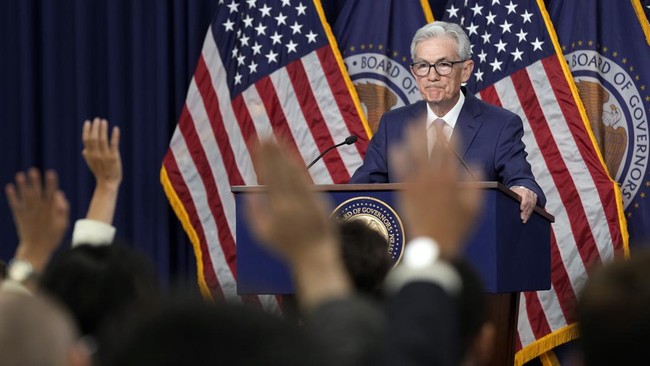
Jakarta, CNBC Indonesia - The Chair of the United States Federal Reserve (the Fed), Jerome Powell, is set to end his term on 15 May 2026.
Prior to that, Powell is scheduled to lead the Federal Open Market Committee (FOMC) meeting on 28-29 April 2026. This meeting will be Powell’s last as Fed Chair before the end of his second term.
Powell first took office as Fed Chair on 5 February 2018. He was then sworn in for a second term on 23 May 2022.
Although his term as Fed Chair ends on 15 May 2026, his position as a member of the Fed Board of Governors remains valid until 31 January 2028.
Powell’s eight years of leadership have not been an easy period. He led the Fed as the US faced trade wars, political pressure from President Donald Trump, the Covid-19 pandemic, the highest inflation surge in four decades, and significant pressure on the central bank’s independence.
Powell’s decisions have not only shaken Wall Street. The direction of Fed policy also determines the movement of the US dollar, global capital flows, bond yields, and pressure on emerging market currencies, including the rupiah.
Early in His Tenure, Powell Immediately Tested by Trump and Markets
Powell entered the Fed Chair position replacing Janet Yellen. Unlike several predecessors known for their strong academic economist backgrounds, Powell came with experience in law, government, and financial markets.
When he began his tenure in 2018, the US economy was still in relatively strong condition. Unemployment was low, the labour market was solid, and the economy continued its recovery after the 2008 global financial crisis.
In that situation, the Fed under Powell continued monetary policy normalisation.
This meant the US central bank began reducing the super-loose policies previously implemented after the global financial crisis. One of them was done by gradually raising interest rates.
In December 2018, the Fed raised the benchmark interest rate to the 2.25%-2.50% range. That level became the highest since early 2008. This policy indicated that the Fed viewed the US economy as strong enough to withstand higher rates.
However, that decision immediately brought Powell into a whirlwind of political pressure. Trump, who at the time wanted faster economic growth and a strong stock market, repeatedly criticised the Fed. For Trump, interest rate hikes could hinder US economic momentum.
This is where Powell faced his first test as Fed Chair. He had to maintain market confidence that central bank decisions were made based on economic conditions, not political pressure from the White House.
The pressure intensified when the US-China trade war pressured global economic prospects. Trade uncertainty made businesses more cautious, while financial markets became more sensitive to the direction of Fed policy.
In 2019, the Fed finally began to reverse course. After previously raising rates, the US central bank started cutting rates to mitigate risks of economic slowdown.
This phase showed one important aspect of Powell’s style: pragmatism and willingness to change direction when economic data signalled danger.
Covid-19 Pandemic: Powell’s Heavy Challenge
Powell’s first major test came in 2020, when the Covid-19 pandemic struck the world.
Economic activity stopped abruptly, businesses closed, unemployment figures surged, and global financial markets panicked briefly.
In a short time, the situation changed dramatically. The Fed, which had previously tried to keep policy normal, had to reopen the taps for massive stimulus.
In March 2020, the Fed cut the benchmark interest rate to the 0%-0.25% range. This step was taken to contain market panic and provide room for businesses and households to obtain cheap financing.
Not only that, the Fed also resumed large-scale asset purchases. This policy is known as quantitative easing. The aim was to ensure financial markets remained liquid and the credit system did not seize up.
During that time, Powell was widely praised because the Fed acted quickly. Financial markets that had fallen into panic regained support. Borrowing costs were kept low, liquidity was injected, and confidence in the financial system slowly recovered.
However, the super-loose policy also brought consequences. When the economy began to reopen, cheap money, fiscal stimulus, and surging consumer demand created price pressures.
Initially, many viewed the price surge as temporary. The Fed also once assessed inflation as a transitory or temporary phenomenon. However, that estimate later proved wrong.
Highest US Inflation in 40 Years
After the pandemic, the US economy did recover quickly. However, that recovery did not go smoothly.
Consumer demand surged, but goods supply had not fully recovered. Global supply chains were still disrupted, logistics costs rose, and energy prices also climbed.
Those conditions caused US inflation to steadily rise. Prices of daily necessities, energy, housing, and services increased. The pressure was even heavier because US households had been accustomed to low inflation for years.
The peak occurred in June 2022. US inflation soared 9.1% year-on-year, becoming the largest increase in 40 years. This marked a major shift in Fed policy direction.
Powell, who had previously led the Fed in saving the economy from the pandemic, then had to switch roles. From market saviour, he became an inflation hunter.
The Fed began aggressively raising interest rates in 2022. The goal was simple, but the impact was significant: to make borrowing more expensive so demand would slow and price pressures could ease.
Interest rate hikes proceeded quickly. By July 2023, the