
Poultry Farmers Reject Foreign Investors Entering the Egg Industry, Here's Why
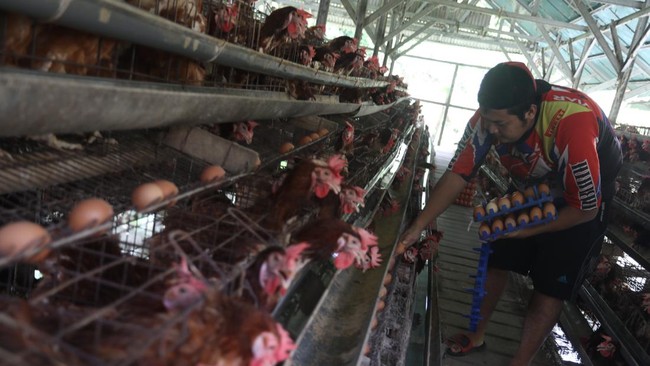
Jakarta, CNBC Indonesia - Small-scale poultry farmers are highlighting issues with production data and the entry of large investors into the national livestock industry. They assess that this situation could worsen business disparities amid ongoing pressure from falling egg prices at the farmer level.
Chair of the Berkah Telur Blitar Cooperative, Yesi Yuni Astuti, stated that the main problem in the poultry industry is not just prices, but also the openness of data on population and the distribution of day-old chicks (DOC). Therefore, the government needs to open up production data transparently so that business actors can know the real market conditions.
“We request open data on GPS and DOC distribution. Why? Because this is a deeply rooted problem,” Yesi said at the AGRIMAT forum at NICE PIK 2 on Friday (8/5/2026).
Handling falling prices would differ if the cause is truly due to excess chicken population. However, as long as production data is not open, farmers struggle to read market conditions.
This situation is seen as confusing for small-scale farmers. Because if national production already meets domestic needs, then adding new capacity is feared to worsen price pressures at the small farmer level.
Open data would allow all industry players to understand the actual market conditions. Thus, business decisions and government policies can be more measured.
“If everyone says we are now overpopulated, then no one would say we add egg stock. None. Now it’s become ridiculous,” she said.
Moreover, she has heard about foreign investors investing in the egg sector. Small-scale farmers do not reject modernisation in the livestock sector. However, they reject the dominance of foreign investors, which is seen as able to narrow the space for independent farmers.
Farmers only want cultivation rights to remain biased towards small communities as part of national food sovereignty. According to her, the existence of small-scale farmers must be maintained amid increasingly large industrial changes.
“We do not reject modernisation, no. But we reject foreign investors entering the livestock world. And also return cultivation rights to the people’s food,” Yesi stated.