
Potential to Reduce Imports by 75%, DME Subsidy Reform Key to Success
Jakarta, CNBC Indonesia - The fate of the national energy subsidy programme now stands at a crossroads. Hitherto, dependence on LPG imports has rendered the state budget less optimal, as subsidy expenditures have been predominantly used to support imported commodities rather than mobilising domestic resources.
According to the 2025 Performance Report of the Directorate General of Oil and Gas under the Ministry of Energy and Mineral Resources, Indonesia’s reliance on gas imports has worsened over the past five years. In this regard, the share of LPG imports has dominated more than 75% of national consumption.
In 2021, out of total LPG consumption of 8.36 million tonnes, imports reached 6.34 million tonnes. This import figure then surged to 7.49 million tonnes in 2025 from total consumption of 9.24 million tonnes.
“Our foreign exchange every year is only for buying LPG alone, around Rp120 trillion to Rp150 trillion. Moreover, if world oil prices rise, it will certainly be even larger,” said the Minister of Energy and Mineral Resources, Bahlil Lahadalia, as written on Monday (11/5/2026).
In addition to foreign exchange pressure, Bahlil highlighted the growing burden of LPG subsidies in the State Revenue and Expenditure Budget (APBN).
The Ministry of Finance recorded LPG subsidy spending at Rp67.6 trillion in 2021, surging to Rp100.4 trillion in 2022, then Rp74.3 trillion in 2023, Rp80.9 trillion in 2024, and reaching Rp87 trillion in 2025.
“There is no other way for efficiency than to find a way so that raw materials available domestically can be converted to replace LPG,” Bahlil explained.
One strategy being aggressively pursued to close the large LPG import gap is through the downstreaming of low-calorie coal into Dimethyl Ether (DME), developed by MIND ID, Pertamina, Bukit Asam, and Pertamina Patra Niaga.
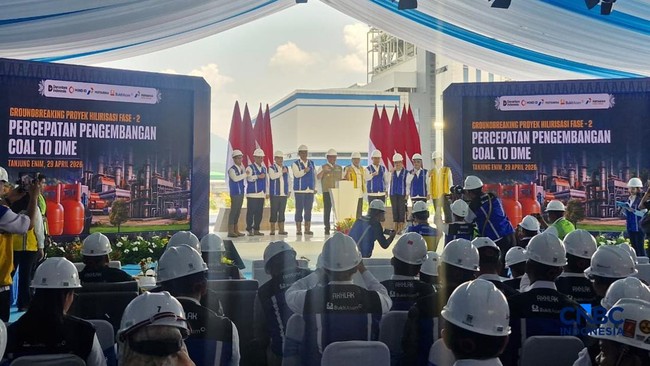
This project was inaugurated as the Acceleration of Coal to DME Development by President Prabowo as part of the Groundbreaking of the Second Hilirisasi Project series at the end of April 2026.
In addition, several academics and observers have provided critical notes on the groundbreaking of this project. Energy observer and Professor at the Faculty of Engineering, University of Indonesia (FTUI), Iwa Garniwa, assesses that the success of DME as a LPG substitute does not only depend on factory construction, but also requires support from fiscal incentives and consistency.
He said that DME needs to be supported by certainty of coal prices and policy stimuli in the form of subsidies so that its selling price is more affordable and accepted by the public.
“DME is very sensitive to coal prices and the gasification capex is high. If coal prices are above US$60 per tonne, DME is not competitive without subsidies,” Iwa said in a separate opportunity.
In this regard, Iwa encourages the implementation of gradual energy subsidy reforms from commodities to individuals through the Integrated Social Welfare Data (DTKS). Without this reform, incentives to switch to piped gas networks (jargas), electricity, or DME become weak.
Furthermore, the government is urged to develop performance indicators for this project. Success should not only be measured by the number of DME factories, but also by the reduction in LPG import volumes, subsidy savings, and reduction in per capita emission intensity.
“Household energy diversification is a multidimensional issue concerning fiscal matters, energy security, the environment, and social justice. Its success depends on policy consistency across government periods and the ability to manage a just transition,” Iwa explained.
Not only that, the government also needs to prepare a roadmap for household energy diversification based on regional characteristics. For example, utilising natural gas networks (jargas) in big cities close to gas transmission pipelines, using electric stoves in areas with electricity surplus, and utilising DME in non-pipeline regions such as South Sumatra and Kalimantan.
With this scheme, the potential LPG substitution is estimated to reach 4.5 million to 6.5 million tonnes per year, equivalent to 55%-75% of current LPG import volumes.
In addition to policy support, Oil and Gas Energy Observer Hadi Ismoyo also emphasised the importance of collaboration between the government and business actors to develop DME infrastructure.
“DME stove infrastructure is already available at Lemigas. No problem. Just build large-scale factories. And it can collaborate with Pertamina, which already has a mature and measured distribution network,” Hadi asserted.