
Potential of New Toll Roads and the Dilemma of Investment Interest
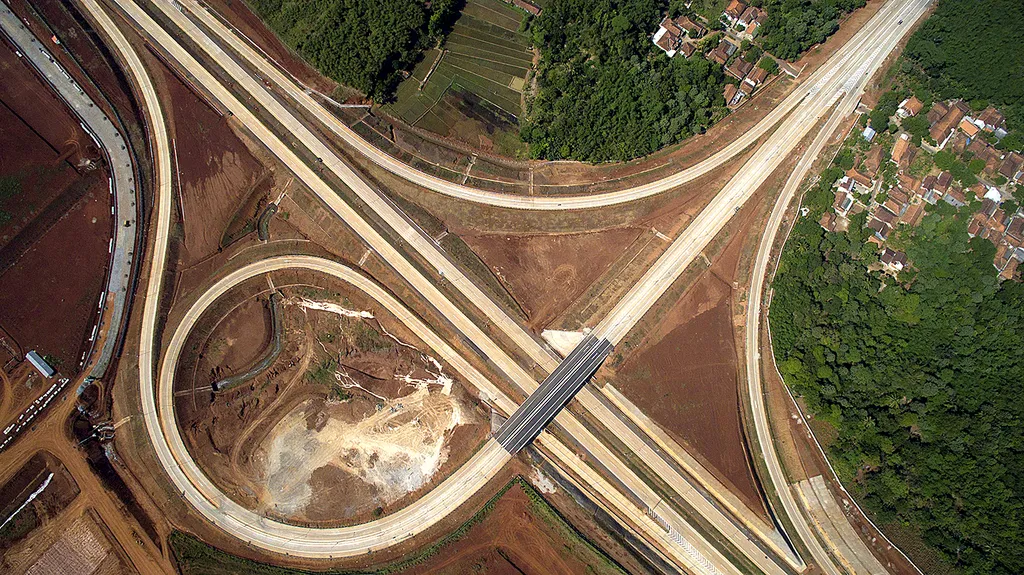
The construction of new toll roads in several regions remains stalled. However, if realised, the potential profits and multiplier economic impacts on the areas are considerable.
The stagnation of plans for new toll road construction risks hindering public mobility, inter-regional connectivity, and local economies. In this situation, government support and collaboration with the private sector are key.
Developments in transportation infrastructure in Indonesia in recent years have increasingly shown their impact. This progress is evident at least from the construction of road infrastructure, particularly toll roads.
Citing data from the Toll Road Regulatory Agency (BPJT), over 36 years from 1978 to 2014, the length of toll roads was only 795 kilometres (km). However, data as of 15 April 2026 records 3,115.98 km of toll roads built in Java, Sumatra, Kalimantan, Bali, and Sulawesi. More than half of this toll road length is in Java.
As Indonesia’s economic centre supporting 56-57 per cent of gross domestic product (GDP), the massive construction of toll roads is important in driving the economy in Java. Not only that, the dense economic activity and mobility of the population on this island, home to around 56 per cent of Indonesia’s population, make toll roads essential.
In daily life, toll roads support population mobility. Especially during certain moments, such as Eid exodus, toll roads become the preferred route for private vehicle drivers and public transport. Relatively faster and more predictable travel time is the main reason they choose to travel via toll roads.
Not limited to major moments like the exodus, the existence of toll roads in Java has a broad influence on the regional economy. In 2021, Kompas’ research and development analysis captured the impact of toll road construction, particularly in Java, using the interregional input-output (IRIO) model.
The results showed that additional investment allocated from 2016-2026 for the Trans-Java Toll Road construction provided additional output, income, and gross value added to all business sectors in the six provinces of Java Island. The impact of the 10-year Trans-Java Toll Road construction is projected to create economic output of Rp23.23 trillion per year (Kompas, 20/12/2021).
The impact of toll road construction in Java also spills over to the economies of cities and regencies. Fahmi’s (2022) research from IPB University titled “Impact of Trans-Java Toll Road Construction on Economic Growth in Central Java” showed that of 13 cities and regencies in Central Java analysed, 10 experienced economic growth two years after the toll was built compared to two years before.
The analysis of toll road construction impacts in Java is not just numbers that seem intangible. In reality, this toll construction reduces travel time and increases certainty in logistics distribution, which is vital for economic activities.
Moreover, the existence of toll roads also provides positive feedback for the development of industrial areas being intensively promoted by the government. In 2021 alone, after the Trans-Java Toll Road was connected, there was an 11 per cent increase in investment in Central Java (Kompas, 27 December 2021).
The impacts created indeed prove that the goal of toll road construction to address inter-regional connectivity issues and regional economic growth has been achieved. However, this can still be maximised because the potential for new toll road construction in Java is relatively large. Especially since this potential relates to the current direction of industrial area development.
Data from the Ministry of Investment and Downstreaming/BKPM indicates there are 73 industrial areas spread across all provinces in Java. The industrial areas in Kendal and Batang have proven capable of attracting foreign investment worth Rp15.86 trillion and domestic investment of Rp6.73 trillion throughout 2025. This achievement places Kendal and Batang as regions with the highest investment realisation in Central Java.
The connectivity of several industrial areas with toll roads becomes one of the attractions for incoming investment according to a report from global professional services and investment management firm Colliers Indonesia, May 2025. Several new industrial areas, such as in Batang, Brebes, Tegal, Kendal, Semarang, and Surabaya, offer higher benefits for companies looking to develop their businesses in Indonesia.
These benefits arise due to infrastructure deemed adequate, such as toll road access. The existence of toll roads, especially in Java, is believed to increase distribution and logistics capacity, greatly facilitating companies and thus reducing logistics operational costs.
However, currently, the existing toll roads are still insufficient to support distribution and logistics. In several regions with continuously growing economic activity, toll infrastructure often bears traffic loads exceeding capacity. This condition is depicted in the Gerbangkartosusila agglomeration area, also known as the Greater Surabaya metropolitan area.
The Krian-Manyar Toll Road, stretching from Sidoarjo to Gresik, was built to complement existing tolls, such as the Sumo and Sugres tolls. The Krian-Manyar Toll Road was also built to provide an alternative for road users when traffic obstructions or accidents occur. Because if such obstructions happen, the travel distance from Sidoarjo to Gresik could be two to three times longer than normal (Kompas, 21 November 2019).
Although it is an important part of development and the regional economy, plans for developing several new tolls often face various challenges. This condition hampers the realisation of new toll construction.
Most recently, for example, the Gedebage-Tasikmalaya-Cilacap (Getaci) Toll failed to auction twice due to low investor interest. The toll project, estimated to be the longest with an investment value