
Porters at Pasar Senen and Gambir Stations Become Vital for Eid Holiday Travellers
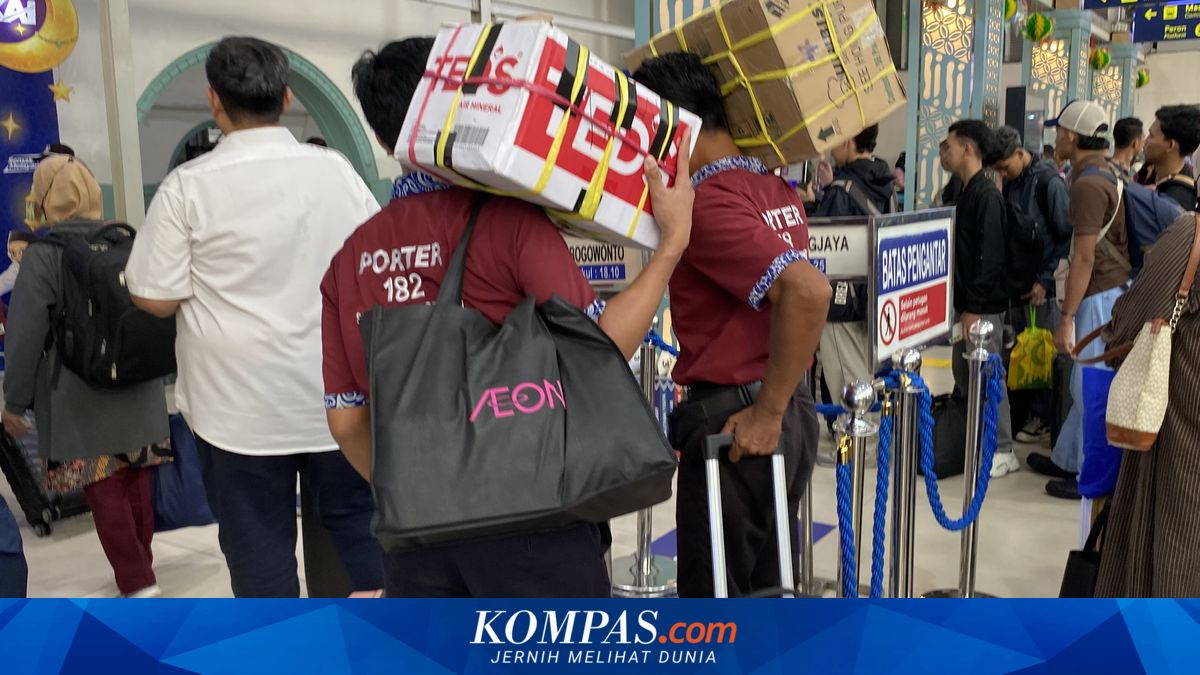
JAKARTA — In the long-distance train departure hall at Pasar Senen Station in Central Jakarta, queues of passengers snake towards the ticket inspection gate. Some travellers pull wheeled suitcases, whilst others arrive with large cardboard boxes filled with gifts, tied together with plastic string.
Amidst the bustle, a man wearing a red vest numbered 182 is seen shouldering a cardboard box of mineral water whilst pulling a passenger’s suitcase. He is Slamet, 38, a porter who has worked for nearly five years assisting passengers with their belongings at the station.
As the Eid holiday season approaches, activity at the station surges sharply. The flow of passengers carrying many items has made porter services busy once again. For porters, this moment represents an opportunity to earn extra income. However, their work ultimately depends on the number of passengers requiring assistance.
Slamet explains that porters at the station operate under a scheduling system managed by a porter coordinator. This system requires porters to work in rotating shifts. “We usually follow a schedule. We work according to the coordinator’s assignments,” he said.
This system ensures porter services remain available throughout the day for passengers needing help. According to Slamet, the number of porters at Pasar Senen Station is substantial, which means they must share working hours. When passenger numbers increase, as before Eid, porters typically must move faster to serve more customers. The luggage they carry is not always light. “Sometimes passengers bring very large boxes. The weight can be dozens of kilogrammes,” Slamet said.
Nevertheless, he says the holiday exodus always creates a different atmosphere at the station. “People look happy about going home to their villages, and we’re also happy to help the travellers,” he said.
Whereas previously most passengers requested porters directly on-site, some now book through porter service applications. “Now some people also order through applications,” said Rohman. Through the application, porter service tariffs are determined transparently. According to Rohman, the rate is approximately 38,000 rupiah for one service carrying luggage from the station area to the platform or vice versa. “With the application, there’s a fixed rate and the porter’s name is also recorded,” he said.
Payment from the application goes directly to the porter who accepts the order. However, some passengers still prefer calling a porter directly when seeing them in the station area. “There are still those who call directly when they see us pass by, and they usually pay around 50,000 rupiah per load,” said Rohman.
During busy periods, daily earnings can reach approximately 120,000 to 200,000 rupiah. However, this amount is not always the same each day. “When it’s quiet, there might be only one or two customers,” Rohman said. This means in a day, a porter can earn income from several loading services.
According to Yudi, 39, another porter at Pasar Senen Station, their work is typically busier approaching the Eid holiday season because many passengers carry more luggage than usual. “When Eid approaches, it’s usually busier because people travel with more belongings,” Yudi said. He notes that holiday travellers often carry several items at once. However, not all passengers use porter services.