
Polri: National One-Way Scheme Flexible to Follow Field Conditions
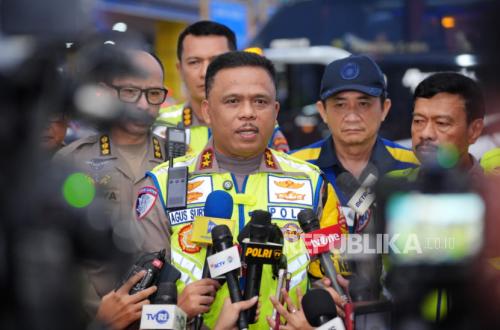
BANYUMANIK — The Head of the Indonesian National Police Traffic Corps, Inspector General of Police Agus Suryonugroho, emphasised that traffic management policies, including the national one-way scheme, are being implemented flexibly to follow actual conditions on the ground. Monitoring is conducted through traffic counting as well as support from digital aerial technology.
He explained that the return flow on Tuesday (24/3/2026) had entered a dense phase since the implementation of the national one-way scheme, led by Police Chief General Listyo Sigit Prabowo at 2:00 p.m. WIB. Predictions for the peak return flow also fell on that date, so various layered traffic engineering schemes were prepared.
“It could also be tomorrow morning (Wednesday) if the traffic counting or the generation of flow from the Trans Java direction, both from Semarang to Jakarta, is still high; the one-way might be extended,” Agus said at the Banyumanik Toll Gate Command Post on Tuesday.
Previously, the police had prepared a scenario for implementing the national one-way stage three during the 2026 Lebaran return flow if the vehicle surge from the Trans Java direction remained high. The Traffic Corps chief conveyed that such steps are based on field evaluations and digital data.
The Traffic Corps had previously taken anticipatory measures by implementing local one-way schemes in Central Java. This scheme was applied from Salatiga to Kalikangkung to accelerate vehicle flow towards Jakarta.
In the next stage, the Traffic Corps implemented a precise segmental one-way concept from KM 263 to KM 70. At subsequent points, a two-lane contraflow was prepared to ease the flow generation from East Java, Central Java, and the Greater Semarang area.
Developments in the afternoon showed the addition of one-way routes from KM 459 to KM 414 Kalikangkung based on evaluations with the Central Java Regional Police. This step was taken to maintain smooth traffic flow at dense points.