
Police Propose Including Whip Pink in Narcotics Law to Prevent Misuse
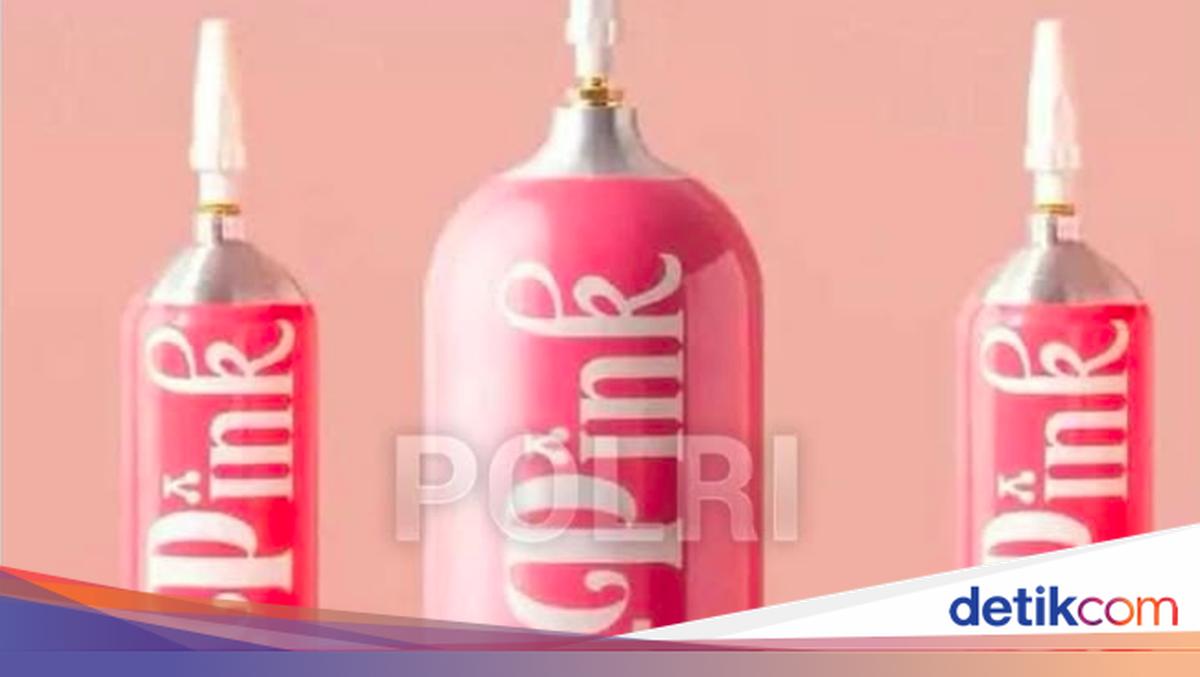
The National Police have proposed that dinitrous oxide gas (N2O) in Whip Pink canisters be included in the appendix of the Narcotics Law. The move is considered urgent given the rampant misuse of the gas and the difficulty of legal enforcement due to regulatory gaps.
The proposal was put forward by the Head of Sub-Directorate III of the Narcotics Directorate at the Criminal Investigation Agency (Bareskrim Polri), Commissioner Zulkarnain Harahap, during a discussion on ‘Regulation of Electronic Cigarettes (Vapes) and Restrictions on the Use of Dinitrogen Oxide (Whip Pink)’ at the National Narcotics Agency (BNN) headquarters in East Jakarta on Wednesday (18 February 2026).
Zulkarnain explained that legal enforcement against the misuse of laughing gas in Whip Pink canisters cannot currently be carried out, as there is no robust legal framework to address violations in the field.
Medically, N2O is recognised as an anaesthetic agent when mixed with oxygen. However, Whip Pink products circulating on the market contain pure N2O and are labelled as not intended for health purposes.
“We wanted to take action using Health Law Number 17, but we cannot because they hide behind the label ‘not for health purposes’. If we use the Food Law, they shelter behind business-to-business (B2B) schemes,” said Zulkarnain.
Consequently, the Police have recommended two strategic steps. In the short term, the Police are urging the Food and Drug Supervisory Agency (BPOM) to include N2O in the Indonesian Pharmacopoeia Edition VI as a pharmaceutical preparation, referencing pharmacopoeia standards in other countries such as the United States.
“Once it is included in the Pharmacopoeia, we can take enforcement action under the Health Law,” he said.
The other recommendation is to include N2O in the appendix of the Narcotics Law. According to him, this policy could enhance oversight of N2O distribution.
“Our recommendation is to elevate this to the appendix of the Narcotics Law so that oversight, usage control, and enforcement can be carried out collectively,” said Zulkarnain.
“Even once it falls under the narcotics category, all uses of N2O, including in its legitimate fields, would certainly be supervised. This does not mean obstructing those in other fields, but rather ensuring oversight,” he added.
New Tactics by Whip Pink Sellers
The distribution of Whip Pink continues unabated. Zulkarnain noted that distributors have changed their operational patterns by employing fictitious B2B transaction schemes.
“Now they have changed their guise. Every buyer who contacts their call centre is given a form containing fields for name, location, business entity, and so forth,” Zulkarnain revealed.
He explained that the use of business entity forms is deliberately employed to circumvent BPOM regulations. BPOM strictly regulates the retail sale of propellant gas for whipped cream, which is classified as a food additive.
However, if transactions are conducted under inter-company or B2B schemes, a gap in distribution permit oversight opens up, as the product is treated as an industrial raw material or large-scale commodity rather than a retail item.
“But in this case, it is no longer regulated by BPOM. This means they do not need a distribution permit because it is business-to-business in nature. It is made to appear as if large quantities are sold to restaurants, sprayed in small amounts as a topping. This has become our obstacle,” he said.
Whip Pink packages are priced in the range of Rp1.2 million to Rp1.5 million. He stated that the misuse of Whip Pink has been rampant since last year.
He noted that one of Indonesia’s largest music festivals, the Djakarta Warehouse Project (DWP), had previously used Whip Pink as a promotional tool.
“Whip Pink was already widespread last year, even several years ago. It even became a promotional addition at DWP, which was held in Bali last year,” said Zulkarnain.
He explained that the DWP promotion in question involved purchasing a package of five canisters and receiving one Whip Pink canister free of charge. “If you buy five canisters, you get one free. That is the extent of Whip Pink distribution,” Zulkarnain added.
Beyond DWP, Zulkarnain also mentioned YouTubers who use Whip Pink and upload content about it on social media. Regulation of Whip Pink distribution is expected to curb the potential for misuse.
“There is now a trend among YouTubers using Whip Pink. They even play padel whilst carrying Whip Pink — it has become a lifestyle,” he said.
According to Zulkarnain, the massive use of Whip Pink is driven by widespread misconceptions among users. Distributors propagate the narrative that the gas is safe because it is used in the medical field.
“They know N2O is used in medicine. But in medicine, its use is mixed with oxygen and is regulated. This is the anecdote they spread so that users are not worried and feel safe,” he concluded.