
Polar Ice Melt Lengthens Days on Earth, Scientists Explain
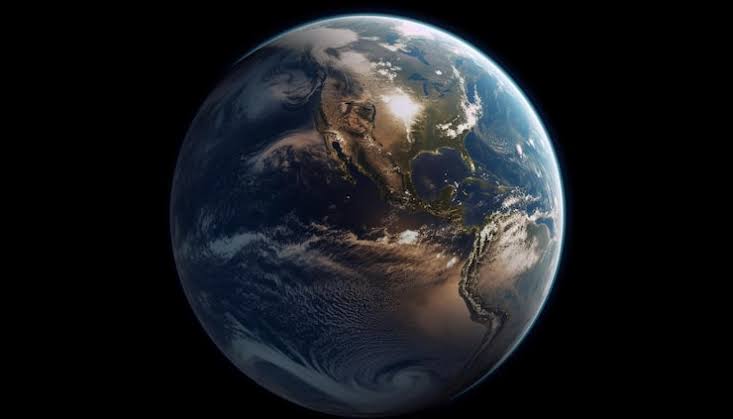
Scientists have discovered that Earth’s rotation is currently slowing, causing the length of days to increase, albeit only in terms of milliseconds. The findings indicate that this change is occurring at a rate not previously recorded for at least the past 3.6 million years.
In theory, one day on Earth lasts 24 hours—the time the planet takes to complete one full rotation on its axis. However, in reality, this duration can be slightly longer or shorter, influenced by various factors ranging from the Moon’s gravitational pull to geophysical processes occurring within Earth, on its surface, and in the atmosphere.
For example, in July and August 2025, the Moon’s relatively close position caused Earth’s rotation to slow slightly, resulting in day lengths recorded as approximately one millisecond longer than typical days.
Beyond the Moon’s gravitational influence, researchers have also identified a long-term trend linked to climate change. Global warming triggered by human activity is causing polar ice sheets and glaciers worldwide to melt faster. Water previously trapped in ice for thousands to millions of years now flows into the oceans, raising sea levels and indirectly altering Earth’s mass distribution.
As Earth’s mass shifts from polar regions towards the wider oceans, the planet’s rotation becomes slightly slower—a phenomenon often compared to an ice skater spinning more slowly when extending their arms. When ice was concentrated near the poles, its mass was concentrated close to Earth’s axis of rotation. As ice melts and disperses across the oceans, the mass moves further from the rotation axis, particularly towards equatorial regions. This redistribution of mass is what causes Earth’s rotation to slow.
In recent research, scientists from the University of Vienna, Austria and ETH Zurich, Switzerland analysed changes in day length by tracing Earth’s rotation history from the end of the Late Pliocene epoch. The study, led by Mostafa Kiani Shahvandi from the Department of Meteorology and Geophysics at the University of Vienna, noted that previous research had already demonstrated that polar ice sheet melting in the 21st century increases sea levels and slows Earth’s rotation. However, scientists wanted to determine whether a similar phenomenon had occurred previously at the same rapid rate.
The analysis revealed that day length on Earth is currently increasing by approximately 1.33 milliseconds per century, primarily caused by rising sea levels from melting ice sheets that alter Earth’s mass distribution. The research also concluded that the current rate of day lengthening had not occurred in at least the past 3.6 million years.
Benedikt Soja, professor of space geodesy at ETH Zurich, stated that such rapid increases in day length demonstrate that modern climate change is occurring at rates unprecedented since the end of the Pliocene epoch. He added that by the end of the 21st century, climate change’s impact on Earth’s rotation could potentially exceed the influence of the Moon’s gravitational pull.
Although day length changes occur only in milliseconds, this phenomenon has important implications, particularly for technologies requiring extremely precise time measurement. Systems such as navigation satellites, including the Global Positioning System, rely heavily on accurate Earth rotation data. Even very small time changes can affect navigation systems, communications, and global financial networks.
Nevertheless, for humans directly, the change of approximately 1.33 milliseconds per century is barely perceptible in everyday life.
These findings confirm that climate change affects not only the environment and sea levels, but also impacts the fundamental dynamics of planet Earth, including how the planet rotates.