
PLN EPI Strengthens ESG Commitment through Community-Based Biomass Development
PT PLN Energi Primer Indonesia (PLN EPI) is strengthening its environmental, social, and governance (ESG) commitments through the development of a community-based biomass supply chain.
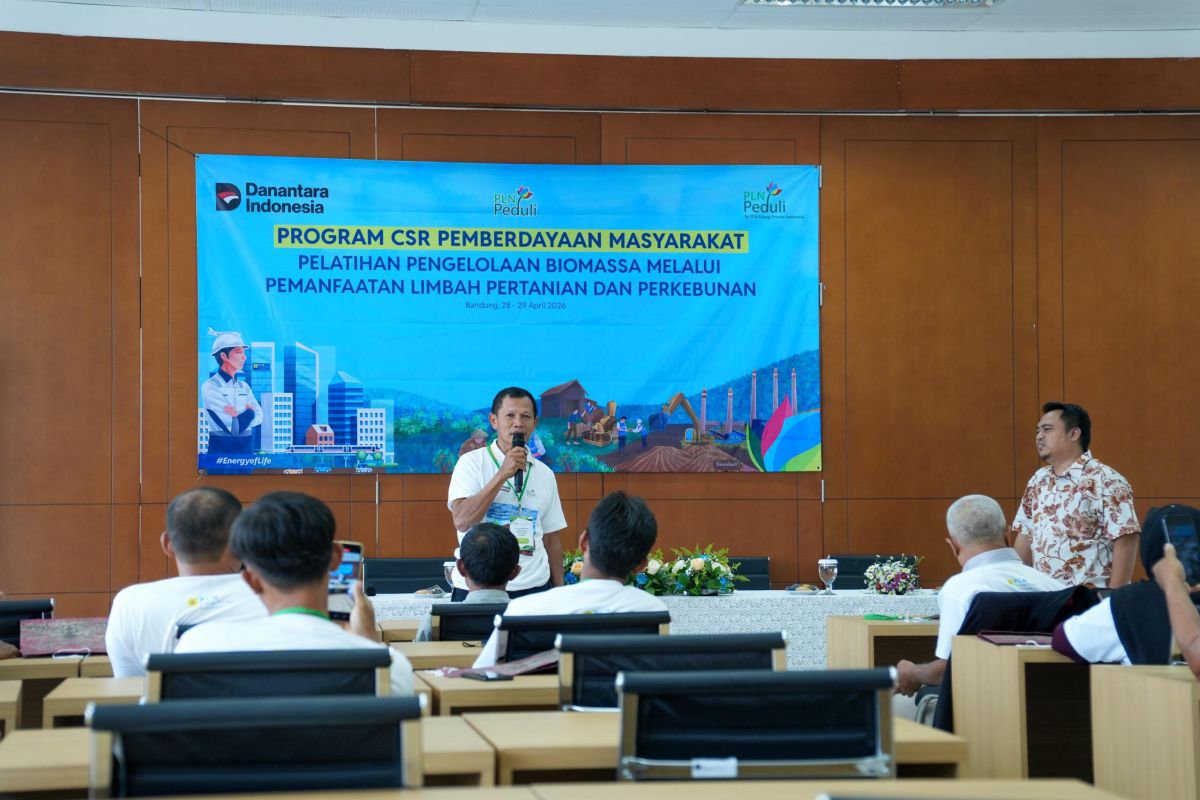
Company Secretary of PLN EPI, Mamit Setiawan, stated in Jakarta on Wednesday that the company, in collaboration with PT PLN (Persero), is implementing social and environmental responsibility (TJSL) activities in the form of biomass management training utilising agricultural and plantation waste at Institut Teknologi Bandung (ITB) in Bandung, West Java, from 28-30 April 2026.
“This programme is part of the company’s strategy to build a community-based biomass supply chain while supporting national policies in the Electricity Supply Business Plan (RUPTL) 2025-2034, which encourages an increase in the renewable energy mix and a gradual reduction in carbon emissions,” he said.
Fifteen participants, consisting of farmer groups, village-owned enterprises (BUMDes), and community forest groups (HKM) mentored by PLN EPI from various regions including East Lombok, Tasikmalaya, Cilacap, and Gunung Kidul, attended the training on biomass potential introduction, processing technology, production practices, and market-oriented business model development.
Mamit emphasised that this programme is part of the company’s systematic approach to ensuring the sustainability of biomass supply as an alternative energy source.
“Through this TJSL programme, we encourage communities not only as beneficiaries but as part of the biomass energy supply chain. This is a tangible implementation of ESG, particularly in community empowerment and strengthening environmental aspects,” he said.
He added that biomass plays a strategic role in the co-firing programme for coal-fired power plants (PLTU), namely substituting part of the coal with biomass-based fuel to reduce carbon emissions without the need for massive new power plant construction.
From the PLN Group perspective, this programme reflects the synergy between the parent company and its subholding in building an inclusive and sustainable energy transition model.
Senior Manager of Communication & Public Relations for PLN UID West Java, PT PLN (Persero), Krisantus H Setyawan, stated that the utilisation of biomass not only impacts waste reduction but also opens new economic opportunities for communities.
“The utilisation of agricultural and plantation waste as energy provides economic added value while promoting a community-based circular economy,” he said.
Meanwhile, ITB’s Director of Community Service and Expertise Services, Prof Zulfiadi, emphasised that biomass has advantages as a renewable energy with a more sustainable carbon cycle compared to fossil fuels.
“Biomass enables a faster and more controlled carbon cycle, making it an important part of climate change mitigation efforts,” he explained.
Furthermore, he assessed that community-based biomass development also opens opportunities for regional economic transformation.
“In the future, regions will not only be energy consumers but also biomass-based energy producers that support national needs,” he said.
Rismayadi, representative of the Jaga Lembur Tani Makmur Farmer Group, stated that this programme opens opportunities for community-based biomass business development.
“I am optimistic that through this training, agricultural and plantation waste can be optimally utilised as a valuable energy source, while also improving the economy of the farmer group in Bojongkapol Village, Tasikmalaya,” he said.
With this initiative, according to Mamit, PLN EPI not only strengthens environmental aspects through emission reductions but also social aspects through community empowerment, and governance aspects through the structured and sustainable development of the biomass supply chain.
This programme also reflects a paradigm shift in the national energy transition, where villages are no longer positioned as development objects but as strategic partners in clean energy production that directly contributes to national energy security.
“By making villages the centre of biomass production, PLN EPI affirms that Indonesia’s energy future is built on collaboration, sustainability, and community empowerment,” Mamit stated.