
Pindar Considered as National Financing Infrastructure, How Is That Possible?
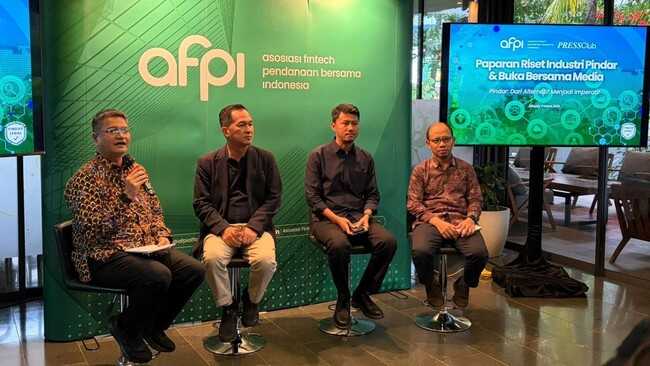
Jakarta, CNBC Indonesia - The Chairman of AFPI, Entjik S. Djafar, revealed that online lending (pindar) has today become part of the national financing infrastructure and is no longer merely an alternative form of financing.
This is evident from data from the Financial Services Authority (OJK) as of August 2025, which recorded 25.5 million active loan recipients, with the industry’s total outstanding at Rp87.49 trillion, up 21.46% year on year.
‘Pindar has become part of the national financing infrastructure, serving as a buffer for household liquidity and as a catalyst for business growth, especially for MSMEs,’ Entjik told the media on Wednesday, 4 March 2026.
Nevertheless, he noted several challenges that Pindar must face, notably illegal online lending and public perception.
According to AFPI’s research, around 45% of respondents consider current loan tenors too short, while 39.5% view interest or service fees as relatively high.
On the other hand, user satisfaction (CSAT) stood at 82.9%, with a repurchase intention of 78.3%. However, the proliferation of illegal lending practices continues to cast a shadow over the industry’s image.
‘That is why it is important to clearly distinguish between legal Pindar that is licensed by the OJK and subject to AFPI’s ethical code, and illegal practices that damage public trust. Cost transparency, financial education, and regulatory enforcement must go hand in hand,’ said Kuseryansyah, Head of Public Relations for AFPI.
In terms of risk, the industry’s default rate beyond 90 days (TWP90) remained within regulator tolerance, below 5% throughout 2024-2025. AFPI reiterated the industry’s commitment to strengthening risk management through the optimisation of the Fintech Data Center (FDC) and improving the quality of reporting to the Financial Information Service System (SLIK).
Looking ahead, AFPI sees significant opportunities in strategic collaboration between the Pindar industry and banking, particularly in optimising the distribution of government liquidity stimulus to the real sector. With data-based credit scoring and reach into the micro segment, Pindar is seen as an effective banking partner to expand financial inclusion and accelerate economic recovery.
‘Strengthening the Pindar industry means strengthening the inclusive economic foundation of society. With good governance, disciplined risk management, and the right collaboration, Pindar can be a strategic partner for the government in driving more equitable and sustainable growth,’ Kuseryansyah said.
Over the past two years, research has noted a shift in the industry’s financing mix. The share of productive lending declined from around 30% in late 2024 to around 20% by mid-2025 through August 2025.
However, this situation underscores the important role of consumer financing as a buffer for household liquidity amid the economy’s slowdown. In macro terms, household consumption has contributed roughly 52-58% of Indonesia’s GDP in the last five years.
When productive financing slows, preserving household purchasing power is key to preventing domestic demand from falling. This is where multi-purpose Pindar financing functions as a stabiliser, and Kuseryansyah concluded.