
Pigai Submits Draft Indigenous Peoples' Law Bill to DPR Legislative Body
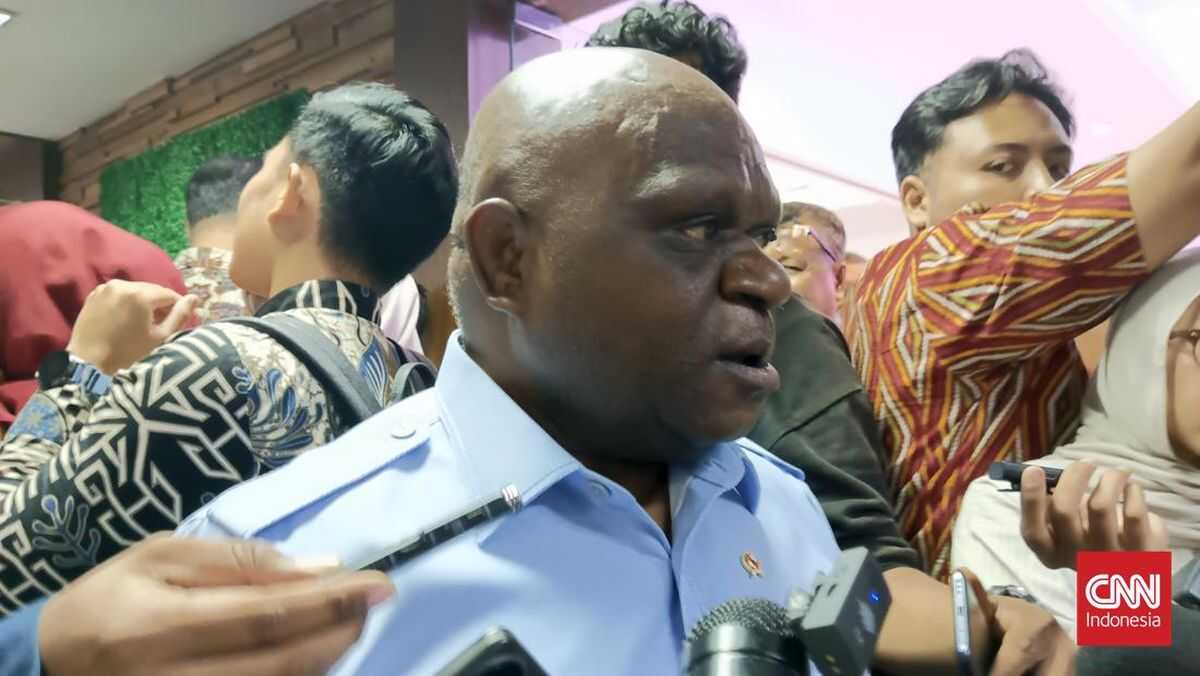
The Ministry of Human Rights has submitted the draft Indigenous Peoples’ Law Bill to the House of Representatives’ Legislative Body (Baleg) for prompt deliberation between the government and parliament.
The document was personally handed over by Human Rights Minister Natalius Pigai at the parliamentary complex on Thursday (19 February). Pigai said the draft bill was the product of direct consultations with indigenous communities.
“We met with the Baleg leadership and its members, including the head of the working committee, to present the draft Indigenous Peoples’ Bill,” Pigai said on the occasion.
Pigai explained that indigenous and traditional community groups must urgently receive recognition and be regulated through legislation. He said Indonesia should follow the example of the United States, which recognises its population as divided into four distinct groups.
The same applies to Indonesia. Citing historian Ben Anderson of Cornell University, Pigai said Indonesia is divided into four community groups: first, imagined communities — those who believe in Indonesia as a single identity.
Second, limited communities, referring to Indonesia’s population as a bounded community. Third, sovereign communities, denoted by identity cards. Fourth, traditional communities.
Until now, Pigai continued, the state has frequently seized authority from indigenous peoples. The state, he argued, has often disregarded and failed to preserve their existence.
“That is precisely why there needs to be a comprehensive explanation that the law governs two matters: first, the law of indigenous legal communities, and second, traditional communities. That is what we conveyed,” Pigai said.
He proposed that the Indigenous Peoples’ Law Bill should establish a National Commission on Indigenous Peoples. The commission would recognise their existence, rights, and standing before the state — ranging from the right to express opinions, freedom of association and organisation, rights over land, rights over water, and all other rights inherent to them.
“So that indigenous peoples become masters in their own land, so that indigenous peoples can make their own decisions,” Pigai said.