
PIER assesses domestic consumption as Indonesia's primary economic pillar
Looking ahead, coordination of fiscal and monetary policies remains crucial to maintain balance between supporting economic growth and macroeconomic stability.
Jakarta (ANTARA) - The Permata Institute for Economic Research (PIER), an economic research institution under Permata Bank, assesses that domestic consumption, accelerated government spending, and resilient investment will serve as the main pillars of Indonesia’s economic growth in early 2026.
As is known, Indonesia’s Gross Domestic Product (GDP) in Q1 2026 grew by 5.61% year-on-year (yoy), an increase from 5.39% in Q4 2025. This figure also represents the highest growth since Q3 2022.
However, on a quarterly basis, the Indonesian economy still experienced a contraction of 0.77%. Therefore, the high annual growth achievement needs to be read in the context of the low base effect from Q1 2025, seasonal boosts from Ramadan and Eid al-Fitr, and accelerated government spending at the start of the year.
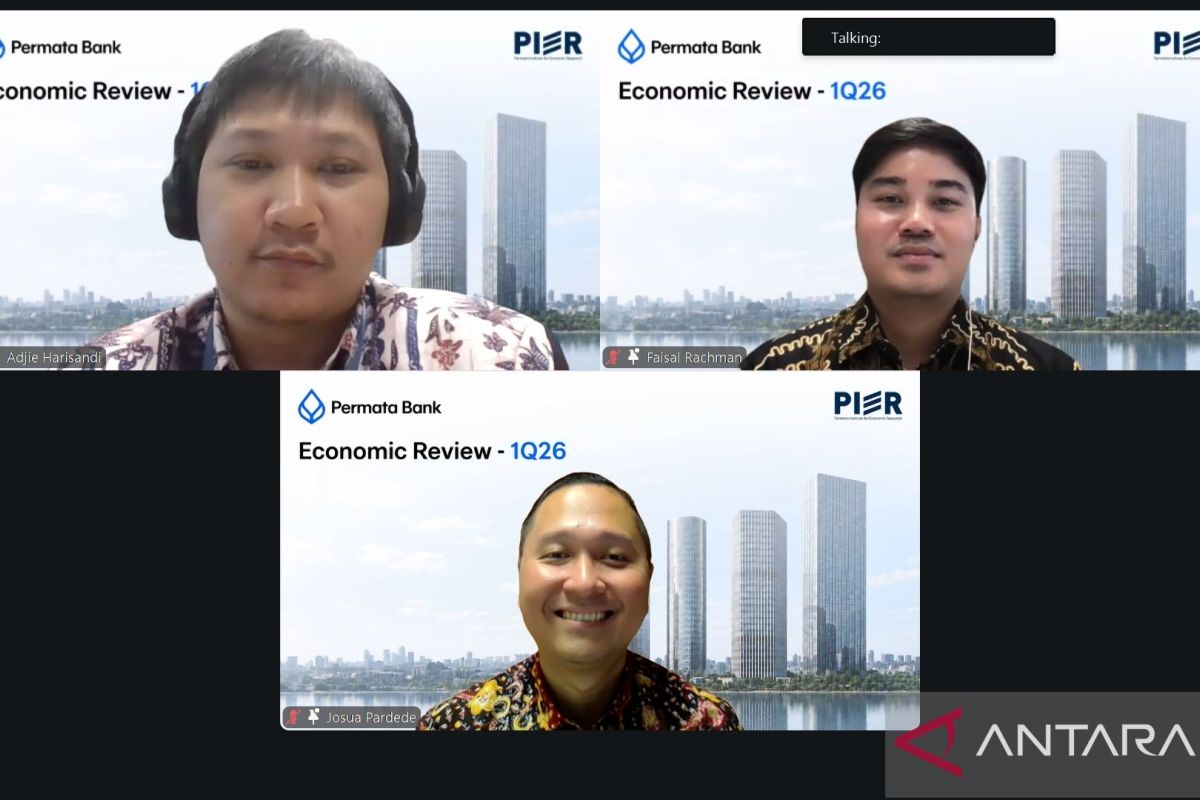
“Indonesia’s economic growth in early 2026 is still strongly supported by domestic demand, particularly household consumption and government spending. Nevertheless, external dynamics such as trade wars, geopolitical conflicts, and global economic slowdowns still need to be monitored as they can affect stability and future growth prospects,” said Head of Economics at Permata Bank, Josua Pardede, during the PIER Q1 2026 Economic Review event held virtually in Jakarta on Tuesday.
As the largest contributor to GDP, household consumption grew by 5.52% yoy in Q1 2026, up from 5.11% in the previous quarter. The strengthening of consumption was driven by increased public spending activities during Ramadan and Eid al-Fitr, as well as improving consumer confidence indicators and retail sales in March 2026.
From the investment side, Gross Fixed Capital Formation (GFCF) growth moderated to 5.96% yoy from the previous 6.12% yoy. Nevertheless, domestic investment activity is still considered sufficiently resilient, particularly supported by investments in buildings and structures related to government priority programmes.
Meanwhile, government spending surged by 21.31% yoy in line with accelerated fiscal realisation at the beginning of the year, including support for priority programmes such as the Free Nutritious Meals (MBG).
PIER assesses that the dominance of household consumption and government spending indicates that the national economic growth engine has not yet been fully supported by strong and sustainable private investment expansion. Some growth drivers are still seen as seasonal and policy-based.
On a sectoral basis, the accommodation, food, and beverage sector recorded the highest growth, increasing from 7.41% yoy to 13.14% yoy in Q1 2026. Growth also occurred in other services sectors as well as transportation and warehousing.
On the other hand, the processing industry, as the largest GDP contributor, experienced moderated growth to 5.04% yoy from the previous 5.40% yoy. Meanwhile, the mining sector remains under pressure due to production controls on several major mineral commodities.
Based on regions, economic growth in Bali and Nusa Tenggara, Sulawesi, and Java was recorded higher than the national average, at 7.93% yoy, 6.95% yoy, and 5.79% yoy respectively.
PIER states that this growth was supported by the normalisation of mining in West Nusa Tenggara, strong manufacturing industry in Sulawesi, and acceleration of domestic consumption on Java Island.
Furthermore, business world caution is also reflected in labour market conditions and the manufacturing sector.
The Open Unemployment Rate (TPT) in February 2026 was recorded at 4.68%, with the number of employed people reaching 147.67 million or an increase of 1.896 million people compared to February 2025.
Although labour absorption is still positive, its quality needs to be monitored because the proportion of formal workers slightly declined by 0.02 percentage points, while part-time workers increased by 0.16 percentage points.
“The emerging risk is not a large surge in unemployment, but rather increasing informality and income pressure on lower-middle income groups,” PIER wrote in its report.
From the manufacturing sector, the Q1 2026 Business Conditions and Prospects Index remained in the expansion zone at 51.37, but slowed compared to the previous quarter’s 52.21.
Signals of slowdown are increasingly evident in April 2026 after the manufacturing PMI fell to 49.1, indicating contraction in output, rising input costs, and declining business confidence.
PIER assesses that real sector dynamics are also closely related to financial market conditions that have not fully recovered.
Although economic growth remains positive, investors continue to monitor several risks such as rupiah weakening, rising energy prices, geopolitical uncertainty, limited room for interest rate cuts, and fiscal pressures due to energy subsidies.
In Q1 2026, foreign investors recorded a net outflow of around US$1.79 billion from the domestic market, consisting of US$1.48 billion in bonds and US$1.95 billion in stocks. Nevertheless, Bank Indonesia’s Rupiah Securities (SRBI) still recorded inflows of US$1.64 billion.
Amid these pressures, the financial services sector and household consumption are still seen as economic buffers.
The Bank Indonesia Banking Survey shows that new credit disbursement in Q1 2026 still grew, though lower than the previous quarter, with more selective lending standards.
Meanwhile, the Consumer Confidence Index in April 2026 remained at an optimistic level of 123.0.
PIER forecasts Indonesia’s economic growth throughout 2026 to remain in the range of 5.1-5.3%, with domestic demand still serving as the main growth driver.
However, external risks such as geopolitical tensions, global trade wars, and slowdowns