
PGRI Commits to Boost Transformative Education for Teachers
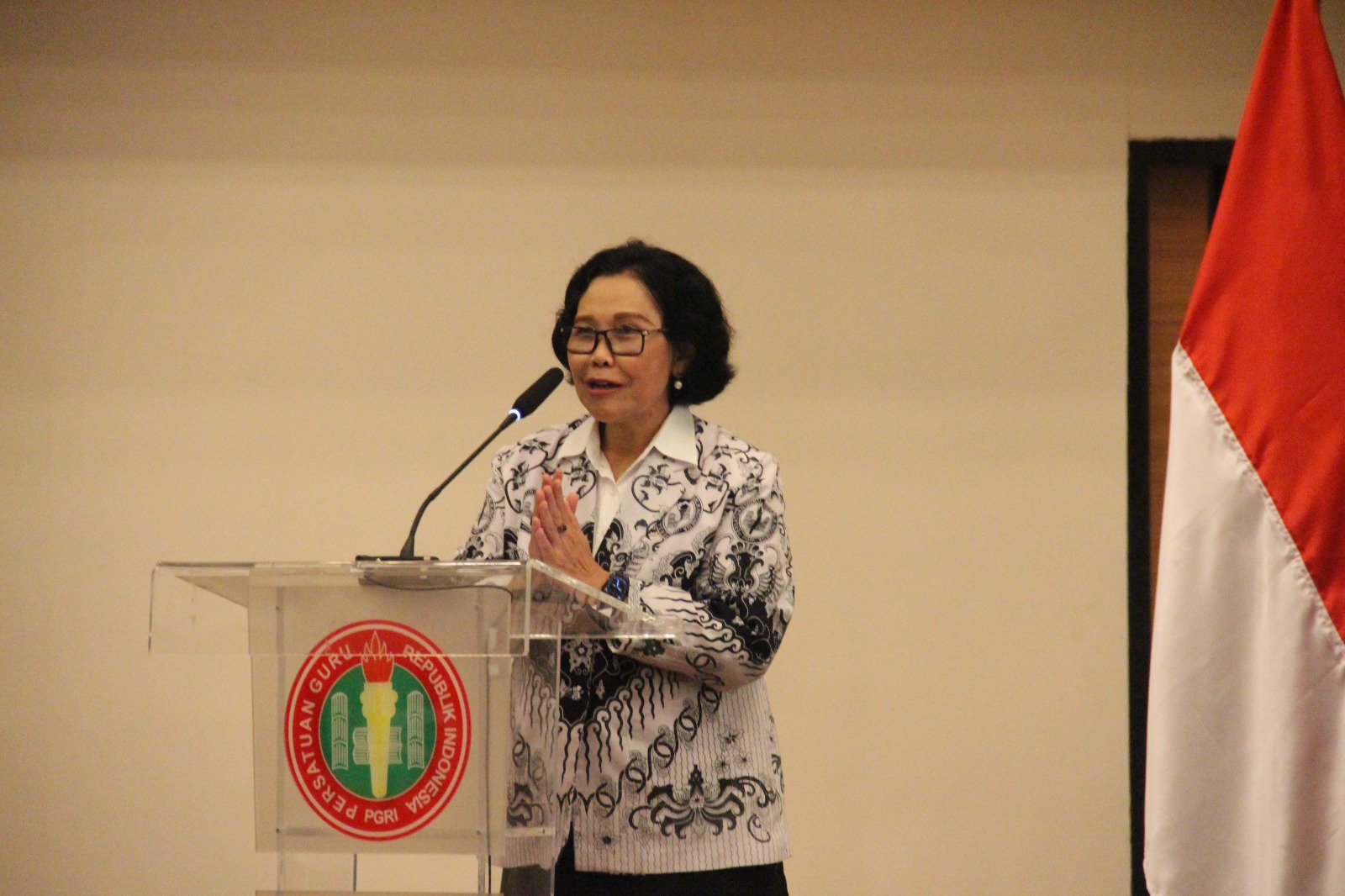
The Indonesian Teachers Association (PGRI) is committed to boosting the quality of education for teachers nationwide through transformative learning. This commitment was stated by PGRI General Chair Unifah Rosyidi, a professor at Jakarta State University (UNJ), at the National Seminar and Launch of the Indonesia Center for Transformative Education (ICTE) under the theme ‘Innovative and Impactful Universities for Advanced Indonesia 2045’, held at the Guru Indonesia Building in Jakarta on Wednesday, 20 May.
Unifah Rosyidi said there is strong enthusiasm among teachers to participate in transformative learning, with the online training programme reaching around two million participants across Indonesia. ‘We are surprised and proud by the high level of interest; our online training has drawn around two million viewers,’ she said.
The event underscored the importance of innovative and adaptive higher education institutions to face contemporary changes and challenges, and to demonstrate tangible societal impact. The forum also discussed the implementation of the Main Performance Indicators (IKU) for impactful higher education in Indonesia, and strengthening the relevance of campuses to the industrial world. According to Unifah, transformative learning is increasingly popular in higher education, but primary and secondary teachers are also keen to learn it. She noted that teachers inherently possess a strong motivation to adapt to educational change, yet many lack adequate access to training channels.
In addition to upskilling teachers, PGRI plans to deliver financial literacy training to strengthen educators’ financial literacy and long-term financial resilience. ‘Teachers should be resilient when facing difficult conditions,’ she added. The financial literacy programme will be conducted in collaboration with the banking sector, providing spaces for regions to manage programmes according to local needs. Unifah hopes this small initiative can grow into a broad movement that improves teachers’ welfare. The programme has been approved by the organisation’s plenary to be socialised to relevant parties in financial literacy.
Meanwhile, the Deputy Minister of Education, Culture, Research and Technology (Wamendiktisaintek), Prof Fauzan, in a remote address via video, expressed appreciation for the launch of ICTE as a collaborative hub that can bridge scientific and technological developments with humanity and national values. He said the country needs more spaces that connect knowledge with real-world application, technology with humanity, and innovation with national values. He added that this movement could foster a collective effort to deliver higher education that is innovative, inclusive, and has real national impact. He reminded that Indonesia’s progress should not rely solely on natural resources, but on the quality of its human resources. ‘A great nation is built not only on wealth but also on the quality of its people,’ he said.
Furthermore, PGRI highlighted the possibility that there may be no recruitment of Civil Servant Teachers (CPNS) for teaching positions in 2027. The Ministry of Education, Culture, Research and Technology is pursuing upskilling via D4 or S1 with the Recognition of Learning from Experience (RPL) for 150,000 teachers. PGRI Secretary-General Dudung Abdul Qodir praised the government’s decision to continue with face-to-face learning. PGRI urged the government and Parliament to explicitly enshrine Teacher Protection in the draft legislation. Deputy Minister Fajar Riza Ul Haq emphasised that the government, under President Prabowo Subianto, is pursuing a revolution, and the ministry is continuing to raise teacher qualifications via D4 or S1 with RPL for 150,000 teachers. PGRI supports the shift in performance evaluation policy, arguing that meeting the 24 hours of weekly face-to-face teaching can be fulfilled by other teaching tasks and duties.