
PGN-BRIN Biosalin Rice Yields 176 Tonnes on 22-Hectare Land
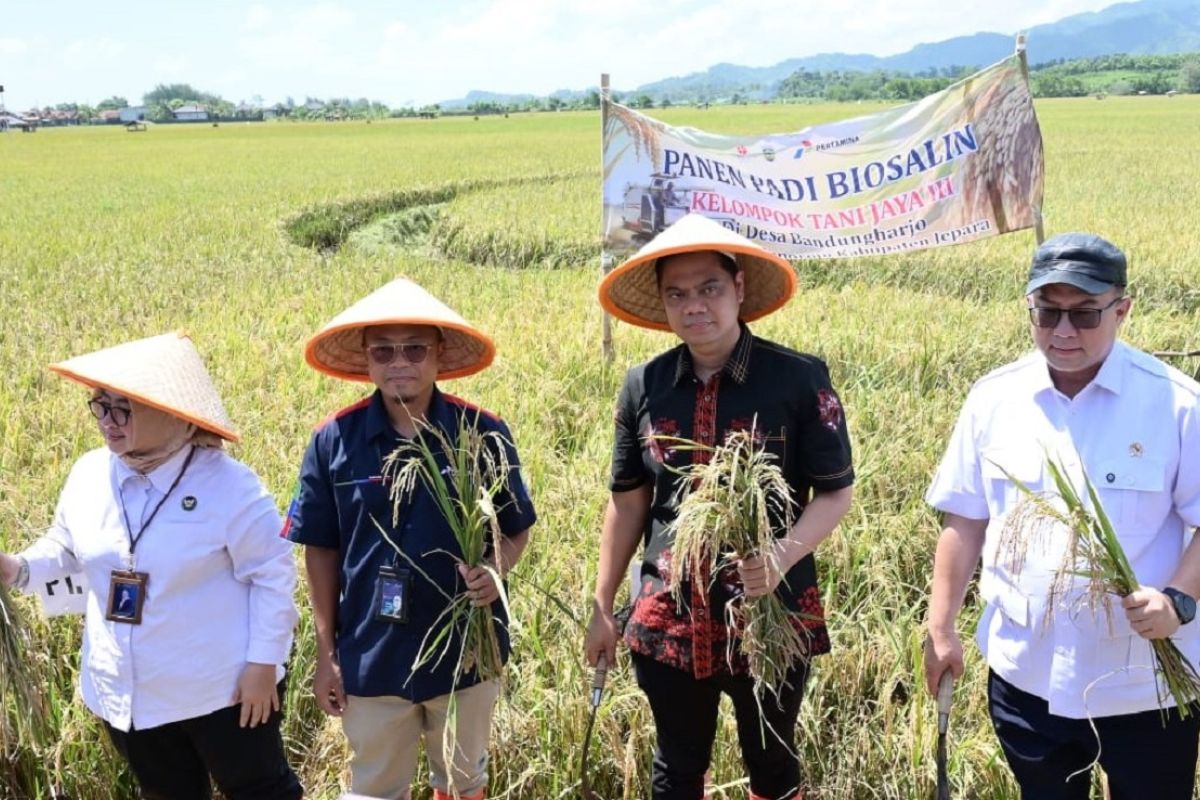
Jakarta (ANTARA) - The biosalin rice cultivation programme in the coastal area of Jepara Regency, Central Java, a collaboration between PT Perusahaan Gas Negara (Persero) Tbk/PGN, the National Research and Innovation Agency (BRIN), and the Jepara Regency Government, has produced 176 tonnes from 22 hectares of land.
BRIN Head, Prof. Dr. Arif Satria, explained that biosalin rice cultivation using the biosalin variety is designed to address specific challenges faced by agricultural land in coastal areas experiencing increased salinity due to seawater intrusion, tidal flooding, and climate change, which often lead to crop failures.
“The advantage of the Biosalin variety is its ability to produce approximately 9 tonnes per hectare with a planting period of between 84 and 107 days. Equally important, this biosalin variety is resistant to pests and diseases and can survive on marginal land,” he stated in his remarks in Jakarta on Saturday.
According to him, this harvest realisation covering 22 hectares exceeded the initial target of 20 hectares, with an average productivity of 7-9 tonnes per hectare, resulting in a total production of around 176 tonnes of unhulled rice.
From an economic perspective, he added, this achievement generates a value of about Rp1.23 billion, assuming an unhulled rice price of Rp7,000 per kilogram.
He emphasised that the development of the biosalin rice variety is not only to boost production but can also be seen as an approach to mitigation and post-disaster recovery.
For this reason, Arief hopes that this model can be replicated in various other coastal areas in Indonesia facing similar challenges, so that research-based innovation truly becomes a driver in maintaining national food security while improving farmers’ welfare.
Meanwhile, PGN’s Division Head of Corporate Social Responsibility (CSR), Krisdyan Widagdo Adhi, affirmed that the company’s involvement in the programme is part of its commitment to creating sustainable social impacts.
He explained that through the programme, the company not only provides intensive mentoring but also encourages capacity building and knowledge transfer so that farmers can independently adopt adaptive farming practices in the next planting season.
“This means that today’s success becomes the foundation for farmers to continue producing without dependence on programme interventions in the future,” Krisdyan clarified.
The biosalin programme, he continued, not only adds value in terms of production but also creates measurable economic impacts for farmers and the local ecosystem.
“We hope this programme can continue to develop as a research-based empowerment model and collaboration, while also serving as the company’s contribution to supporting national food security and sustainable development,” Krisdyan said.
Jepara Regent, Witiarso Utomo, stated that the biosalin rice cultivation programme not only helps maintain agricultural production but also gives confidence to farmers to continue producing amid climate uncertainties.
“This harvest success shows that with the right approach, the agricultural sector can still grow and provide economic value, even under extreme weather pressures,” he said.
Looking ahead, his side hopes that this initiative can continue to be expanded and become a model for strengthening regional food security based on research and strategic partnerships.