
Peak Migration Traffic at Merak Port Wednesday Evening, 13,000 Vehicles Reserve Crossings
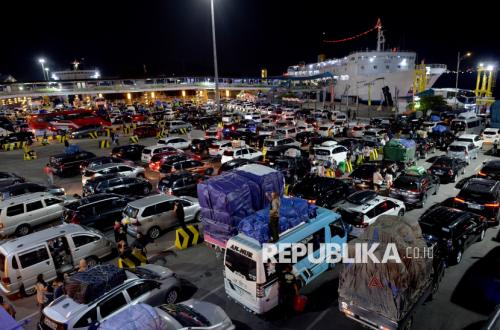
MERAK — PT ASDP Indonesia Ferry recorded peak crossing traffic at Merak Port on Wednesday evening, 18 March 2026 (local time). ASDP data indicated that approximately 13,000 vehicles had made reservations for crossing.
Chief Executive Officer of PT ASDP Indonesia Ferry Heru Widodo stated that vehicle movement had been continuously increasing from morning through evening. Traffic flow to the port and crossing operations remained under control.
“Based on our projections, this evening represents the peak of public movement at Merak. From morning to evening, approximately 12,680 vehicles have been recorded, and if accumulated for today, roughly 13,000 vehicles have already made reservations,” said Heru at Merak Port.
He explained that field conditions remained relatively manageable despite increased vehicle volumes. Buffer areas such as Indah Kiat were temporarily activated to manage traffic flow but returned to normal as vehicle distribution proceeded smoothly. Cross-agency coordination between ASDP, the police, and the Ministry of Transport was continuously strengthened to ensure smooth traffic flow and port operations.
“One key to smooth operations is the distribution of vehicle types across three ports. At Merak, we handle pedestrians, private vehicles, and buses. At Ciwandan, we handle motorcycles and certain vehicle categories. Meanwhile, at BBJ, we handle large logistical vehicles,” Heru said.
The port separation scheme created better organised vehicle flow. Each vehicle type was directed to different locations, thereby reducing potential congestion. Ferry service users experienced smoother movement with more manageable waiting times. Heru added that ASDP also implemented an integrated ticketing system, or single ticketing, to optimise vehicle distribution to ships.
“With this system, users do not choose the vessel. Vehicles are directly distributed to the dock and ship that is ready, so the crossing process is faster and more evenly distributed,” said the ASDP chief executive.
Implementation of the system made ship loading more efficient. The available fleet could be utilised optimally to handle traffic surges.
Crossing traffic was projected to remain high through the evening. Management based on port distribution and the integrated ticketing system proved key to maintaining service continuity during the peak migration period.