
'Peace Throughout the Middle East': These Are the 10 Ceasefire Conditions from Iran Accepted by Trump
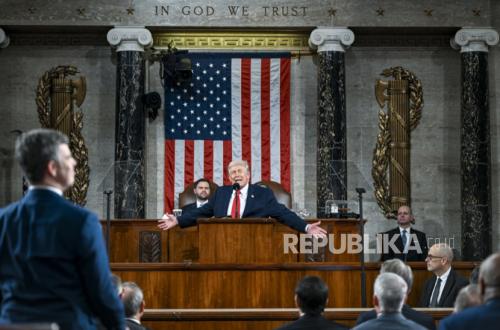
REPUBLIKA.CO.ID, WASHINGTON – US President Donald Trump has retreated from his previous threats to “destroy the entire Iranian civilisation” and announced a two-week ceasefire. In his statement, Trump also said he has accepted 10 points of ceasefire conditions from Iran and described them as reasonable.
“We have accepted Iran’s 10-point proposal, and we believe this is a workable basis for negotiations,” Trump wrote in his tweet on Wednesday. He stated that the agreement to be reached would not only bring peace with Iran but also peace in the Middle East.
This is important because the conditions that have leaked to the media recently are not easy and will have far-reaching impacts. Those conditions, outlined by state media and supported by Tehran’s leadership, call for the immediate cessation of war in various regions, including Iran, Iraq, Lebanon, and Yemen, alongside broader demands aimed at ending the war completely.
The core of the proposal is a call for the complete and permanent cessation of war against Iran, without time limits, and the end of all regional conflicts.
Tehran also demands the reopening of the Strait of Hormuz and the establishment of guarantees to ensure safe and secure navigation through this vital waterway, which handles much of the world’s oil shipments.
The plan further demands full compensation for reconstruction in Iran, the lifting of all sanctions, and the release of Iran’s frozen funds by the United States.
Here are Iran’s ten demands:
Total cessation of war against resistance groups in Iraq, Lebanon, and Yemen.
Total and permanent cessation of war against Iran without time limits.
Ending all conflicts in the region as a whole.
Withdrawal of all US troops from the region.
Establishing protocols and provisions to guarantee freedom and security of navigation in the Strait of Hormuz.
Full payment of compensation for reconstruction costs to Iran.
Full commitment to lifting sanctions and resolutions against Iran.
Release of Iran’s funds and frozen assets held by the United States.
Acceptance that Iran may enrich uranium for its nuclear programme.
Immediate ceasefire to take effect on all fronts as soon as the above conditions are agreed.
Alongside the proposal, Iran’s Supreme National Security Council also confirmed that they have approved a two-week ceasefire period, and negotiations with the United States are expected to begin in Islamabad.
Officials emphasised that the pause “does not mean the end of the war” and underlined the conditional nature of the agreement.
Foreign Minister Abbas Araghchi said Iran would allow safe maritime routes through the Strait of Hormuz during the talks, although under coordination with its armed forces and subject to “technical limitations”.
It remains unclear whether this signals a full easing of restrictions on the vital shipping lane, which Iran has effectively controlled since the conflict escalated.
Donald Trump has indicated that he is prepared to do the same, announcing a suspension of plans to attack Iran for two weeks, contingent on the full, immediate, and safe reopening of the strait.
He described the move as a “two-sided ceasefire” designed to create space for diplomacy. Trump said the decision followed discussions with Pakistani Prime Minister Shehbaz Sharif and Army Chief General Asim Munir, and pointed to Iran’s proposal as a “workable basis” for negotiations.
He claimed that most major points of contention between Washington and Tehran have been resolved, and expressed hope that the temporary pause could lead to a long-term agreement.