
PBD Plants 36,000 Mangrove Seedlings as Climate Change Mitigation Action
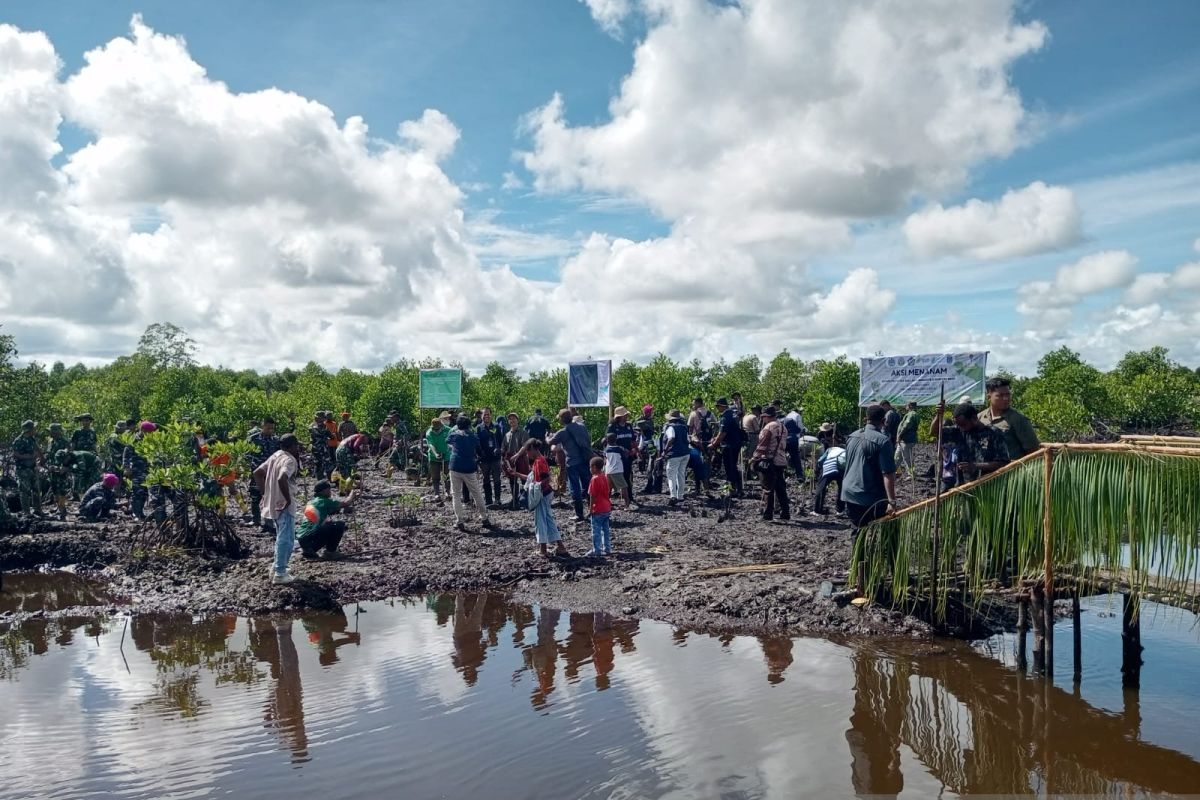
Aimas - The Southwest Papua Provincial Government (Pemprov PBD) has planted 36,000 mangrove seedlings on 20 hectares of land in Maibo Village, Sorong Regency, as a tangible action for climate change mitigation.
Governor Elisa Kambu in Aimas on Friday stated that this mangrove planting is part of the region’s commitment to supporting the national target for reducing greenhouse gas emissions, while also preserving the coastal ecosystem, which plays a crucial role as a carbon sink.
“All the prepared mangrove seedlings number 36,000 stems, and the planting process is targeted to be completed within one to two months,” she said.
“We are committed to contributing to the national emission reduction target of 3.7 to 4 percent, which is cascaded to the provincial level through various environmental programmes, including forest and coastal rehabilitation,” she added.
According to her, the condition of mangroves in Papua in general remains very good, with around 99 percent in dense and well-maintained condition. The remaining one percent is the focus of rehabilitation through planting activities such as those in Maibo Village.
Pemprov PBD is also carrying out land tree planting in several areas. Approximately 85 hectares of land in Maybrat Regency have been rehabilitated with budget support of Rp3.8 billion. “This year, the programme continues with the maintenance phase,” she said.
In addition, the government is distributing productive plant seedlings, such as mango and rambutan, to community groups, churches, and schools to encourage social participation in tree planting actions.
“Around 16,000 seedlings have been planted as part of efforts to empower communities while enhancing food security,” she stated.
The former two-term Regent of Asmat expressed appreciation for the community’s involvement in the activity.
She emphasised that environmental preservation cannot be done by the government alone but requires active participation from all elements of society.
According to her, planting mangroves and other trees is a form of shared responsibility to restore the environment impacted by human activities, such as logging and natural resource exploitation.
She highlighted the importance of protecting coastal areas that are prone to disasters. Mangrove vegetation is considered capable of serving as a natural barrier in reducing disaster impacts, including tsunamis.
“What is encouraging is the significant community involvement. This shows that collective awareness to protect the environment has grown well,” she said.