
Patients in North Nias Willing to Travel Dozens of Kilometres to See a Specialist Doctor
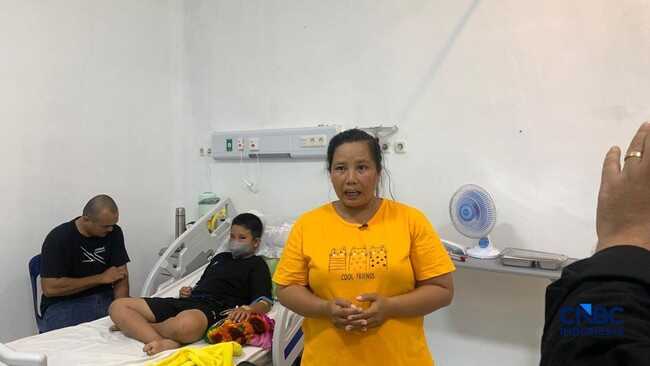
North Nias, CNBC Indonesia - Access to health services remains a challenge for some residents in island areas like North Nias, North Sumatra. In order to obtain specialist treatment, several patients even have to travel dozens of kilometres to the hospital.
This is what happened to Lastiaw Harefa who brought his child, Stephen Lase, for treatment at RSUD Tafaeri in Lolofaoso, Lotu District, North Nias Regency, North Sumatra. He said he had to travel about 30 kilometres from his home in Lahewa so his child could receive specialist care.
‘From our home to here is about 30-31 kilometres. Because in North Nias this is the most adequate hospital here,’ Lastiaw told CNBC Indonesia, on Friday (5/3/2026).
The journey to the hospital is not entirely easy either. According to CNBC Indonesia’s on-site observations, about 2.5 to 3 kilometres of road are damaged on the way to RSUD Tafaeri North Nias. The condition of the road means vehicles must move very slowly.
To traverse that damaged stretch, vehicles take around 15 to 20 minutes. This condition could become a barrier for patients needing urgent medical attention, especially in emergencies.
Lastiaw said road access to the hospital is indeed one of the challenges for residents living far from health facilities.
‘If the patient is severe, reaching here is quite heavy. The road is damaged, so we sometimes struggle on the way,’ he said.
Initially, his child had a fever and swelling around the lips. He had taken his child to a village doctor who only had general practitioner services.
But because the child’s condition had not improved, the family decided to bring Stephen to RSUD Tafaeri for further treatment from a pediatric specialist.
‘There in the village there is only a general doctor. So we thought it would be better to bring him to this hospital to get better treatment,’ he said.
After arriving at the hospital, Stephen immediately received intensive care, starting from an infusion, administering medication, and injections. Lastiawati said the child’s condition is starting to show improvement.
‘Previously he had difficulty speaking because his lips were swollen, but now he’s starting to improve since being treated by the doctors here,’ she said.
She also said the BPJS Health process was quite easy although they initially arrived without referral from a primary health facility.
‘We initially went straight to the outpatient department, but afterwards we were advised to use BPJS. The process was easy, no difficulties,’ she said.
Nevertheless, she believes there are still some hospital facilities that need improvement, such as room cooling and water supply.
‘There is air conditioning but it’s somewhat faulty, so we brought our own fan. There is water but the flow isn’t strong,’ she added.
She hopes that in the future hospital facilities and health service access in North Nias can be further improved so that people do not have difficulty obtaining treatment.
Most common illnesses
The internal medicine specialist at RSUD Tafaeri, North Nias, Dr Davinda Filarshi said chronic diseases such as diabetes mellitus, hypertension, and tuberculosis (TB) are among the most frequently treated cases. He noted that these three diseases dominate patients who come for treatment.
‘The most common here are type 2 diabetes mellitus, then hypertension, and pulmonary TB,’ Davinda told CNBC Indonesia, Thursday (5/3/2026).
In addition to these chronic diseases, several patients also come with digestive complaints such as dyspepsia and diarrhoea. However, he said non-communicable diseases like diabetes and hypertension remain the most dominant.
According to Davinda, one challenge in handling chronic diseases in this region is the still low level of understanding among the public about the importance of regular medication. He revealed that many patients fear taking medicines because they worry it could damage the kidneys.
‘Many patients are afraid to take medicines because they think diabetes or high blood pressure medicines can damage the kidneys. In reality, if taken regularly it can protect the kidneys,’ he said.
In addition, health education for the public also faces language barriers, especially for residents who are not fluent in Indonesian.
‘Some people, especially the elderly, do not understand Indonesian very well. So health education often has to be through interpreters,’ he said.
From the facilities side, Dr Davinda assessed that supporting services at the hospital are actually adequate, such as laboratories, X-ray, and ultrasound. However, some medical equipment still needs to be completed.
One of the current obstacles is the absence of anatomical pathology services for tissue examination, which is important for cancer diagnosis.
‘If there are patients with suspected cancer they must be referred because there is no anatomical pathology here. Usually samples or patients are referred to Medan,’ he said.
Moreover, the CT scanner in the Nias region is reportedly out of order, limiting further examination for certain patients. Looking ahead, he hopes that upgrading RSUD Tafaeri North Nias’s class can strengthen health services in the area, including increasing the number of specialist doctors and medical facilities.
‘The hope is that specialists will be more complete here, such as internal medicine, paediatrics, surgery, obstetrics and gynaecology, and anaesthesiology, so health services for the community can be better,’ Dr Davinda said.
RSUD Tafaeri is currently being prepared to upgrade from a type D hospital to a type C. The upgrade is expected to broaden health services for people in North Nias.
From the capacity increase, the hospital is targeting a more complete specialist service, including internal medicine,