
Parliamentary threshold should be reviewed rationally and comprehensively, says Yusril
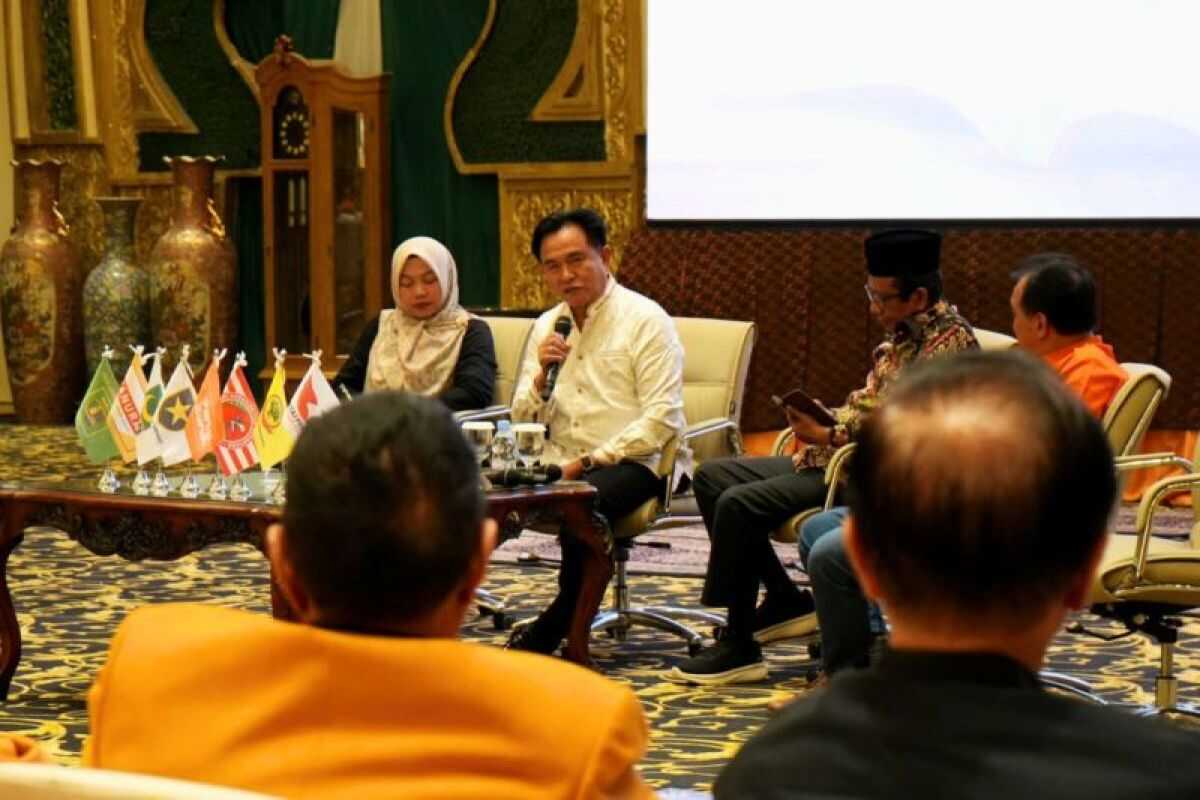
Democracy is a complex and protracted system, but there is no system better than democracy. On the parliamentary threshold, it is an open political choice,” said Yusril Ihza Mahendra. In Jakarta, the Coordinating Minister for Law, Human Rights, Immigration, and Corrections emphasised that the parliamentary threshold in the general election system is an open political option within a democracy. “Democracy is a complicated and lengthy system, but there is no system better than democracy. As for the threshold, that is an open political choice,” he said, as confirmed in Jakarta on Wednesday. The coordinating minister did not deny that democracy is indeed a complex system that often takes a long process, but to date there is no system better than democracy. Therefore, he said, the use of the parliamentary threshold in elections is a political policy that is open for debate and evaluation. He argued that the existence of the threshold is not automatically linked to government stability. Conceptually, he even said, the parliamentary threshold is not absolutely necessary and does not always correlate with the effectiveness of the governance system. “In fact, the threshold does not have a direct link to government stability. Political compromise is what guarantees stability, not merely the parliamentary threshold,” he said. Yusril noted that there are hundreds of political parties registered with the Ministry of Law, so simplifying the party system cannot simply justify the existence of the threshold. He added that the debate on the magnitude of the parliamentary threshold is ongoing and should be based on clear rationality. “There must be rationality about how many thresholds can truly guarantee government stability and the effectiveness of parliament’s work,” the Coordinating Minister said. The former State Secretary also highlighted that the current political dynamics show no strict dichotomy between opposition and government parties, so stability is more determined by political compromise and consensus than by the technical design of the threshold. Meanwhile, GKSR chair Oesman Sapta Odang criticised the parliamentary threshold for potentially oversimplifying the party system without guaranteeing an improvement in parliamentary quality. He argued the policy risks erasing the people’s voices. “There must be no voice of the people considered insignificant in democracy. The mechanism that erases the people’s voice is, in essence, an empty procedure that betrays the sovereignty of the people,” said the man known as Oso. Oso emphasised that Indonesia needs an inclusive party system that provides fair representation. Earlier, the NasDem Party proposed raising the parliamentary threshold to 7 percent. This has repeatedly been stated by NasDem elites and has not changed to date. NasDem party chairman Surya Paloh and deputy chairman Saan Mustopa stated that NasDem has consistently proposed increasing the figure to 7 percent to be included in the revision of the Election Law. Deputy Chairman of Commission II of the DPR, Zulfikar Arse, revealed that discussions on revising the Election Law would begin in 2026 after the Legislative Body (Badan Legislasi) of the DPR decides that the bill enters the Prolegnas for 2026. Separately, the Constitutional Court (MK) on 29 February 2024 granted part of Perludem’s constitutional challenge to Article 414(1) of Law No. 7 of 2017 on General Elections (the Election Law). The decision is registered under number 116/PUU-XXI/2023. In that ruling, the MK did not find a rational basis for the size of the threshold, whether a four per cent minimum, as previously stipulated in Article 414(1) of the Election Law. Therefore, the MK asked lawmakers to amend the threshold provisions before the 2029 elections.