
Parliamentary House: Military Justice System Not Immunity Shelter
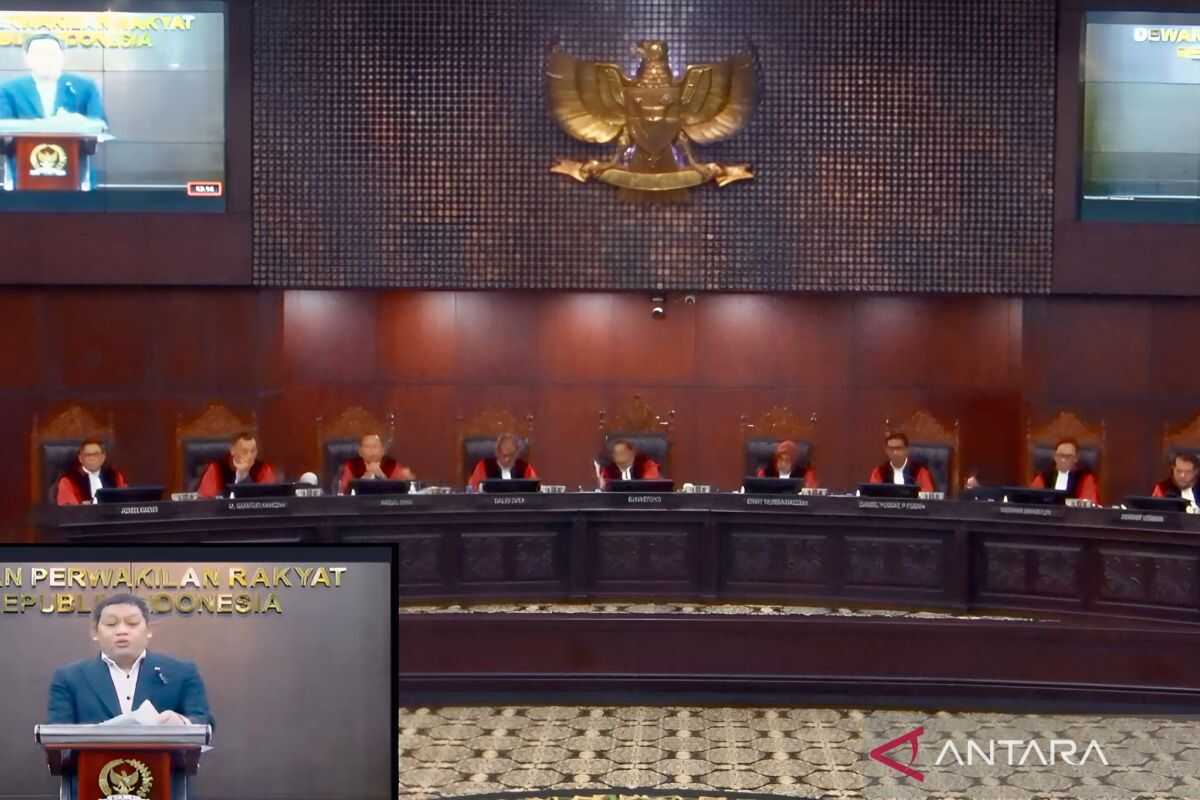
Jakarta — The House of Representatives has stated it is inappropriate to characterise the military justice system as a space for impunity, contrary to claims made by petitioners challenging the Military Court Law (Law No. 31 of 1997) at the Constitutional Court.
“In its application, the military justice system is not appropriately described as a space for impunity,” said Anggota Komisi III DPR RI Abdullah during the House’s statement at the continued hearing of case number 260/PUU-XXIII/2025 at the Constitutional Court on Wednesday.
Abdullah, who appeared virtually at the proceedings, stated that in practice, the military courts have not hesitated to punish guilty service members. He cited Decision No. 50-K/PM.1-04/AD/V/2025, in which the judicial panel sentenced the defendant to death and dismissal from military service.
Beyond exercising judicial authority within the military sphere, the military courts are said to serve a coaching function. Abdullah noted that within military discipline, the military courts function to develop disciplined, responsible, morally upright, and professional service members through an educational legal process that corrects behaviour and maintains military honour.
He explained that the Military Court Law was established based on the understanding that military life has special procedures related to specific military principles, necessitating a special mechanism to adjudicate cases involving military service.
Abdullah clarified that in criminal law, two models of jurisdiction exist: subjective and objective. Subjective jurisdiction is based on the status of the perpetrator, whilst objective jurisdiction is based on the type or nature of the criminal act.
He emphasised Article 9 of the Military Court Law, which stipulates that military courts have authority to try criminal acts committed by service members, including general criminal offences, as a form of subjective jurisdiction. “Article 9 of Law 31/1997 adopts subjective jurisdiction because judicial authority is determined by the status of the perpetrator as a service member, not by the type of criminal act committed,” he stated.
The case was filed by Lenny Damanik and Eva Meliani Br. Pasaribu, who are challenging Article 9(1), Article 43(3), and Article 127 of the 1997 Military Court Law. Lenny is the mother of Michael Hitson Sitanggang (15), who was beaten to death by Sergeant Reza Pahlivi in May 2024. Eva Pasaribu is the daughter of Rico Sempurna Pasaribu, a journalist who died along with his wife, child, and grandchild after his house was burned following his reporting on a gambling operation allegedly run by a military officer.
The petitioners argue that when committing criminal offences, non-military citizens are tried in civilian courts, whilst military members are tried in military courts despite committing the same general criminal offences. They further contend that civilian court proceedings are open, observable, and monitored, with accessible verdicts, whereas military court proceedings are closed, minimally supervised, and verdicts are difficult to access.
In their petition, Lenny and Eva request that the Constitutional Court change the phrase “criminal act” in Article 9(1) of the Military Court Law to “military criminal act”. They argue that the broader phrase “criminal act” allows wide interpretation of military court jurisdiction, enabling military courts to try not only military offences and disciplinary violations but also general criminal offences.