
Parliament invites media to build human rights civilisation narrative in Indonesia
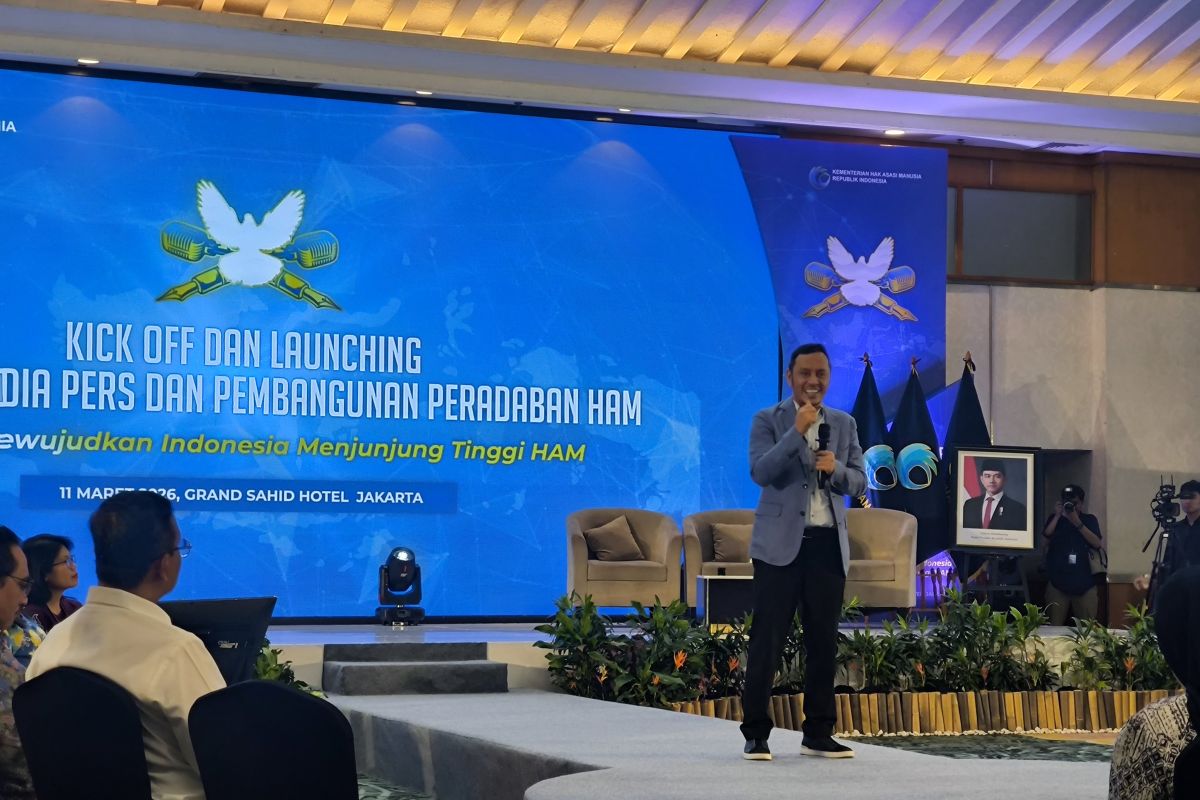
Jakarta – The Chairman of Commission XIII of the Indonesian Parliament, Willy Aditya, has called upon the media to play an active role in building public narratives to promote the development of a human rights civilisation in Indonesia.
Aditya stated that the media holds an important position in shaping national imagination and public discourse space, making its contribution crucial in strengthening public awareness of human rights values.
“Indonesia was formed by the printing press. Our imagination of being part of Indonesia Raya is a product of all fathers and mothers, from printing,” said Willy during the Kick Off and Launch of the Media Press and Human Rights Civilisation Development Programme in Jakarta on Wednesday.
He appreciated the Ministry of Human Rights’ initiative to promote human rights civilisation development through collaboration with the media as a commendable step.
Previously, the Ministry of Human Rights also initiated human rights development planning deliberations (musrenbang) as an approach to formulating work instruments through various human rights perspectives.
However, Aditya emphasised that human rights civilisation cannot be achieved solely through the enactment of laws or the establishment of state institutions.
According to him, such efforts require a lengthy process involving cultural change and active public participation.
“Speaking of civilisation is not a one-night affair. It is not simply passing a law and establishing an institution,” he said.
He noted that Indonesia already possesses various legal instruments and institutions related to human rights. Nevertheless, the existence of such instruments does not automatically guarantee the formation of a civilisation that upholds human values.
Therefore, he believed that the development of human rights civilisation must begin with strengthening public narratives and critical public awareness regarding the importance of respecting human rights.
Aditya observed that human rights movements in many historical experiences have actually emerged from civil society and developed through social dynamics, rather than solely through state policy.
“The most important thing is to build narratives and imagination of how the human rights movement progresses,” he said.
In this context, he emphasised the importance of collaboration between the state, civil society, and the business community to strengthen the human rights development agenda in Indonesia. He also reminded the public to maintain critical reasoning in examining the role of laws and state institutions.
According to Aditya, whilst the existence of regulations and institutions is important, they cannot serve as an absolute guarantee for the development of human rights civilisation without being supported by strong social and cultural awareness.
He also cited a message from Muslim intellectual Nurcholish Madjid emphasising the importance of ethical reflection in every social action.
“You must always ask yourselves, does this violate human rights, is this sinful,” he said, quoting Nurcholish Madjid’s message.
Aditya added that Indonesia actually possesses a strong constitutional foundation for human rights protection. However, the main challenge lies in implementing these values in the practice of state and community life.
“Let us join hands. This is the era of collaboration to uphold humanity towards one another,” he said.