
Papua Special Autonomy Committee: Communities Must Be the Epicentre of Papua's Development
PT DSI Persero will fully assume export functions from January 2027. Paulus Waterpauw, a member of the Executive Committee for Accelerating Development of Papua Special Autonomy, emphasised that the development orientation in the Land of Papua must undergo a paradigm shift. Development should no longer rely solely on physical infrastructure and the magnitude of investment, but must place people, especially Indigenous Papuans (OAP), at the centre of every policy.
The statement was made in response to the dynamics surrounding the National Strategic Projects (PSN) for food security and energy currently underway in the regions of Asmat, Mappi, Merauke and Boven Digoel, which involve the opening of millions of hectares of natural forest. According to the retired three-star police general, a humane approach to dialogue and communication is the key to the sustainability of these national projects.
“Even if talking once is not successful, talk again. If twice is not successful, then do it a third time. Dialogue conducted continuously with a sincere heart will eventually find a meeting point,” Paulus said in a written statement on Saturday (23/5).
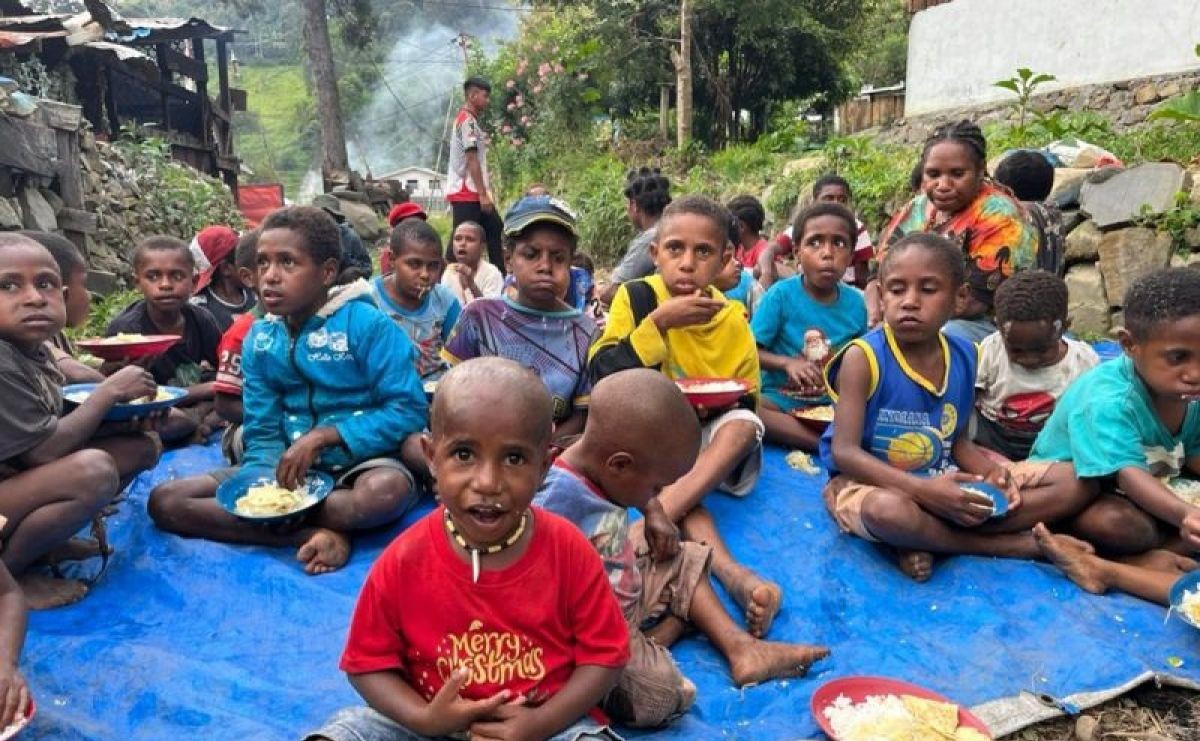
The former Papua Police Chief explained that the root cause of a range of social conflicts, educational underdevelopment, limited access to healthcare, and security disturbances in Papua is extreme poverty. Therefore, the presence of the PSN and large investments must be able to intervene in the problems of people’s stomachs and the household incomes of local congregations.
“Conflict, social tensions, even armed violence, start with poverty. If one’s stomach is full and there is income, the mind is at ease and people can work well,” he said.
Paulus judged that Papuan communities are not adequately served by formal development language or macro investment figures alone. Grassroots communities affected at the grassroots level must be invited to sit together to be given concrete understanding of economic opportunities, employment, and future protections for their adat rights. A unilateral step without community involvement must be avoided.
Paulus, who was inaugurated by President Prabowo Subianto on 8 October 2025 as a member of the Papua Otsus Executive Committee, believes that planning Papua’s development is now to use a bottom-up method (from bottom to top). Policy cannot be dictated from above (top-down) solely from the perspective of elites or the central government.
The genuine aspirations of communities from kampung, desa, distrik to city must be heard and turned into a policy blueprint. This approach is a tangible form of real respect for the existence, culture, and identity of Indigenous Papuan communities.
“Large projects and national investments will have meaning if they can bring welfare, reduce poverty, create jobs, and provide a better future for Indigenous Papuans,” Paulus concluded. (E-3)
Unpad scholar Rusdin Tahir emphasised the importance of viewing Papua’s development comprehensively, objectively, and based on official fiscal data to avoid bias.
Expansion of development projects and rising conflicts in Papua are seen as not only affecting the loss of customary land.
Billy Mambrasar affirmed President Prabowo Subianto’s commitment to accelerating development in Papua.
Unpad scholar Rusdin Tahir emphasised the importance of viewing Papua’s development comprehensively, objectively, and based on official fiscal data to avoid bias.
He noted that a mismatch between central policy and local aspirations leaves communities feeling neglected.
Based on the discussion documents, the Helsinki MoU is proposed to be included in the considered clause B.
PRESIDENT Prabowo Subianto stressed the central government’s commitment to reforming the governance of national wealth and to taking firm action against corruption in its management.
The government continues to give special attention to regions with asymmetrical decentralisation status as mandated by the constitution and the Regional Government Law.