
Papua Mountains Forests as Earth's Ecosystem Buffer
Wamena (ANTARA) - Papua Mountains Province covers an area of approximately 43,968.54 km². The province has its capital in Wamena, Jayawijaya Regency, and is Indonesia’s only province without sea access, located in the eastern Jayawijaya Mountains range.
Papua Mountains Province comprises eight regencies: Jayawijaya, Lanny Jaya, Tolikara, Nduga, Pegunungan Bintang, Yalimo, Yahukimo, and Mamberamo Tengah. These eight regencies feature well-preserved tropical forest areas.
The forest area in Papua Mountains Province totals 5,121,331.29 hectares, consisting of limited forest covering 474,745.07 hectares or 9.27 percent, production forest covering 341,866.48 hectares or 6.68 percent and convertible covering 2,510.71 hectares or 9.81 percent, protection forest covering 1,840,415.99 hectares or 35.94 percent, and conservation forest covering 1,802,624.72 hectares or 35.20 percent.
With such extensive forest areas, the central government, through the Indonesian Ministry of Forestry (Kemenhut), is promoting the “Sub-National Indonesia’s Folu Net Sink 2030” initiative, a national target where the forestry and land use sector is projected to absorb more carbon (net sink) than it releases into the atmosphere by 2030, at -140 million tonnes, to control climate change and support “net zero emissions 2060”.
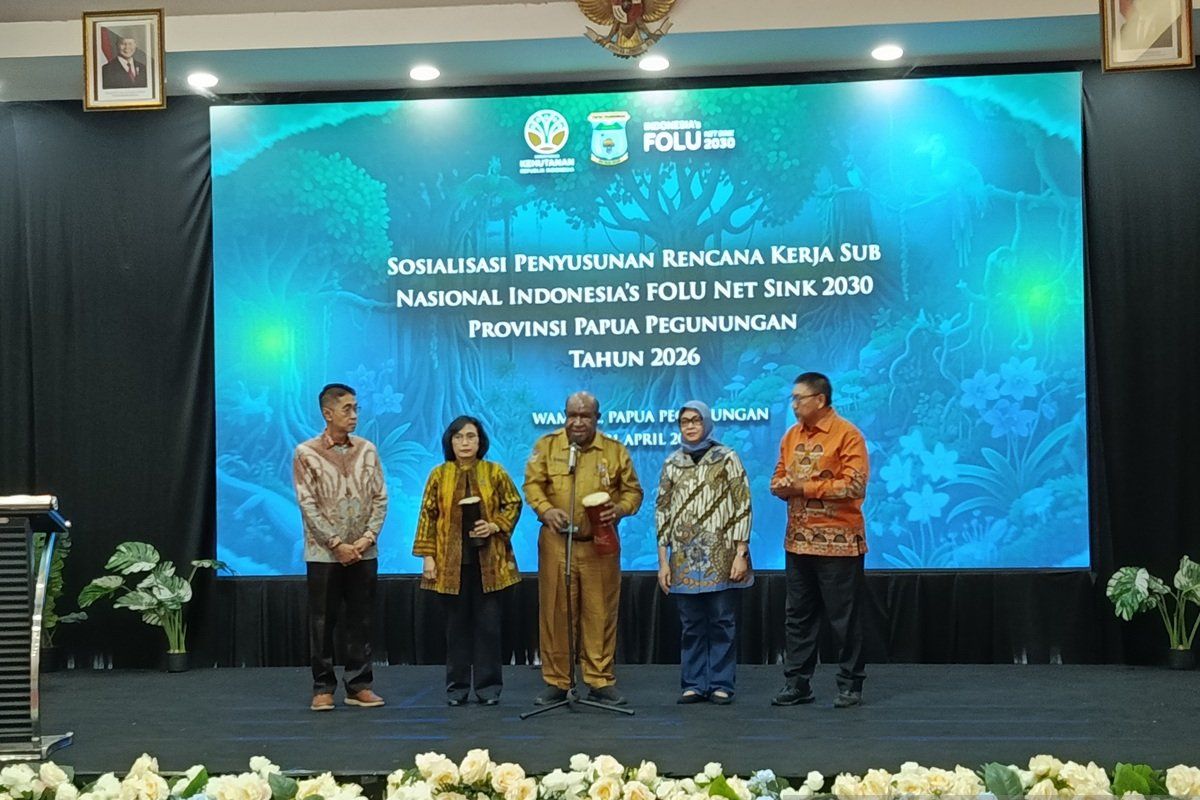
The Ministry of Forestry’s serious commitment to preserving forests in Papua Mountains Province is demonstrated through the socialisation of the “Sub-National Indonesia’s Folu Net Sink 2030” in Wamena, Jayawijaya Regency, Papua Mountains. The event was attended by all levels of local government, both provincial and regency, as well as community and customary leaders from the eight regencies.
“We hope that the regional government and all components in Papua Mountains will jointly protect the forest ecosystem,” said Prof Haruni Krisnawati, Special Advisor to the Minister of Forestry on Climate Change.
Support is Needed
Some forest areas in Papua Mountains have been converted into housing, plantations, and community agriculture. Therefore, concrete support from the central government through ministries, institutions, or technical agencies handling sustainable forest management is required.
For areas that have changed function and need to be re-greened, budget support is needed, not only from regional revenue and expenditure budgets (APBD) but also from the state revenue and expenditure budget (APBN).
“We hope for assistance from the central government to help with reforestation of forest areas in Papua Mountains,” said Governor of Papua Mountains, John Tabo.
Forest areas in Papua Mountains Province or Papua in general represent Indonesia’s and the world’s last hope in reducing greenhouse gas carbon emissions. The forests of Papua Mountains serve as the “final carriage” after forest areas in Sumatra frequently experience fires due to the tropical rainforests being filled with easily combustible peat.
Tree Distribution
To assist with reforestation in Papua Mountains, the Ministry of Forestry distributed trees to the Papua Mountains Provincial Government. The trees were handed over symbolically by Ruanda Agung Sigardiman, Advisory Council Member of “Indonesia’s Folu Net Sink 2030” from the Ministry of Forestry, to Lince Kogoya, Head of the Environmental, Forestry, and Land Agency (DLHKP) of Papua Mountains.
This tree distribution represents hope and concrete action by the Ministry of Forestry to ensure that forest areas in Papua Mountains are maintained, cared for, and protected.
Meanwhile, the implementation of the “Indonesia’s Folu Net Sink 2030” programme has three main points: mitigation actions to control emissions, maintaining forests in a sustainable state, and increasing carbon stocks.
The symbolic handover of plants or trees aims to increase carbon stocks in Papua Mountains.
“This means that to increase forest cover in Papua Mountains, active tree planting is necessary,” said Ruanda Agung Sigardiman, Advisory Council Member of Indonesia’s Folu Net Sink 2030 from the Ministry of Forestry.
Therefore, through the Indonesia’s Folu Net Sink 2030 programme, one of the main activities is to increase forest cover or multiply trees so that forest areas in Papua Mountains remain well-maintained.
The forests in Papua Mountains serve as one of the “fortresses” in succeeding the programme to reduce greenhouse gas carbon emissions.
Currently, Papua Mountains and Papua Island in general play a very significant role in efforts to reduce greenhouse gas carbon emissions.
For Ruanda, Papua’s forests as a whole are “the last warrior” for Indonesia’s carbon stocks because their cover remains above 70 percent.
Java Island, which is densely populated with 60 percent of Indonesia’s population, has only 18 percent forest cover remaining. In such conditions, oxygen production on Java is very insufficient for its large population. At the same time, Kalimantan is starting to decline, and Sumatra’s forest cover is also decreasing due to frequent fires.
“Papua is Indonesia’s hope to keep its forest cover green,” said Ruanda Agung Sigardiman.
Socialisation
Following the Sub-National Indonesia’s Folu Net Sink 2030 event, the Papua Mountains Provincial Government, through the Environmental, Forestry, and Land Agency (DLHKP), is enhancing socialisation and empowerment programmes for communities in the eight regencies to keep their forest areas sustainable.
The DLHKP of Papua Mountains has a strong commitment to maintaining forest areas in the eight regencies in good condition and sustainable.
“We will establish forest management units or KPH in the eight regencies, whose task is to provide socialisation to communities to protect the forests,” said Acting Head of DLHKP Papua Mountains, Lince Kogoya.
Forests in Papua Mountains or Papua in general serve as the last protector of Earth’s atmosphere from carbon gases, as well as a strengthener of oxygen for humans and living creatures.