
Papua Becomes a Mining "Colony": ATAM Warns that Prabowo–Trump ART Deal Mortgages Indonesian Sovereignty
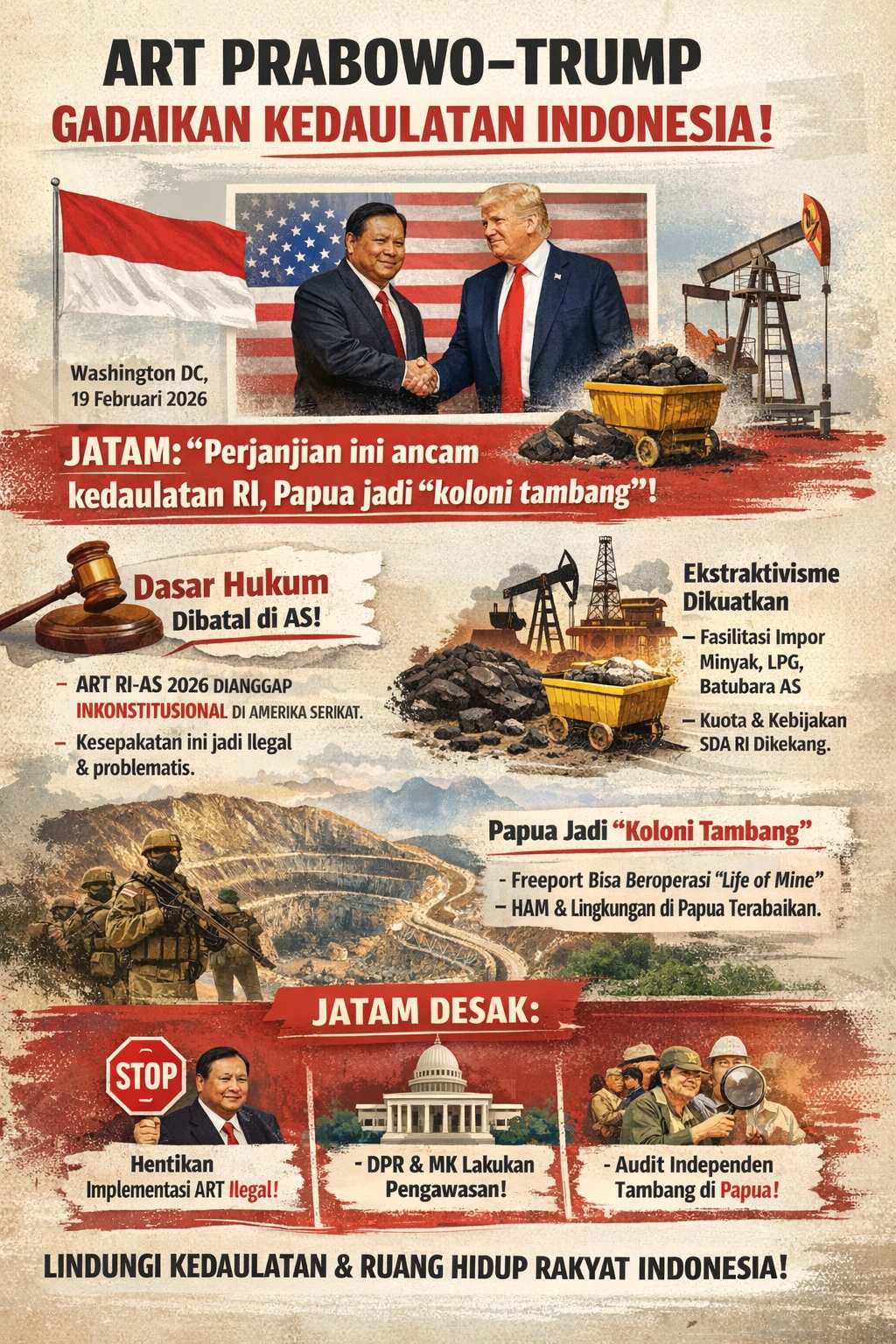
The Mining Advocacy Network (JATAM) has launched a critical assessment evaluating the latest trade agreement between Indonesia and the United States as having the potential to erode national sovereignty. In a document titled “Reciprocal Tariff Agreement Indonesia–US 2025–2026: Strengthening Extractivism, Eroding Indonesian Sovereignty,” the organisation has scrutinised various clauses in the Agreement on Reciprocal Trade (ART), which it contends narrow the state’s policy space over natural resources and the domestic economy.
The agreement was signed by Indonesian President Prabowo Subianto and US President Donald Trump on 19 February 2026 in Washington DC. A day earlier, several business memoranda of understanding were also signed, including a tripartite memorandum of understanding between Freeport-McMoRan, PT Freeport Indonesia, and the Indonesian government, which opened the prospect of extending mining operations in Papua for the “life of mine” or for the entire lifetime of the mining reserves.
JATAM Coordinator Melky Nahar assessed that the series of agreements concerns far more than trade tariffs, but rather touches on the core of Indonesia’s economic-political sovereignty. According to him, several provisions in the ART can restrict government authority in regulating imports, industrial policy, and the management of natural resources.
“This agreement demonstrates a legal-political architecture that has the potential to deepen extractivism and narrow the space for democracy in managing Indonesia’s natural resources,” Melky stated in a written statement on Monday, 16 March 2026.
Regarding the Legal Basis of the Agreement
One of JATAM’s primary criticisms concerns the legal status of the agreement in the United States. The organisation noted that the legal basis for the reciprocal tariff policy used in the ART was declared unconstitutional by the US Supreme Court on 20 February 2026, merely two days after the agreement was signed.
If this is indeed the case, according to JATAM, the political and legal legitimacy of the agreement becomes problematic for Indonesia.
“An agreement born from a legal basis that has already been nullified in the partner country should not serve as the foundation for restricting the space for Indonesia’s economic policy,” Melky said.
Locking Indonesia In
In its analysis, JATAM cited numerous articles in the ART that have the potential to compel Indonesia to open its market widely to American products and investments, including in agriculture, pharmaceuticals, digital technology, and energy sectors.
Several provisions were also assessed as limiting Indonesia’s ability to control imports through quota or licensing mechanisms, and obligating certain treatment of US companies in tax and investment policy.
Furthermore, the agreement was said to promote Indonesian dependence on fossil fuels. In annexes to the agreement, Indonesia is allegedly obligated to facilitate the purchase of crude oil, liquefied petroleum gas, and metallurgical coal from the United States, as well as to open investment access in critical minerals sectors.
According to JATAM, such policy has the potential to hinder energy transition and prolong the dominance of extractive industries in Indonesia.
Papua Becomes a Mining “Colony”
The most prominent issue highlighted concerns the agreement’s impact on mining operations in Papua.
Through the tripartite memorandum of understanding signed alongside the trade agreement, the Grasberg Mine operations potentially could be extended for the entire lifetime of the mining reserves or “life of mine.”
For JATAM, this measure has the potential to foreclose the possibility of a major evaluation of mining management that should occur when the operating licence expires in 2041.
The organisation assessed that such policy could position Papua as a “repository of critical minerals” for the US industrial supply chain, whilst environmental issues, social conflicts, and documented human rights violations in the mining area remain unresolved.
In its critical assessment, JATAM urged the Indonesian government to halt the implementation of the ART until there is clarity regarding its legal legitimacy.
The organisation also called upon the House of Representatives of the Republic of Indonesia and the Constitutional Court of the Republic of Indonesia to exercise their oversight functions to review the process of negotiation and signing of the agreement.
Additionally, JATAM called for an independent audit regarding the social and environmental impacts of mining operations, and urged a natural resource management model that places popular sovereignty as the core principle.
According to Melky, international trade agreements must not sacrifice the rights of communities and environmental sustainability.
“What is at stake is not merely a matter of trade tariffs, but the future of political sovereignty, ecology, and the living space of the Indonesian people,” he said.