
Pancasila Must Become the Mainstream in Character Formation
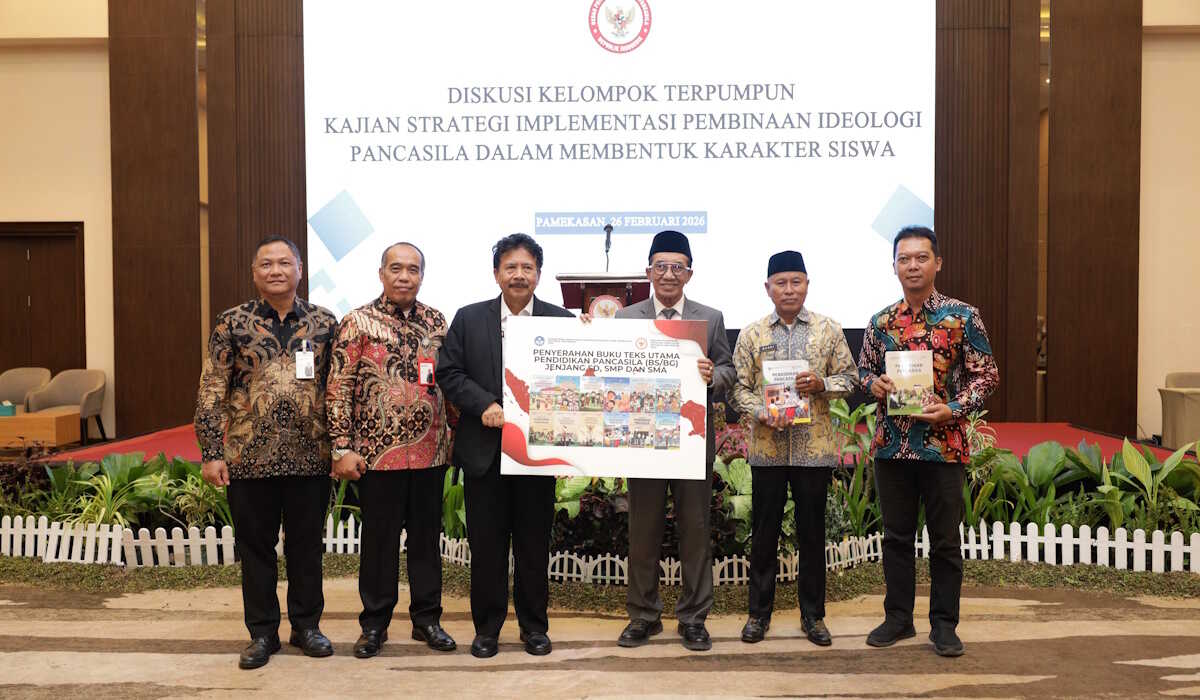
The head of the State Ideology Foundation (BPIP) Yudian Wahyudi has stressed that Pancasila education must become the mainstream approach in shaping the character of young people, especially amidst the increasingly complex challenges of the digital era.
“Pancasila education is not merely the transfer of knowledge. It is a process of forming the character and personality of the nation. Pancasila values must be alive and reflected in the daily behaviour of learners,” he said during a focused group discussion titled “Study of Implementation Strategies for Pancasila Ideology Development in Shaping Student Character” held in Pamekasan, East Java, on Wednesday (26 February).
According to him, technological disruption, artificial intelligence, unfiltered information flows, and rising bullying and intolerance represent genuine challenges facing education today. Therefore, schools must do more than equip students with academic abilities; they must also strengthen integrity, empathy, and national spirit.
“If our children have strong character, they will not be easily swayed by negative influences that contradict the nation’s identity,” he added.
During the event, Yudian also handed over 2,430 Primary Textbooks (BTU) of Pancasila Education as concrete support for strengthening Pancasila learning in educational institutions. Pamekasan Regent Kholilurrahman expressed appreciation for BPIP’s attention and support for education in his region. He considered the handover of thousands of books to be a strategic step in strengthening the character foundation of Pamekasan’s young generation.
According to him, Pamekasan Regency, which possesses rich cultural heritage and high religiosity, greatly needs the strengthening of national values so that young people can maintain unity in diversity.
“Synergy between the central government and regional authorities is essential so that Pancasila values are truly implemented in the learning process in schools,” he added.
Furthermore, BPIP Deputy for Research and Materials Surahno emphasised the importance of understanding Pancasila from a historical and philosophical perspective. He reviewed the process of formulating the state’s foundation, from Sukarno’s speech on 1 June 1945, discussions in the BPUPK session, to the ratification of the constitution following Indonesia’s independence declaration by Mohammad Hatta and Sukarno on 17 August 1945.
“Pancasila did not emerge suddenly. It was drawn from values that have lived within the nation’s civilisation. Therefore, our task today is to ensure that these values continue to be actualised in education and state policy,” he said.
The Centre for Curriculum and Learning at the Ministry of Education and Culture, Sapto Aji, added that strengthening Pancasila character has been integrated into curriculum policy and learning outcomes. He emphasised the importance of deep, meaningful, and contextual learning.
“Character cannot merely be taught; it must be cultivated. Learning must be designed so that learners understand, experience, and practise Pancasila values in their daily lives,” he said.