
PAM Jaya reveals Jakarta government offices still using groundwater despite efficiency drive
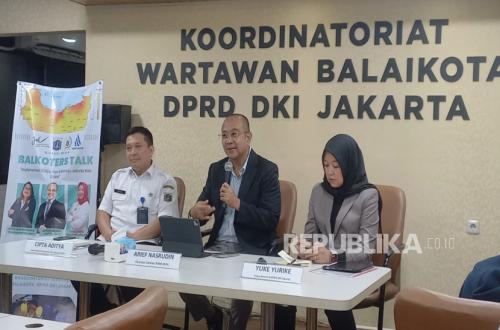
PT PAM Jaya has revealed that numerous high-rise buildings in Jakarta remain dependent on groundwater, including several government offices that should be setting an example by reducing groundwater consumption.
PAM Jaya chief executive Arief Nasrudin disclosed receiving information about government offices still utilising groundwater, though these buildings do not fall under the Jakarta Provincial Government administration.
“I was rather disheartened to learn that government offices too are using groundwater. Although they may not be under the DKI administration,” Arief stated at Jakarta City Hall on Wednesday (11 March 2026).
Arief expressed concern that groundwater use is often justified on efficiency grounds, yet the practice still requires significant expenditure for electrical pumps, and groundwater quality cannot be guaranteed as safe for use.
“How can they revert to this practice? They claim to want efficiency and so they stop using PAM, then switch to groundwater, but they forget to calculate their electricity costs. Groundwater requires pumping, and secondly, there is the quality issue,” Arief explained.
Arief attributed the continued prevalence of groundwater use in Jakarta’s high-rise buildings to inadequate enforcement of groundwater-free zone regulations. The Jakarta Provincial Government has designated groundwater-free zones, whereby buildings in these areas are prohibited from using groundwater when PAM Jaya services are available, with current coverage exceeding 80 per cent.
“I must emphasise law enforcement: high-rise buildings that already have mains water supply should no longer be permitted to use groundwater,” Arief asserted firmly.
According to Arief, excessive groundwater extraction can cause serious environmental damage, including land subsidence that has already occurred in several Indonesian regions such as Semarang and Tegal.
Cipta Aditya, head of development and environmental affairs at the Jakarta Provincial Planning Board (Bappeda), added that the regional government is preparing policies to expand groundwater-free zones. A study on expanding groundwater-free zones was initiated last year, and regulatory drafting is currently undergoing internal review.
Cipta hopes the regulation will be completed soon to encourage more residents to transition from groundwater to mains water supply.
The Jakarta Provincial Government has designated the following areas and roads as groundwater-free zones under Jakarta Provincial Regulation Number 93 of 2021:
Groundwater-free industrial and commercial zones:
Pulo Gadung Industrial Zone (JIEP), East Jakarta
Mega Kuningan Zone, South Jakarta
Rasuna Epicentrum Zone, South Jakarta
SCBD Sudirman Zone, Central Jakarta
Kuningan Zone, South Jakarta
Medan Merdeka Zone, Central Jakarta
Asia Afrika Zone, Central Jakarta
Menteng Zone, Central Jakarta
Tanah Abang Zone, Central Jakarta
Groundwater-free roads:
Jalan Gaya Motor Raya, North Jakarta
Jalan Yos Sudarso, North Jakarta
Jalan Danau Sunter Utara, North Jakarta
Jalan R.E Martadinata, North Jakarta
Jalan Cakung Cilincing, North Jakarta
Jalan Akses Marunda, North Jakarta
Jalan DI Panjaitan, East Jakarta
Jalan Raya Bogor, East Jakarta
Jalan Jenderal Sudirman, Central Jakarta
Jalan MH Thamrin, Central Jakarta
Jalan Prof Dr Satrio, South Jakarta
Jalan Gatot Subroto, South Jakarta