
PAM Jaya: Dirty water in Cengkareng due to reduced raw water supply
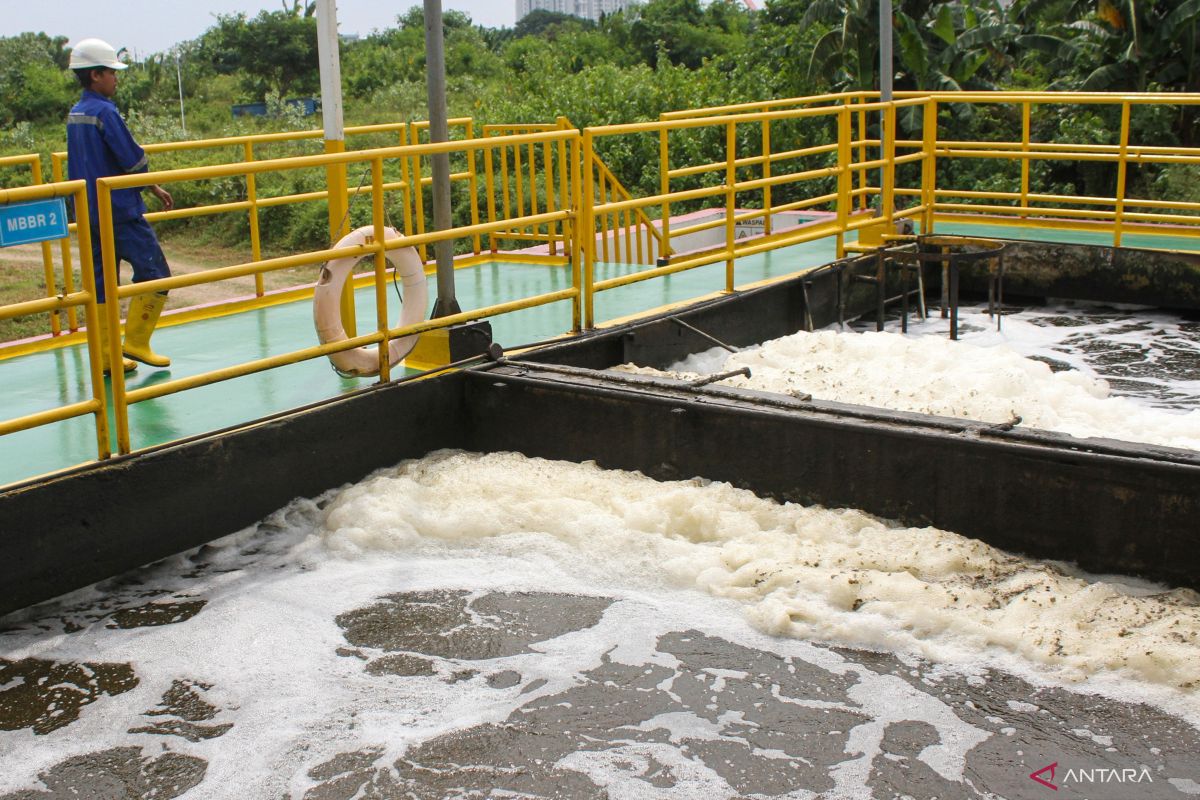
Jakarta (ANTARA) - Perumda Air Minum (PAM) Jaya has revealed that the dirty and smelly water in RT 05/RW 02, Rawa Buaya, Cengkareng, West Jakarta, is caused by a depletion in the supply of raw water from Perusahaan Daerah Air Minum (PDAM) Tirta Kerta Raharja (TKR) in Tangerang.
Senior Manager of Corporate & Customer Communication at PAM Jaya, Gatra Vaganza, explained that the company purchases bulk water from that firm to store in its reservoirs.
“So the source of the water is from TKR (Tirta Kerta Raharja), the PDAM in Tangerang. We buy bulk water from there to put in our reservoirs. They had a supply disruption from TKR due to rubbish interference in their raw water source in Bogor,” Gatra said when contacted in Jakarta on Tuesday.
He also denied that the dirty water problem in the area has been occurring for years, stating it has only happened in the last few days due to the raw water shortage.
According to him, the thinning of the raw water supply has directly impacted the volume of water in PAM Jaya’s Distribution Service Reservoir (DSR) 4, located in the Permata Hijau area.
The drastic drop in water volume has caused sediment at the bottom of the reservoir to be sucked into the residents’ distribution pipe network.
“Simply put, if we forget to clean our tank, when the water level drops low, the remaining sediment will rise into the network. That’s more or less the cause of the black and smelly water,” Gatra said.
“One thing we can do is flushing. Basically, we drain the water from the pipe network to remove those sediments,” he explained.
PAM Jaya has also taken samples from several customers’ homes in RT 05/RW 02 and confirmed that the water is now clear. However, he advised residents to leave their taps open for a moment if any remaining dirt comes out.
“There might still be some residual sediment reaching customers. If that’s the case, they need to open the tap first to flush out the remaining sediment in the network. After that, there shouldn’t be any more issues with smell or cloudy colour,” he said.
Regarding residents’ complaints that PAM water often stops in the afternoon and only flows strongly in the early hours, Gatra confirmed the phenomenon.
According to him, this occurs because the Rawa Buaya area and surroundings are at the furthest end of PAM Jaya’s pipe distribution network in the west.
During peak times like morning and evening, the water is said to have been used up by customers whose homes are in areas closer to the storage.
“When water is used simultaneously, those living at the end will get the leftovers. But during non-peak hours when people aren’t using water, the neighbours in front of them aren’t using it, so they get the water (in the middle of the night),” Gatra said.
Therefore, residential areas at the very end of the network can only be maximally supplied when most Jakarta residents are asleep at night.
Furthermore, Gatra revealed that the water supply for West Jakarta actually heavily relies on the Sistem Penyediaan Air Minum (SPAM) Karian-Serpong project being undertaken by the central government.
However, the project, initially targeted to operate in 2023, has been delayed and is not yet complete.
“So for now, the raw water supply for West Jakarta still relies quite heavily on water from PDAM TKR and Tirta Benteng in Tangerang to be brought to PAM Jaya’s reservoirs,” he said.
PAM Jaya is also continuously expanding the pipe network and adding the number of customers. However, the increase in customers has not yet been matched by an increase in raw water production.
Even with the SPAM Karian-Serpong delay, PAM Jaya assures that the target of 100% piped water services for all Jakarta residents in 2029, set by DKI Jakarta Governor Pramono Anung, will still be pursued.
“With that delay, we won’t use it as an excuse. That’s why we’re taking the initiative to build four new Water Treatment Installations (IPAs) so that the 100% target in 2029 is still achieved. We’re balancing the supply production with the addition of those four new IPAs,” Gatra emphasised.
Previously, several residents on Jalan H. Djairi, RT 05 RW 02, Rawa Buaya, Cengkareng, West Jakarta, had complained again about difficulties with clean water in their area.
One resident, Nurliana Sihombing (61), claimed that the clean water difficulties have been felt since first subscribing to PAM water about 25 years ago.
“It’s not recent (the clean water crisis), it’s been like this from the beginning. When we first installed it, it was good, clear. Not long after, it didn’t come out at all, and it’s always been like that until now. Lately, the water sometimes looks like milk, sometimes like coffee, and it smells really bad. Like sewer smell,” Nurliana told reporters at the location on Tuesday.
“It’s strange why the water is so good at night. Around 01:00 WIB until 04:30 WIB, it’s always good every day. But sometimes by dawn, it already smells, rotten smell,” she complained.